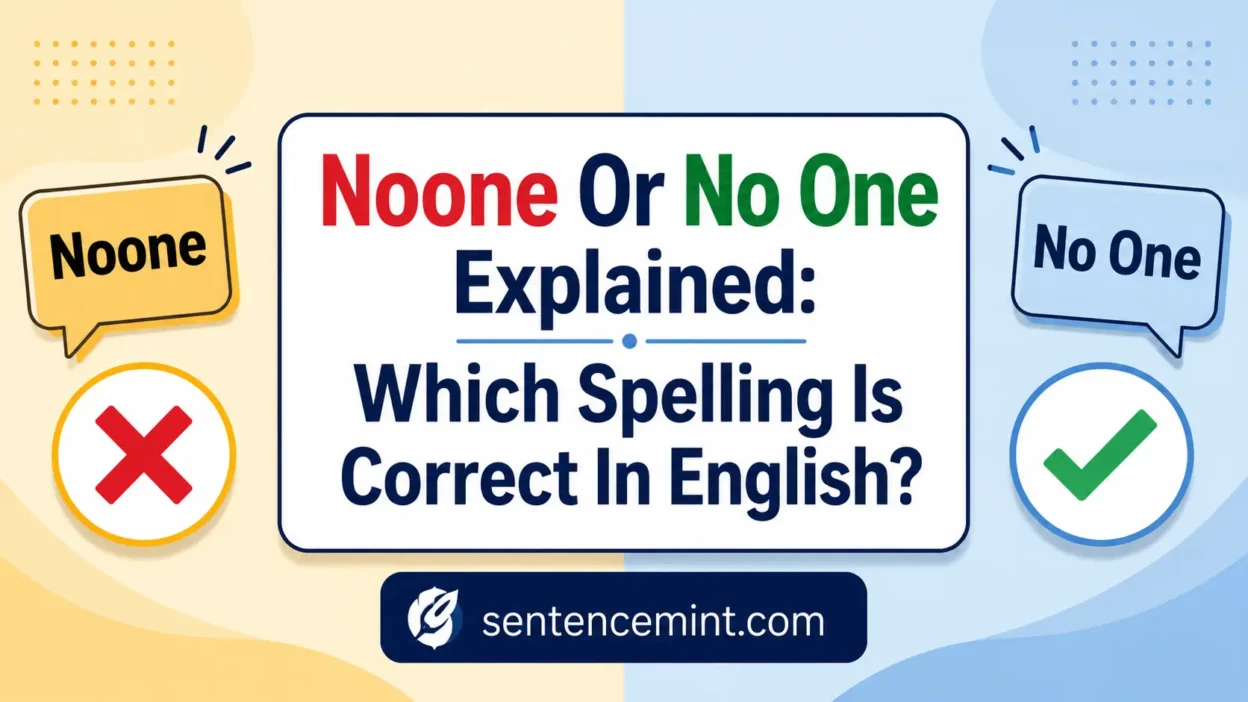
The correct spelling in modern English is “no one” (two words).
The form “noone” is incorrect in standard writing and is considered a spelling mistake across formal and academic English.
- This confusion is common because the word sounds like a single unit in speech, but grammar rules keep it as two separate words.
Quick Answer
- Correct: no one
- Incorrect: noone
Meaning: “not any person”
Example:
- ✅ No one arrived late.
- ❌ Noone arrived late.
Why People Confuse “No One” And “Noone”
- People often merge the words because spoken English blends them naturally.
Main reasons include:
- Fast typing habits
- Autocorrect assumptions
- Informal texting style
- Hearing “no one” as a single sound unit
- However, written English follows grammatical structure, not pronunciation flow.
Key Differences At A Glance
| Feature | Noone | No one |
|---|---|---|
| Standard English | ❌ Incorrect | ✅ Correct |
| Grammar structure | Invalid fusion | Indefinite pronoun |
| Writing acceptance | Not accepted | Fully accepted |
| Formal usage | Avoid | Required |
Are “No One” And “Noone” The Same Word?
No.
- “no one” is a standard indefinite pronoun meaning “not a single person.”
- “noone” is not recognized as a valid English word.
- They may represent the same idea in intent, but only one is grammatically correct.
Grammar Breakdown: Why “No One” Is Two Words
“No one” is formed using a simple grammatical structure:
- no = negation
- one = person
Together, they create an indefinite pronoun.
English keeps similar pronouns as separate or structured forms:
- no one
- someone
- anyone
- everyone
This consistency helps readability and grammatical clarity.
US Vs UK Usage
- Both American and British English use:
- no one (standard form)
There is no regional variation in correctness.
- However, older British usage sometimes included:
- no-one (hyphenated form)
- Today, this is mostly outdated, and modern writing prefers no one in both regions.
No One Vs Nobody
Both are correct and widely used:
- no one → slightly more formal
- nobody → more casual and conversational
Examples:
- No one attended the meeting.
- Nobody attended the meeting.
Meaning is identical.
Which Spelling Should You Use?
Always use “no one” in:
- Academic writing
- Business communication
- Emails
- Exams
- Published content
Avoid “noone” completely, as it is treated as an error in all formal contexts.
When One Spelling Looks Wrong
Using “noone” in professional writing is immediately perceived as:
- A typo
- A proofreading mistake
- Non-standard English
This can reduce credibility in formal communication such as reports, resumes, and articles.
Common Mistakes
Mistake:
- ❌ Noone knows the answer.
Fix:
- ✅ No one knows the answer.
Quick rule:
If the word can be split into “no + one,” always keep the space.
Everyday Examples
Correct usage:
- No one called me yesterday.
- No one was ready for the presentation.
- No one answered the door.
- No one noticed the change.
These follow standard English grammar rules in both spoken and written form.
Why “Noone” Happens
The error usually comes from how the brain processes spoken language.
When spoken quickly, “no one” sounds like one word. In typing, this leads to:
- Word merging
- Autocomplete influence
- Pattern confusion with words like “someone” and “anyone”
- However, English grammar does not allow merging in this case.
Rule Summary (Quick Reference)
- “No one” = correct indefinite pronoun
- “Noone” = spelling mistake
- Always use two words in formal English
- No regional variation exists
FAQ
Is “noone” a real word in English?
No. “Noone” is not recognized as a standard English word.
Why is “no one” written as two words?
- Because it is formed from the indefinite pronoun structure “no + one,” which English keeps separate for clarity.
Is “noone” ever correct?
No. It is always considered incorrect in standard English.
What is the difference between “no one” and “nobody”?
- Both mean the same thing. “No one” is more formal, while “nobody” is more casual.
Is “no one” formal English?
Yes. It is widely used in academic, professional, and published writing.
Why do people write “noone”?
- Because spoken English blends the words, and fast typing or autocorrect often causes the spelling error.
Conclusion
The correct form is always “no one.”
The merged form “noone” is a common spelling mistake with no acceptance in standard English writing.
Using the correct structure ensures clarity, professionalism, and grammatical accuracy in all contexts.