
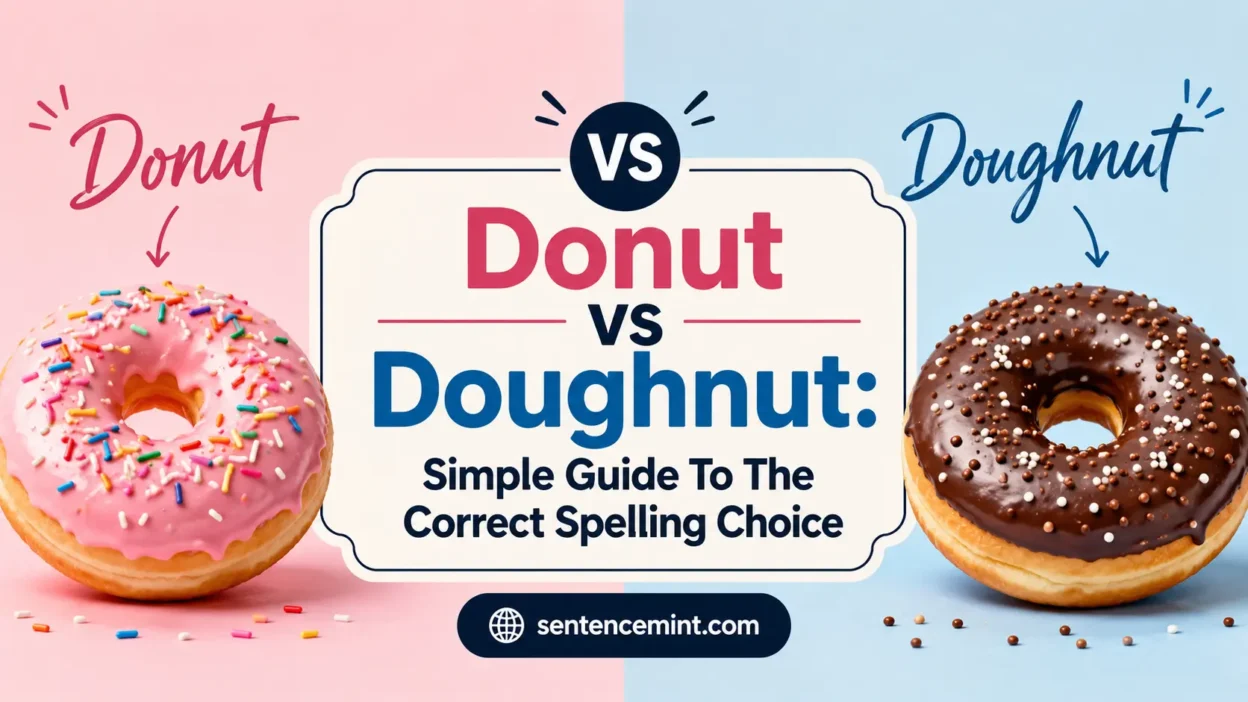
The spelling debate between “donut” and “doughnut” confuses many writers, but the answer is simple: both are correct. The difference is not meaning, but tone, tradition, and writing context. One feels modern and casual, while the other feels traditional and formal.
Understanding when to use each spelling helps you write more naturally in American English, British English, and professional content environments.
Quick Answer
Both “donut” and “doughnut” are correct spellings of the same word.
- “Doughnut” is the older, traditional spelling.
- “Donut” is the modern, simplified spelling widely used in everyday American writing, branding, and menus.
Why People Confuse Donut And Doughnut
The confusion happens because both words sound identical. Since pronunciation does not change, readers often assume one spelling must be wrong.
In reality, English often preserves multiple accepted spellings, especially when one becomes simplified over time for convenience and branding.
Key Differences At A Glance
| Context | Preferred Spelling | Reason |
|---|---|---|
| Formal writing | doughnut | Traditional, widely accepted in academic and dictionary usage |
| Casual writing | donut | Shorter, more modern tone |
| Branding & marketing | donut | Visually simpler and more memorable |
| British English publications | doughnut | More traditional editorial preference |
Are Donut And Doughnut The Same Word?
Yes. They refer to the exact same food: a sweet, fried pastry that is often ring-shaped or filled.
There is no difference in meaning, ingredients, or pronunciation. The distinction exists only in spelling style.
US Vs UK Usage Trends
In modern American English, both spellings are accepted, but “donut” has become extremely common in casual communication, food branding, and digital media.
In British English, “doughnut” remains the more frequently used spelling in formal writing and publications.
Dictionary references from Merriam-Webster and Cambridge Dictionary confirm that both forms are valid, with usage differences based on style rather than correctness.
Which Spelling Should You Use?
The best choice depends on your writing context:
- Use donut when writing:
- Blog content
- Social media posts
- Marketing copy
- Menus or product naming
- Branding or SEO-focused content
- Use doughnut when writing:
- Academic writing
- Formal essays
- Editorial publications
- Traditional or descriptive contexts
A simple rule: modern and attention-driven writing prefers “donut,” while formal and traditional writing prefers “doughnut.”
When One Spelling Can Look Wrong
Neither spelling is incorrect, but inconsistency is.
Switching between “donut” and “doughnut” in the same document can reduce professionalism and readability. Writers should choose one version and use it consistently throughout.
Common Mistakes And Fixes
- Mistake: Thinking “donut” is incorrect
Fix: Both spellings are valid and widely accepted. - Mistake: Mixing both spellings in one article
Fix: Pick one spelling style and stay consistent. - Mistake: Assuming UK vs US rules are absolute
Fix: Modern usage is flexible, especially online.
Everyday Usage Examples
- “I ordered a chocolate donut with my coffee.”
- “The bakery sells fresh glazed doughnuts every morning.”
- “She brought a box of donuts to the office meeting.”
- “Hot doughnuts are served after 5 PM.”
These examples show that both spellings function naturally in real-world writing.
Word Meaning And Usage Overview
Both “donut” and “doughnut” are nouns referring to a sweet fried pastry.
They are not typically used as verbs in standard English.
Meaning
A donut/doughnut is a ring-shaped or filled fried pastry, often glazed, sugar-coated, or topped with icing.
Usage Insight
- “Doughnut” reflects the original compound structure (“dough + nut”).
- “Donut” emerged as a simplified spelling that gained popularity in American advertising and everyday writing.
Stylistic Evolution
Modern usage shows a steady preference for “donut” in branding and casual communication, while “doughnut” remains common in formal dictionaries and traditional writing systems.
FAQs
Is donut or doughnut the correct spelling?
Both “donut” and “doughnut” are correct spellings. They refer to the same food, and the difference is only in style and usage, not meaning.
Why are there two spellings for donut?
The word originally comes from “dough + nut,” but over time, the shorter spelling “donut” became popular in American English, especially in casual writing and branding.
Is donut American spelling?
Yes, “donut” is widely associated with American English and is commonly used in marketing, menus, and informal writing in the United States.
Is doughnut British spelling?
“Doughnut” is more commonly used in British English and is considered the traditional spelling in formal writing and dictionaries.
Which spelling is more common: donut or doughnut?
In modern usage, “donut” is very common in everyday American writing and branding, while “doughnut” remains more common in formal contexts and British English.
Do donut and doughnut mean the same thing?
Yes, both words mean exactly the same thing—a sweet, fried pastry that is usually ring-shaped or filled.
When did the spelling “donut” start?
The spelling “donut” became popular in the early 20th century, mainly through American advertising and simplified English usage.
Is donut informal spelling?
“Donut” is often considered informal compared to “doughnut,” but it is still fully correct and widely accepted in modern English.
Conclusion
“Donut” and “doughnut” are two accepted spellings of the same word. The difference is not correctness but style. If you want a modern, clean, and casual tone, choose “donut.” If you prefer traditional or formal writing, choose “doughnut.”
The best writers do not treat this as a rule problem—they treat it as a tone decision.