The confusion between accept and except is extremely common in English. The words look similar, sound close in fast speech, and differ by only one letter. Still, their meanings are completely different.
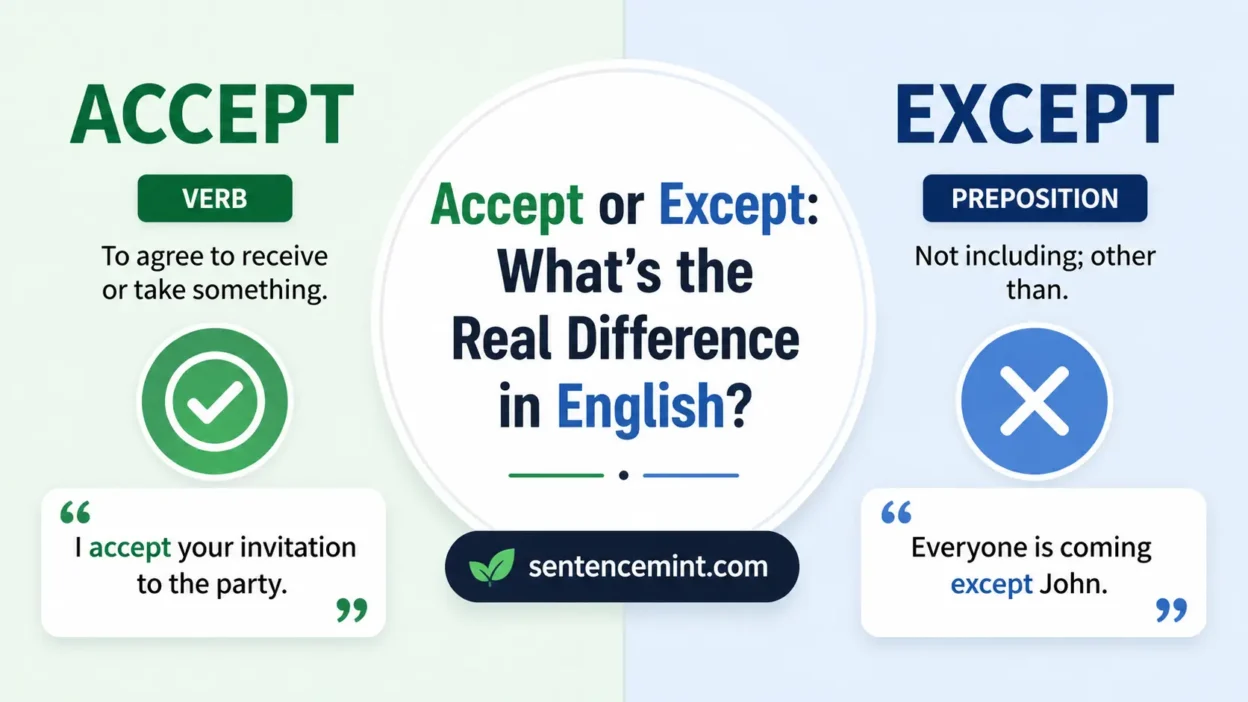
In simple terms, accept usually means to receive, agree to, or approve something. Except usually means leaving something out or excluding it.
Compare these sentences:
- “I accept your apology.”
- “Everyone came except Tom.”
The first sentence is about agreement. The second is about exclusion. Once you understand that difference, choosing the correct word becomes much easier.
Quick Answer
Use accept when you mean:
- receive
- agree to
- approve
Example:
- “She accepted the job offer.”
Use except when you mean:
- excluding
- leaving out
- apart from
Example:
- “Everyone except Sarah agreed.”
The words are not interchangeable. Also, except is usually a preposition or conjunction, not a regular verb in everyday English.
Why People Confuse Them
The biggest reason people mix up accept and except is pronunciation. In casual American speech, the beginning sounds can become less clear, so the words sound very similar.
Their spelling also adds to the confusion:
- accept
- except
Many people type quickly in emails, texts, or school assignments and accidentally choose the wrong word.
For example:
- “Please except my invitation.”
- “Everyone accept Jake arrived.”
Both sentences look close to correct, but the meanings break down immediately.
Another reason is that learners often rely on sound instead of grammar role. Since the words sound alike, they assume they work the same way. They do not.
Key Differences At A Glance
| Context | Best Choice | Why |
|---|---|---|
| Receiving an offer | accept | Means agree to or receive |
| Approving something | accept | Shows agreement |
| Leaving someone out | except | Means excluding |
| “All ___ one” structure | except | Shows an exception |
| Invitations and apologies | accept | Involves agreement |
| “Except for” phrases | except | Introduces exclusion |
Quick Comparison
- accept = include, receive, agree
- except = exclude, leave out
- accept is mainly a verb
- except is mainly a preposition or conjunction
- Wrong word choice often creates grammar problems immediately
Meaning and Usage Difference
The real difference comes from both meaning and grammar.
Accept
Accept is mainly a verb. It means to receive something willingly, approve it, or agree to it.
Examples:
- “The company accepted her proposal.”
- “I accepted responsibility for the mistake.”
- “He accepted the apology.”
You often see accept with:
- offers
- invitations
- responsibility
- payments
- advice
Except
Except usually means excluding something or someone.
Examples:
- “Everyone except Mia finished the test.”
- “The store is open every day except Sunday.”
- “I like all vegetables except mushrooms.”
The phrase except for is also common:
- “The trip was perfect except for the weather.”
Parts of Speech
| Feature | accept | except |
|---|---|---|
| Main role | Verb | Preposition/Conjunction |
| Core meaning | Receive or agree | Exclude or leave out |
| Common structure | accept an offer | except for one |
| Everyday usage | Very common | Very common |
In rare formal or legal writing, except can appear as a verb meaning “to exclude,” but this is uncommon in modern everyday English.
Tone, Context, and Formality
Both words appear in formal and informal English.
You may see accept often in:
- business emails
- customer service
- contracts
- invitations
Examples:
- “We accept credit cards.”
- “She accepted the promotion.”
You may see except in:
- instructions
- school writing
- legal language
- casual conversation
Examples:
- “No food is allowed except water.”
- “Everyone except Ben replied.”
In legal writing, except sometimes appears as a verb:
- “The court excepted part of the evidence.”
That usage sounds formal and uncommon in everyday American English.
Which One Should You Use?
A quick decision method helps.
Ask yourself:
Does the sentence mean receive or agree?
Use accept.
Examples:
- “Did she accept the invitation?”
- “I accept your terms.”
Does the sentence mean exclude or leave out?
Use except.
Examples:
- “Everyone except Alex arrived.”
- “The museum opens daily except Monday.”
A simple memory trick also helps:
- accept starts with “ac” → think “agree/approve”
- except starts with “ex” → think “exclude”
When One Choice Sounds Wrong
Some mistakes sound wrong immediately because they damage both meaning and grammar.
Incorrect:
- “I except your invitation.”
Correct:
- “I accept your invitation.”
Why it sounds wrong:
The sentence is about agreeing to receive an invitation, not excluding one.
Incorrect:
- “Everyone accept Jake arrived.”
Correct:
- “Everyone except Jake arrived.”
Why it sounds wrong:
The sentence needs an exclusion word, not an action verb.
Native speakers often notice these errors instantly because the sentence flow no longer makes sense.
Common Mistakes
Mistake: Using “except” for agreement
Incorrect:
- “She excepted the offer.”
Correct:
- “She accepted the offer.”
Quick fix:
If the sentence means “said yes,” use accept.
Mistake: Using “accept” for exclusion
Incorrect:
- “All students accept Emma passed.”
Correct:
- “All students except Emma passed.”
Quick fix:
If someone is being left out, use except.
Mistake: Speech-to-text confusion
Sometimes voice typing chooses the wrong spelling because the words sound similar.
Quick fix:
Proofread comparison and exclusion phrases carefully.
Mistake: Confusing “except for”
Incorrect:
- “The movie was great accept for the ending.”
Correct:
- “The movie was great except for the ending.”
Quick fix:
“Except for” introduces a problem or exclusion.
Everyday Examples
- “I accepted the refund immediately.”
- “Everyone except Chris joined the meeting.”
- “The school accepted her application.”
- “All stores were open except the bakery.”
- “Please accept my apology.”
- “Nobody except Liam knew the answer.”
- “The restaurant accepts cash and cards.”
- “The team practiced every day except Sunday.”
- “She accepted the award with a smile.”
- “Everyone except my brother enjoyed the movie.”
- “The teacher accepted late homework this time.”
- “I eat everything except olives.”
Dictionary-Style Word Details
Verb
• accept: Commonly used as a verb meaning to receive, approve, agree to, or admit.
Example: “They accepted the contract.”
• except: Rarely used as a verb in modern English. In formal contexts, it can mean to exclude.
Example: “The rule excepts emergency cases.”
Noun
• accept: Not commonly used as a noun in standard English.
• except: Not commonly used as a noun in standard English.
Synonyms
• accept: closest plain alternatives include receive, approve, agree to
• except: closest plain alternatives include excluding, aside from
Exact replacements depend on sentence structure.
Example Sentences
• accept:
- “She accepted the invitation.”
- “The manager accepted responsibility.”
• except:
- “Everyone except Ava was ready.”
- “The shop is open daily except holidays.”
Word History
• accept: Comes from Latin roots connected to receiving or taking willingly.
• except: Comes from Latin roots connected to taking out or excluding.
Phrases Containing
• accept:
- accept responsibility
- accept an invitation
- accept defeat
• except:
- except for
- all except
- except that
If you found vendor vs vender confusing, you might also want to understand other tricky English pairs like accept vs except, which are commonly mixed up in writing and exams.
FAQs
What is the difference between accept and except?
Accept means to receive, agree to, or approve something.
Except means excluding or leaving something out.
Examples:
- “I accepted the invitation.”
- “Everyone came except Ryan.”
Are accept and except interchangeable?
No. They have different meanings and different grammar roles.
Incorrect:
- “Please except my apology.”
Correct:
- “Please accept my apology.”
Is except ever used as a verb?
Yes, but it is rare in modern everyday English. In formal or legal writing, except can mean “to exclude.”
Example:
- “The rule excepts emergency situations.”
Most everyday uses of except are as a preposition or conjunction.
Why do accept and except sound similar?
The words have similar spelling and pronunciation patterns. In fast speech, unstressed sounds can become less clear, which makes the words sound close to each other.
That is why spelling mistakes are common in emails, texts, and school writing.
How can I remember the difference?
A simple memory trick helps:
- accept → think “agree” or “approve”
- except → think “exclude”
If the sentence means “say yes,” use accept.
If the sentence means “leave out,” use except.
Is this sentence correct: “Everyone except me”?
Yes. That sentence is correct because except is being used to exclude one person from a group.
Example:
- “Everyone except me understood the assignment.”
Is “accept responsibility” correct?
Yes. Accept responsibility is a very common phrase in American English.
Example:
- “He accepted responsibility for the mistake.”
Which word should I use with invitations?
Use accept.
Correct:
- “She accepted the wedding invitation.”
Not:
- “She excepted the wedding invitation.”
What does “except for” mean?
Except for introduces an exception or exclusion.
Example:
- “The trip was great except for the rain.”
Why does using the wrong word sound strange?
Because the meanings are completely different. One word shows agreement, while the other shows exclusion.
Compare:
- “I accept your idea.”
- “I except your idea.”
The second sentence sounds wrong because “except” does not fit the grammar or meaning.
Conclusion
The difference between accept and except is simple once you focus on meaning and grammar.
Use accept when you mean receive, approve, or agree. Use except when you mean exclude or leave something out.
Compare these final examples:
- “I accept your offer.”
- “Everyone came except Noah.”
When proofreading, check whether the sentence is about inclusion or exclusion. That quick check usually gives you the correct answer right away.