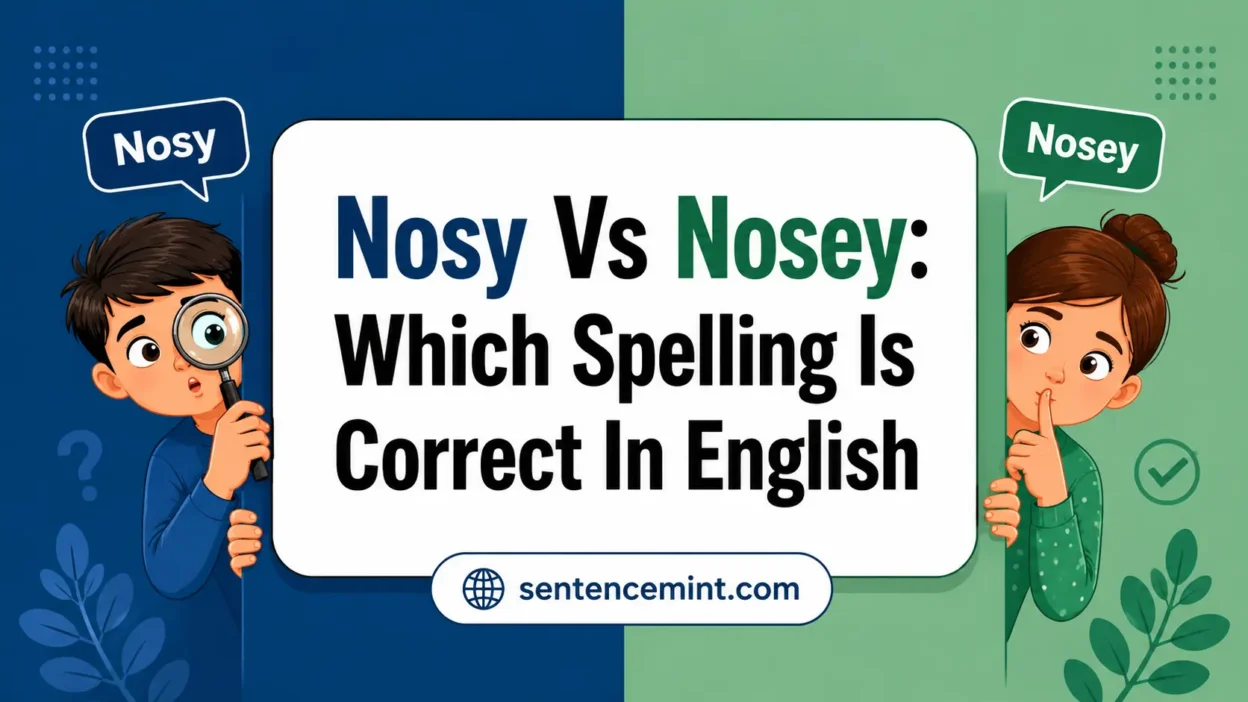
“Nosy” and “nosey” are two spellings of the same word, and both are widely understood in English.
The confusion is not about meaning—it is about which spelling sounds more natural in modern writing.
In most professional, academic, and edited English, one form is clearly preferred.
Quick Answer
“Nosy” is the standard spelling in modern English.
“Nosey” is a recognized variant, more commonly seen in informal writing, especially in casual British usage.
Both are correct, but they are not used equally in formal writing.
Why People Confuse Nosy And Nosey
The confusion comes from spelling logic and pronunciation.
The word comes from “nose,” so many writers assume adding “-ey” is correct.
However, English spelling evolved differently, and the shorter form “nosy” became the standard in modern usage.
Both forms survived, which is why both still appear today.
Key Differences At A Glance
| Context | Preferred Spelling | Why |
|---|---|---|
| US English writing | nosy | Standard modern form |
| Edited/academic writing | nosy | Style-guide preferred |
| Informal British usage | nosey | Common casual variant |
| Text messages/social media | either | Both understood |
| Professional communication | nosy | More neutral tone |
Are Nosy And Nosey The Same Word?
Yes.
Both spellings refer to the same adjective meaning:
overly curious about other people’s private matters
There is no difference in definition, grammar, or usage meaning.
The only difference is spelling style and formality level.
US Vs UK Usage
This is not a strict regional split.
- In American English, “nosy” is the standard spelling.
- In British English, “nosy” is also widely used in edited writing, while “nosey” appears more in informal or conversational contexts.
In modern publishing and dictionaries, “nosy” is the dominant form in both regions.
Which Spelling Should You Use?
Use nosy in most situations:
- emails and workplace communication
- articles and blog writing
- academic assignments
- professional editing
- published content
Use nosey only if:
- you are matching informal tone
- you are writing dialogue or casual speech
- stylistic consistency requires it
Example:
✔ She asked too many questions and seemed nosy.
✔ Stop being so nosey (casual tone).
When “Nosey” Can Look Less Formal
Even though “nosey” is understandable, it can sometimes feel:
- informal
- conversational
- slightly less polished in edited writing
This is why editors and style guides typically prefer nosy.
The difference is not correctness—it is tone and formality.
Common Mistakes And Fixes
Mistake: Thinking One Is Incorrect
Both spellings are valid.
Fix: Use context to choose the appropriate one.
Mistake: Assuming Nosey Is The Original Form
Historical usage includes both forms, but modern standard English favors nosy.
Mistake: Using Nosey In Formal Writing
Even though acceptable, it can reduce polish.
Fix: Replace with nosy in professional contexts.
Everyday Examples
- My neighbor is a bit nosy, but friendly.
- Stop being so nosey about my messages.
- The teacher warned students not to be nosy during group discussions.
- She laughed and admitted she can be nosy sometimes.
These examples show how tone changes perception more than spelling.
Dictionary-Style Word Details
Adjective (Primary Use)
Nosy / Nosey
Describes someone who is overly curious about private matters.
Modern dictionaries list nosy as the primary form, with nosey as a variant.
Synonyms
- curious
- inquisitive
- prying
- intrusive
These vary in tone, with “prying” and “intrusive” often sounding stronger than “nosy.”
Usage Tone Insight
- “nosy” → neutral to mildly negative
- “nosey” → more casual, conversational tone
Tone depends on context, not meaning.
Example Sentences
Nosy:
- The nosy reporter kept asking follow-up questions.
- I didn’t mean to sound nosy.
Nosey:
- Don’t be so nosey—it’s not your business.
- My nosey friend already knows everything.
Word History
Both spellings developed from the word “nose,” used metaphorically to describe someone who “sticks their nose” into other people’s business.
Over time, English standardized spelling preferences, and nosy became the dominant modern form, especially in edited writing and dictionaries.
When To Avoid “Nosey”
Avoid “nosey” in:
- academic writing
- professional emails
- published articles
- formal reports
Use “nosy” instead for a cleaner, more standard appearance.
Frequently Asked Questions
Which spelling is correct: nosy or nosey?
Both are correct, but “nosy” is the standard spelling in modern English, especially in professional writing.
Do nosy and nosey mean the same thing?
Yes. Both mean someone who is overly curious about private matters.
Is nosey incorrect or just informal?
It is not incorrect. It is a recognized informal variant, but less common in formal writing.
Which is more common: nosy or nosey?
“Nosy” is more common in dictionaries, publishing, and edited English.
Is nosy rude or offensive?
It can be mildly rude depending on tone, but it is generally informal rather than offensive.
Can I use nosey in professional writing?
It is better to use “nosy” in professional contexts for consistency and formality.
If you enjoyed clearing up nosy vs nosey, you may also want to check out our guide on Advice vs Advise for another commonly confused pair.
FAQs
Which is correct: nosy or nosey?
Both spellings are correct and mean the same thing. However, “nosy” is the standard modern spelling, especially in American English and formal writing.
Do nosy and nosey mean the same thing?
Yes. Both words describe someone who is overly curious about other people’s private matters or business. The meaning does not change with spelling.
Is “nosey” wrong or just informal?
“Nosey” is not wrong. It is a recognized variant spelling, but it is more informal and less common in modern edited writing compared to “nosy.”
Which spelling is more common, nosy or nosey?
“Nosy” is more commonly used in dictionaries, publications, and professional writing. “Nosey” appears more in casual or conversational contexts.
Is nosy considered rude?
It can be mildly rude depending on tone. It often describes someone who asks too many private questions or interferes in others’ affairs.
Is nosey used in British or American English?
“Nosey” is more often seen in informal British English writing, while “nosy” is standard in both US and UK English today.
Can I use nosey in formal writing?
It is better to avoid it. In formal, academic, or professional writing, “nosy” is preferred for consistency and a more standard tone.
Why are nosy and nosey spelled differently?
Both come from the word “nose,” but English developed spelling variations over time. Eventually, “nosy” became the standard modern form, while “nosey” remained a less common variant.
Conclusion
“Nosy” and “nosey” mean the same thing, but they are not equally standard.
Nosy is the preferred modern spelling in most forms of English writing.
“Nosey” remains acceptable in informal contexts but is less common in edited or professional content.
For clear, modern, and polished writing, nosy is the best choice.