
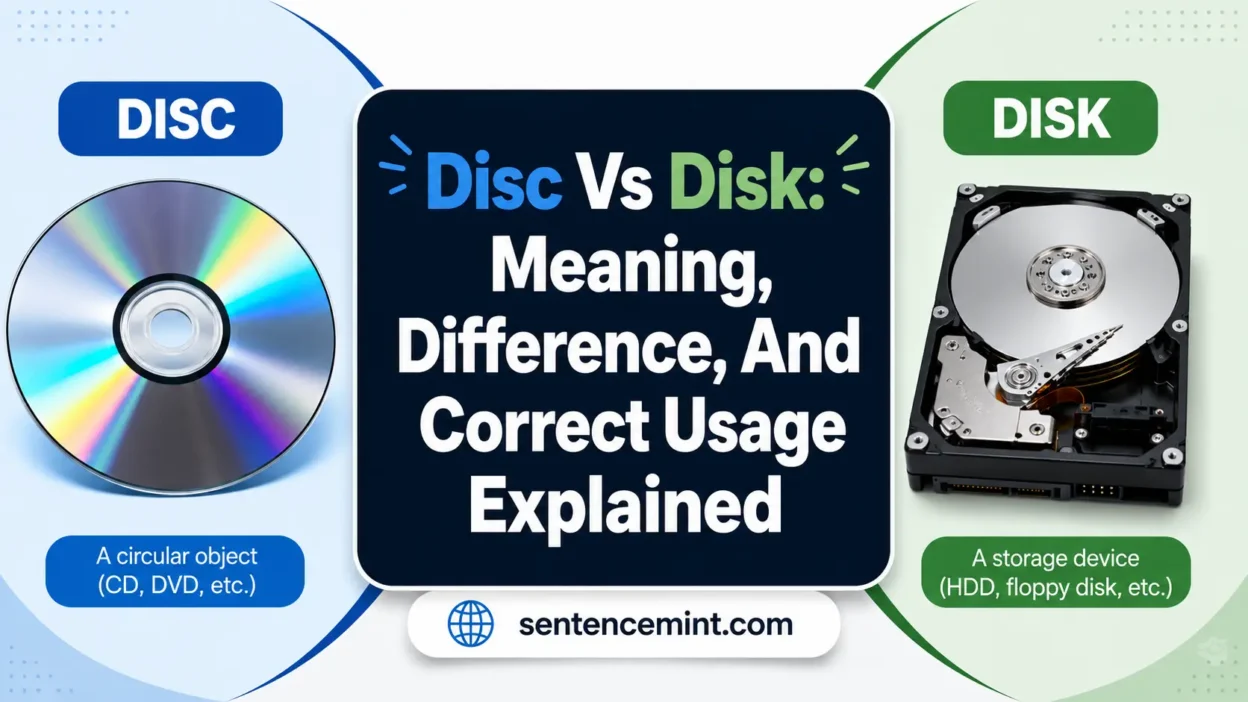
The terms “disc” and “disk” are often treated as two different words, but in most cases, they are simply spelling variations of the same concept. The real difference is not meaning—it is context, especially in computing, medicine, and optical media.
Understanding when to use each spelling is important for clear, professional writing.
Quick Answer
“Disc” and “disk” refer to the same general idea: a thin, flat, circular object.
- Disc is commonly used in medical and optical contexts
- Disk is commonly used in computing and data storage contexts
Neither spelling is incorrect—usage depends on industry conventions.
Why People Get Confused
The confusion happens because English split the spelling across different technical fields over time.
Instead of one strict rule, professionals adopted different forms for consistency:
- Medicine preferred disc
- Computing standardized disk
- Optical media adopted disc
This makes both spellings correct, but context-dependent.
Key Differences At A Glance
| Context | Correct Spelling | Reason |
|---|---|---|
| Spine / medical terms | Disc | Standard anatomical terminology |
| CDs, DVDs, Blu-ray | Disc | Optical media convention |
| Computer storage (HDD) | Disk | Computing industry standard |
| General writing | Either | Depends on context |
Are Disc And Disk The Same Word?
Yes. Historically, both come from the same root idea describing a round, flat object.
Over time, English usage split into two standardized forms based on industry:
- One used in medical and optical contexts
- One used in computing and data storage contexts
So the difference is not meaning—it is conventional usage.
US Vs UK Usage (What Actually Matters)
Many guides oversimplify this as US vs UK English, but the reality is more nuanced.
- US English tends to use disk more in computing contexts
- UK English often uses disc more broadly in general writing
However, in professional fields, both regions follow the same industry standards.
👉 The real deciding factor is context, not geography.
Which Spelling Should You Use?
Use this practical decision guide:
- If writing about computers, storage, or software → disk
- If writing about medicine, anatomy, or optical media → disc
- If unsure → follow industry terminology or style guide consistency
When One Spelling Looks “Wrong” (But Isn’t)
Sometimes a spelling feels incorrect because it violates convention, not grammar.
Examples:
- “hard disc drive” → unusual in computing; standard is hard disk drive
- “spinal disk” → uncommon in medicine; standard is spinal disc
Both words are correct individually—the mismatch is what feels wrong.
Modern Computing Context
Even though modern systems often use SSDs, the term “disk” remains widely used due to legacy terminology:
- Hard Disk Drive (HDD) → mechanical storage
- Solid State Drive (SSD) → no physical disk, but name persists
Computing language kept “disk” for consistency across hardware generations.
Common Mistakes To Avoid
- Mixing “disc” and “disk” in the same technical context
- Assuming one is strictly British and the other American
- Using “disc” in computing documentation without context justification
- Ignoring industry conventions in professional writing
Everyday Examples
- The doctor diagnosed a herniated spinal disc.
- The system writes data to a hard disk.
- I found an old music disc collection.
- The laptop uses an internal SSD disk for storage.
Dictionary-Style Overview
Disc
A thin, flat circular object used in medical anatomy or optical media such as CDs and DVDs.
Disk
A flat circular object used primarily in computing and data storage terminology.
Professional Writing Decision Guide
If you are writing for:
- Medical field → always use disc
- IT / software documentation → always use disk
- General content → match surrounding context
- SEO/content writing → follow industry keyword usage
Consistency matters more than personal preference.
FAQs
What is the difference between disc and disk?
There is no meaning difference. “Disc” is used mainly in medical and optical contexts, while “disk” is used in computing and data storage.
Is disk or disc correct in American English?
Both are correct. American English typically uses “disk” in computing and “disc” in medical or optical terms.
Is disc the British spelling?
Not strictly. British English often uses “disc” more broadly, but both spellings appear depending on industry.
Is hard disk or hard disc correct?
“Hard disk” is correct in computing terminology. “Hard disc” is not standard in modern tech writing.
Why do doctors use disc instead of disk?
Medical terminology standardized “disc” for anatomical consistency, especially for spinal structures.
Can disc and disk be used interchangeably?
No. They are not interchangeable in professional writing because each spelling belongs to different technical conventions.
Conclusion
“Disc” and “disk” are not competing words with different meanings—they are standardized spelling variations shaped by industry conventions.
A simple rule works best:
- Medicine and optical media → disc
- Computing and storage → disk
Using the correct form is less about grammar and more about matching professional context.