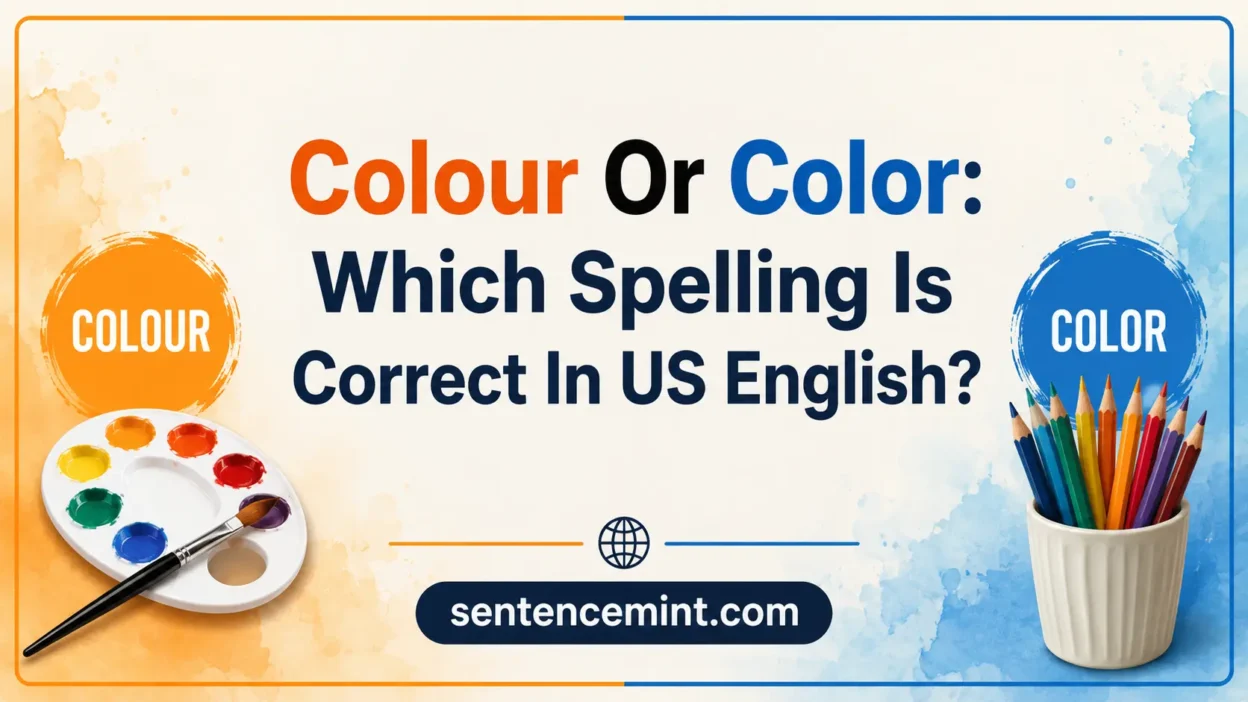
“Colour” and “color” mean exactly the same thing.
The difference is regional spelling preference.
If you write for an American audience, use “color.” If you write for a British audience, use “colour.”
Neither spelling is wrong. Both are accepted English forms. The key is choosing the version that matches your audience and using it consistently.
Quick Answer
For American English:
✅ Color
For British English:
✅ Colour
Meaning:
Both words refer to visual appearance, shades, hues, or pigments such as red, blue, green, or purple.
Pronunciation stays the same.
Why People Confuse Them
People regularly see both spellings online, in books, software menus, marketing materials, and social media.
American English removed the extra “u” from several words that British English kept.
Examples:
| American English | British English |
|---|---|
| Color | Colour |
| Favor | Favour |
| Honor | Honour |
| Behavior | Behaviour |
Because both spellings appear frequently online, many writers assume one must be incorrect.
It is not.
The spelling depends on location and writing style.
Key Differences At A Glance
| Context | Recommended Choice | Reason |
|---|---|---|
| US school writing | Color | Standard American spelling |
| US business writing | Color | Matches American expectations |
| UK school writing | Colour | Standard British spelling |
| UK publishing | Colour | Aligns with British conventions |
| International audiences | Either | Consistency matters most |
Feature comparison:
| Feature | Colour | Color |
|---|---|---|
| Meaning | Same | Same |
| Pronunciation | Same | Same |
| US English | Less common | Standard |
| UK English | Standard | Less common |
| Australia | Standard | Less common |
| Canada | Usually preferred | Less common |
| New Zealand | Standard | Less common |
Are They The Same Word?
Yes.
“Colour” and “color” are spelling variants of the same English word.
They function as both a noun and a verb.
As a noun:
- The sky changed color before sunset.
- Her favorite colour is green.
As a verb:
- Please color the picture.
- Please colour the design.
The meaning remains identical.
Pronunciation also remains identical:
KUH-ler
Changing the spelling does not change how the word sounds.
US Vs UK Preference
American English strongly prefers:
Color
British English strongly prefers:
Colour
This difference comes from broader spelling patterns between American and British English.
American spelling often removes letters British English keeps.
Examples:
American English:
- color
- favor
- honor
- behavior
British English:
- colour
- favour
- honour
- behaviour
The spelling system is intentional rather than random.
Why Does American English Use “Color”?
The American spelling developed during language standardization efforts in the United States.
Lexicographer Noah Webster promoted spelling reforms in the late 1700s and early 1800s to simplify English spelling and create a distinct American writing system.
Words ending in “-our” often became “-or” in American English.
Examples:
- colour → color
- favour → favor
- labour → labor
- neighbour → neighbor
British English kept the older spelling pattern.
Over time, both systems became standard within their regions.
Which Spelling Should You Use?
Choose based on your audience.
For US readers:
Use “color.”
Examples:
- The website uses bright color combinations.
- Her favorite color is blue.
For British readers:
Use “colour.”
Examples:
- The paint colour looked darker indoors.
- His favourite colour is green.
For international brands:
Choose one style guide and stay consistent.
Switching between spellings can reduce professionalism and make writing feel inconsistent.
When One Spelling Looks Wrong
Audience expectations shape perception.
In American writing:
“colour” may look unfamiliar.
In British writing:
“color” may appear unusual.
Examples:
American resume:
✅ Color palette
British design publication:
✅ Colour palette
The issue is not correctness.
It is consistency.
Readers expect spelling conventions that match their language variety.
Common Mistakes
Mistake:
❌ My favorite colour is blue.
US correction:
✅ My favorite color is blue.
Mistake:
❌ The website uses bright color options.
British correction:
✅ The website uses bright colour options.
Mistake:
❌ Mixing both spellings in one article
Correction:
✅ Pick one style and keep it consistent.
Everyday Examples
American English:
- The designer adjusted the background color.
- We added more color to the presentation.
- The app supports custom color themes.
British English:
- The artist changed the wall colour.
- The bright colour stood out immediately.
- The software allows colour adjustments.
Dictionary-Style Word Details
Verb
Color (US English)
Meaning:
To add visual appearance, shade, or pigment.
Example:
“Please color the drawing carefully.”
Colour (UK English)
Meaning:
British spelling of the same verb.
Example:
“Please colour the picture before class.”
Noun
Color
American spelling referring to visual appearance, hue, pigment, or shade.
Colour
British spelling referring to visual appearance, hue, pigment, or shade.
Synonyms
Related words:
- hue
- shade
- tint
- tone
- pigment
Example Sentences
American English:
- The logo uses bright color choices.
- The sunset filled the sky with color.
British English:
- The room needed more colour.
- The jacket changed colour after washing.
Word History
The word comes from Latin color, later entering Middle English through Old French influences.
British English preserved “colour.”
American English standardized “color.”
The meaning stayed unchanged.
Phrases Containing
American English:
- true colors
- color palette
- color scheme
British English:
- true colours
- add colour
- colour palette
FAQ
Is it color or colour in the USA?
American English uses “color.”
“Colour” may still appear occasionally, but “color” is the standard US spelling.
Is colour wrong in America?
No.
Americans understand “colour,” but it usually appears foreign or British.
Professional American writing generally uses “color.”
Why do Americans remove the “u”?
American spelling reforms simplified some British spellings.
Noah Webster helped standardize forms like “color,” “favor,” and “honor.”
Do color and colour mean the same thing?
Yes.
Only the spelling changes.
Meaning and pronunciation remain identical.
Which countries use colour?
“Colour” is commonly used in:
- United Kingdom
- Australia
- New Zealand
- Ireland
- South Africa
Canada often favors British spelling traditions as well.
Which spelling should students use?
Follow your school’s language standard.
American schools generally expect “color.”
British schools generally expect “colour.”
Conclusion
“Colour” and “color” are both correct.
The difference is regional spelling preference.
Use “color” for American English.
Use “colour” for British English.
The meaning never changes.
Choose the spelling that fits your audience, stay consistent, and your writing will feel natural wherever English is used.