Should you write summarize or summarise?
The short answer:
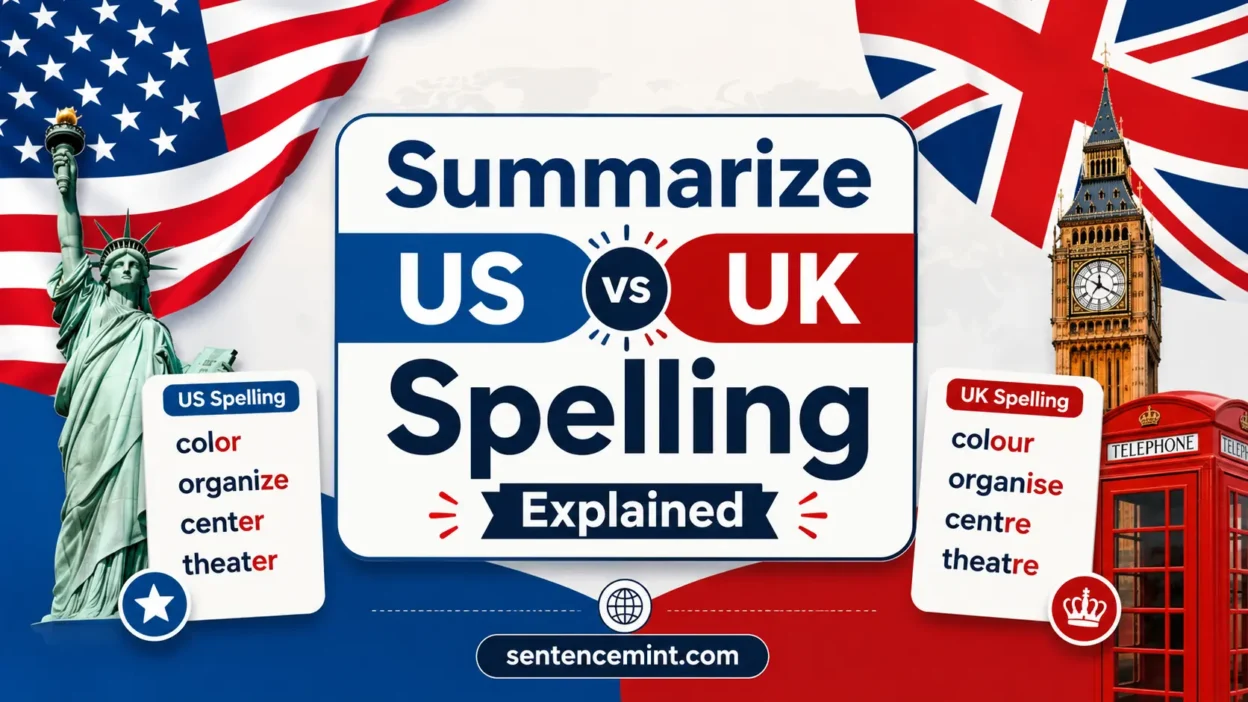
Both spellings are correct.
The difference comes down to regional English conventions.
American English strongly prefers:
summarize
British English commonly prefers:
summarise
The meaning stays exactly the same.
Only the spelling changes.
Quick Answer
Use:
✓ summarize → American English
✓ summarise → British English
Both mean:
- to express important information briefly
- to give key points without unnecessary detail
Examples:
US English:
“Please summarize the report.”
UK English:
“Please summarise the report.”
Both are correct.
Why People Confuse Them
English has multiple spelling systems.
American English often favors:
-ize
British English frequently uses:
-ise
That pattern appears in words like:
- organize / organise
- recognize / recognise
- summarize / summarise
Because both systems exist internationally, writers often see both spellings and assume one must be incorrect.
It is not.
Key Differences At A Glance
| Context | Recommended Choice | Why |
|---|---|---|
| US schools | summarize | Standard American spelling |
| US business writing | summarize | Matches American expectations |
| UK writing | summarise | Common British preference |
| International audience | Either | Consistency matters most |
| Academic publishing | Follow style guide | Editorial rules vary |
Additional comparison:
| Feature | Summarize | Summarise |
|---|---|---|
| Meaning | Same | Same |
| Pronunciation | Same | Same |
| Grammar role | Verb | Verb |
| American English | Preferred | Less common |
| British English | Accepted by some publishers | More common |
Are They The Same Word?
Yes.
Summarize and summarise are spelling variants of the same verb.
They both mean:
- to present key information briefly
- to explain essential ideas in fewer words
- to provide a short version of something longer
Examples:
“Can you summarize the article?”
“Please summarise the meeting notes.”
The meaning never changes.
Only spelling preference changes.
US Vs UK Preference
American English strongly favors:
summarize
British English commonly favors:
summarise
However, British English is not completely uniform.
Some publishers, universities, and style systems still allow -ize spellings.
That means British readers may encounter both.
American English remains more standardized around:
summarize
Which Spelling Should You Use?
Choose based on your audience.
Writing for:
American readers?
Use:
summarize
Writing mainly for UK readers?
Use:
summarise
Writing globally?
Pick one spelling system and stay consistent.
This matters more than choosing one version over the other.
When One Spelling Looks Wrong
Correct spelling can still look unusual when readers expect a different regional style.
Example:
An American college essay using:
summarise
may appear inconsistent.
A UK document using:
summarize
may stand out depending on house style.
That does not automatically make either spelling incorrect.
Context matters.
Common Mistakes
Incorrect:
✗ Summarize is correct and summarise is wrong.
Correct:
✓ Both spellings are correct.
Incorrect:
✗ Mixing spellings in one article.
Correct:
Choose one style.
Incorrect:
✗ Assuming pronunciation changes.
Correct:
Both sound identical.
Everyday Examples
US examples:
“Please summarize the findings.”
“The student summarized the chapter.”
“Our team summarized customer feedback.”
UK examples:
“Please summarise the proposal.”
“The report summarises recent results.”
“The editor summarised the article clearly.”
Business examples:
“Management summarized the quarterly results.”
“The consultant summarised key recommendations.”
Dictionary-Style Word Details
Verb
summarize
Standard American English spelling.
summarise
British spelling variant.
Meaning:
To present information briefly while keeping essential ideas.
Synonyms
- condense
- recap
- sum up
- outline
- shorten
- simplify
Example Sentences
She summarized the presentation in three sentences.
The report summarises market performance.
Please summarize your findings before Friday.
The article summarised major policy changes.
Word History
The spelling difference developed through regional English standardization.
American English strongly standardized around:
-ize
British English commonly developed stronger preference for:
-ise
The meaning remained unchanged.
Phrases Containing
Common examples:
- summarize findings
- summarize results
- summarize information
- summarise a report
- summarise key points
FAQs
Is summarize or summarise correct?
Both are correct.
American English usually prefers summarize.
British English commonly prefers summarise.
Is summarise British English?
Yes.
Summarise is commonly used in British English.
Is summarize American English?
Yes.
Summarize is the standard American English spelling.
Can I use summarise in the United States?
You can, but American readers generally expect:
summarize
Do summarize and summarise sound different?
No.
Pronunciation stays the same.
Which spelling should students use?
Students should follow their school style expectations.
American schools usually prefer:
summarize
British schools commonly prefer:
summarise
Conclusion
The answer is simple.
Use:
summarize → American English
summarise → British English
Both spellings mean exactly the same thing.
The most important rule is consistency.
Choose one spelling system and use it throughout your writing.