You may see the word hiatus in news, TV updates, music headlines, school reading, blog posts, or workplace messages. People often use it when something stops for a while and may continue later.
The word matters because it sounds a little more formal than break or pause. A show can go on hiatus. A band can return after a hiatus. A person can take a hiatus from work or school.
This guide explains hiatus meaning in simple English. You will learn the definition, pronunciation, grammar, examples, related words, and common mistakes.
Quick Answer
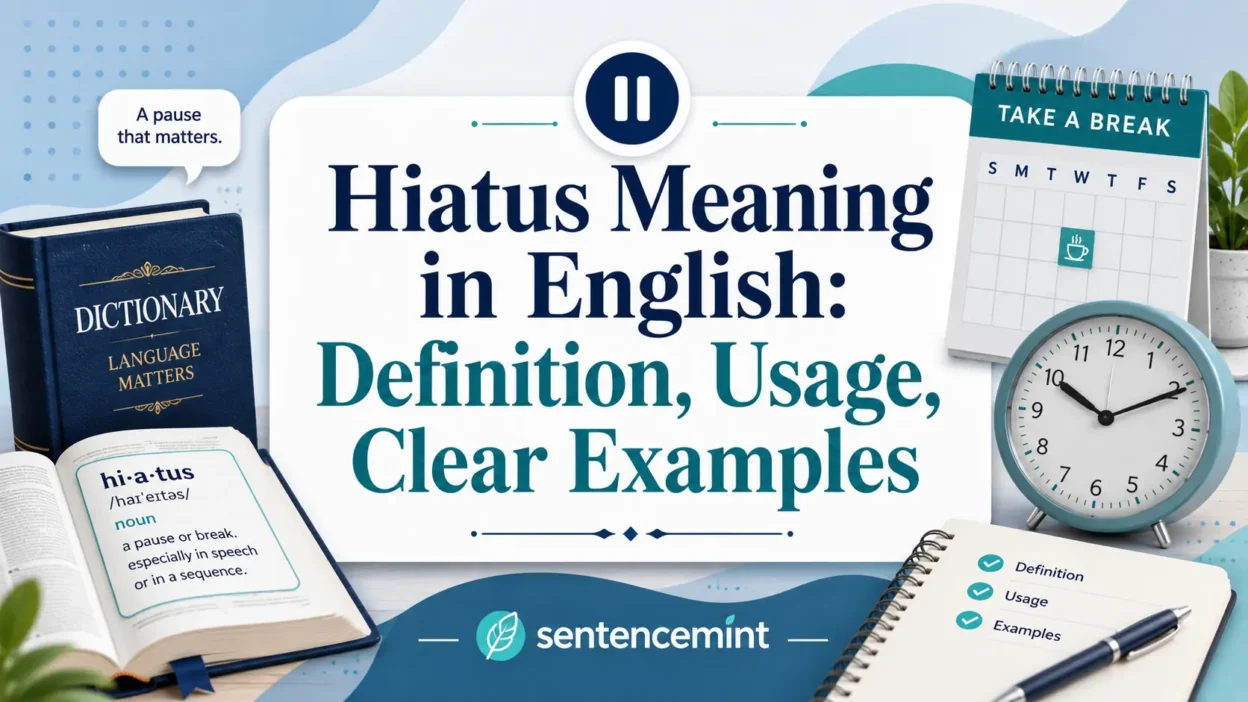
Hiatus means a temporary break, pause, interruption, or gap in something. It is usually a noun. In most cases, it means something has stopped for now, not ended forever.
TL;DR
- Hiatus means a temporary break or gap.
- It is usually a noun.
- It is pronounced high-AY-tus.
- A show, band, or project can be on hiatus.
- A person can take a hiatus from an activity.
- Hiatus does not automatically mean canceled.
- The usual plural form is hiatuses.
What Does Hiatus Mean in Plain English?
A hiatus is a pause in activity. It can also mean a gap where something is missing or interrupted.
In simple English, hiatus means “a break for a while.” The break may happen in work, school, TV, music, writing, business, or public events.
Examples
- The podcast took a short hiatus.
- She returned to school after a long hiatus.
- The band went on hiatus after its tour.
- The magazine resumed publication after a brief hiatus.
The main idea is interruption. Something stops, but the word does not prove it is over forever.
How to Pronounce Hiatus
Hiatus is pronounced:
high-AY-tus
It has three syllables:
- hi
- a
- tus
The stress is on the second syllable: AY.
A common mistake is saying it too quickly as high-tus. Give the middle sound its own space.
Part of Speech and Word Forms
Hiatus is a noun. It names a break, pause, interruption, or gap.
Most modern sentences use it as a countable noun:
- a hiatus
- the hiatus
- this hiatus
- several hiatuses
The plural form is usually hiatuses. Some dictionaries also mention hiatus as a plural form in special cases, but hiatuses is clearer for everyday writing.
Hiatus is not a verb.
Correct
- I will take a hiatus from work.
- The show will go on hiatus next month.
Incorrect
- I will hiatus from work.
- The show will hiatus next month.
How to Use Hiatus in a Sentence
Hiatus appears in a few common patterns. These patterns sound natural in modern English.
- Use “on hiatus” when something is paused
- The show is on hiatus until spring.
- Our weekly newsletter is on hiatus this month.
- The channel went on hiatus after the holiday season.
- Use “take a hiatus” when someone chooses a break
- She took a hiatus from social media.
- He took a hiatus from touring.
- The writer took a hiatus to focus on family.
Use “after a hiatus” when something returns
- The festival returned after a three-year hiatus.
- The series came back after a long hiatus.
- He released new music after a short hiatus.
Use “from” to show the activity being paused
- Maya took a hiatus from teaching.
- The singer is on hiatus from live shows.
- He stepped away from politics for a brief hiatus.
| Context | Best Choice | Why |
|---|---|---|
| TV show or podcast stops briefly | on hiatus | Suggests a pause |
| Person chooses a break | take a hiatus | Shows a planned break |
| Something returns | after a hiatus | Marks a restart |
| Final ending | ended or canceled | Hiatus may be misleading |
Common Contexts for Hiatus
Hiatus is common in entertainment. People use it when shows, bands, podcasts, or creators pause new work.
Example:
The series is on hiatus during the holidays.
It also appears in work and school contexts. A person may take a hiatus because of health, family, travel, rest, or study.
Example:
She took a hiatus from college, then returned in August.
You may also see it in formal writing. In that context, it can mean a missing part or gap.
Example:
The report had a strange hiatus in the timeline.
Is Hiatus Slang or Formal?
Hiatus is not slang. It is a standard English word.
However, it can sound more formal than break in everyday speech.
Compare
- Casual: I’m taking a break from posting.
- More formal: I’m taking a hiatus from posting.
Use hiatus when the pause feels planned, public, noticeable, or longer than usual. Use break when you want a simpler everyday word.
Hiatus vs Break, Pause, and Gap
Hiatus overlaps with break, pause, and gap, but each word has a slightly different feel.
Break
This is the most general and casual word. It works in many everyday situations.
Example:
I need a break from studying.
Pause
This often suggests a shorter stop.
Example:
There was a pause before she answered.
Gap
This often points to an empty space, missing part, or interruption in continuity.
Example:
There is a gap in the record.
Hiatus
This sounds more formal and often suggests a noticeable break in a series, schedule, career, or public activity.
Examples:
- The actor returned after a hiatus.
- The company resumed the project after a hiatus.
Synonyms and Antonyms of Hiatus
The best synonym depends on context.
| Word | Type | Best Use |
|---|---|---|
| break | synonym | General and casual use |
| pause | synonym | Short stop or silence |
| interruption | synonym | Something stops the flow |
| interval | synonym | Time between two events |
| gap | synonym | Missing space or missing part |
| suspension | synonym | Formal temporary stop |
| continuity | antonym | Unbroken flow |
| continuation | antonym | Something keeps going |
Not every synonym fits every sentence. A gap in a wall is not usually called a hiatus, for example.
Common Mistakes with Hiatus
1. Using hiatus for every small break
The word can sound too formal for very simple situations.
Too formal:
I took a hiatus to drink water.
Better:
I took a break to drink water.
2. Treating hiatus as cancellation
A hiatus means a pause, not necessarily a final ending.
Wrong idea:
The show is canceled because it is on hiatus.
Better:
The show is paused, but it may return.
3. Using hiatus as a verb
Hiatus is a noun, not a verb.
Incorrect:
The team will hiatus the project.
Correct:
The team will pause the project.
Correct:
The project will go on hiatus.
4. Using hiatus when a simpler word is better
In casual writing, break often sounds more natural.
Formal:
She took a hiatus from dating.
More natural in casual speech:
She took a break from dating.
Mini Quiz: Test Your Understanding
Choose the best answer.
1. What does hiatus usually mean?
A. A temporary break
B. A final ending
2. Which sentence is correct?
A. The podcast is on hiatus.
B. The podcast will hiatus tomorrow.
3. Which word is more casual?
A. Break
B. Hiatus
4. Does hiatus always mean canceled?
A. Yes
B. No
Answer Key
- A
- A
- A
- B
FAQs
What does hiatus mean?
Hiatus means a break, pause, interruption, or gap. It often describes something that stops for a while.
The word usually suggests the activity may continue later.
What does it mean to be on hiatus?
To be on hiatus means to be paused for a period of time. A show, podcast, band, creator, or project can be on hiatus.
It does not always mean the thing is canceled.
How do you use hiatus in a sentence?
Use hiatus as a noun. Common phrases include on hiatus, take a hiatus, and after a hiatus.
Example:
The singer returned after a long hiatus.
Is hiatus a formal word?
Yes, hiatus often sounds more formal than break. It is correct in everyday English, but break is more casual.
Use hiatus when the pause is public, planned, or important.
What is another word for hiatus?
Good synonyms include break, pause, gap, interval, interruption, and suspension.
Use break for casual writing. Use hiatus for a more formal tone.
How do you pronounce hiatus?
Pronounce hiatus as high-AY-tus. It has three syllables.
The second syllable gets the stress.
What is the plural of hiatus?
The usual plural is hiatuses.
For most everyday writing, hiatuses is the clearest choice.
Does hiatus mean forever?
No. A hiatus usually means a temporary stop. If something has ended completely, words like ended, shut down, or canceled may be more accurate.
Conclusion
Hiatus meaning is simple: a temporary break, pause, interruption, or gap. It is a noun and often sounds more formal than break.
Use hiatus when something stops for a while and may return later. For casual writing, compare it with break or pause first and choose the word that sounds most natural.