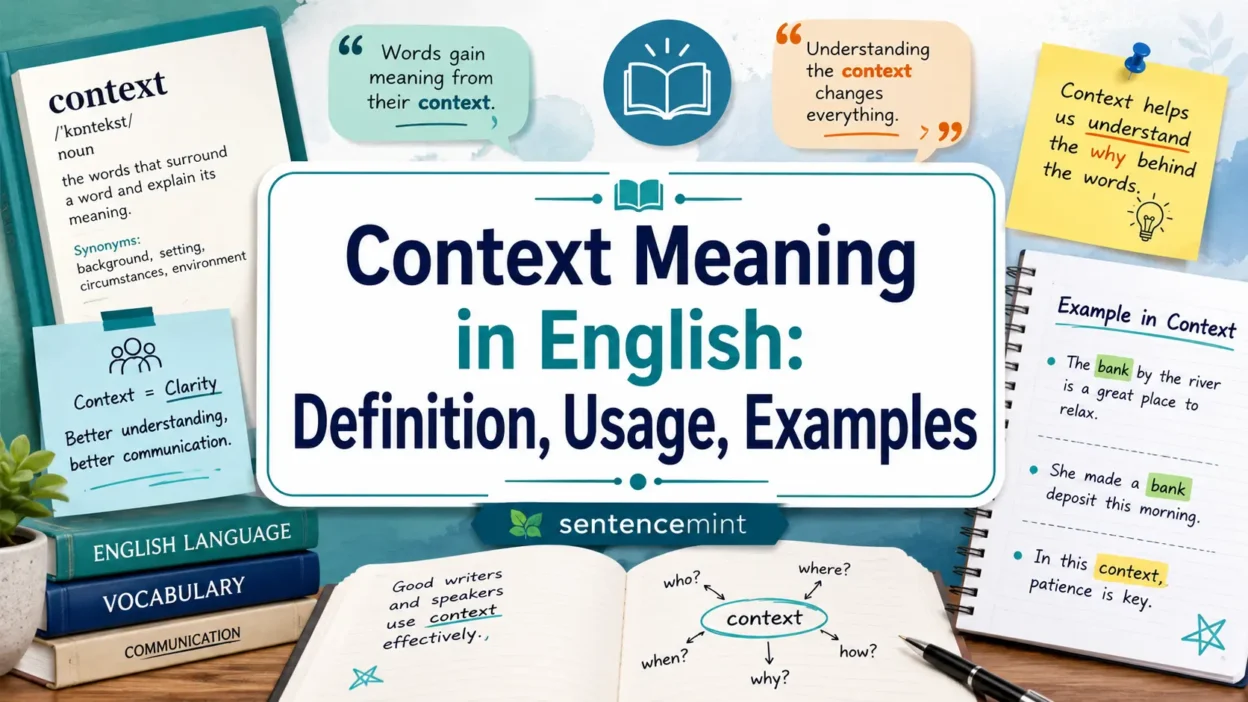
Context is a word you may see in school, writing guides, news stories, workplace emails, and everyday conversations. People often use it when a sentence, quote, event, message, or decision needs more background.
The word matters because meaning can change without the full situation. A short quote may sound rude when read alone. A confusing word may become clear when you see the words around it. A decision may seem strange until you know what happened before it.
This guide explains context meaning in simple English. You will learn its definition, pronunciation, part of speech, common phrases, examples, related terms, and mistakes to avoid.
Quick Answer
Context means the background, setting, or surrounding information that helps you understand something clearly. It is usually a noun. In English, context can refer to the words around a word or the larger situation around an event, quote, decision, or message.
TL;DR
- Context means background or surrounding information.
- It is most often a noun.
- It helps explain meaning.
- Words can change meaning by context.
- Out of context means separated from the full situation.
- Context clues help readers understand unknown words.
- Context is not usually slang.
What Context Means In Plain English
Context means the information around something that helps explain it. That “something” may be a word, sentence, quote, action, event, message, or decision.
Think of context as the full picture. Without it, people may guess the wrong meaning.
Example:
“That was sick.”
This sentence can mean “that was bad” or “that was amazing.” The context tells you which meaning fits.
More examples:
- In a doctor’s office, sick usually means ill.
- At a skatepark, sick trick can mean impressive.
- In a school essay, context may mean the time, place, and background.
- In a news story, context may mean the facts needed to understand an event.
- In a work email, context may mean the reason behind a request.
Context does not have a separate common slang meaning. However, context often helps explain slang words because slang depends heavily on situation, tone, and audience.
Context Definition In Simple Terms
A simple definition of context is:
Context is the background or surrounding information that helps something make sense.
It can refer to:
- words around a word
- sentences around a quote
- facts around an event
- background behind a decision
- situation around a conversation
- culture, history, or setting behind an idea
Example:
“The quote sounds harsh without context.”
This means the quote may seem different if readers do not know the full situation.
Part Of Speech And Pronunciation
Context is a noun. It names the background, setting, or surrounding details that help explain meaning.
Simple pronunciation:
KON-tekst
The first syllable gets the stress: KON.
The plural form is contexts.
Use context when you talk about one situation. Use contexts when you talk about more than one situation.
Examples:
- “The joke makes sense in context.”
- “This word has different meanings in different contexts.”
- “Please give me more context before I answer.”
- “The teacher explained the historical context.”
Context is not normally used as a verb, adjective, or adverb. The adjective form is contextual.
Example:
“The meaning is contextual.”
That means the meaning depends on the situation.
How Context Works In Sentences
Context often comes from the words before and after a word. These nearby words help readers understand the meaning.
Example 1:
“The pitcher threw a fastball across the plate.”
Here, pitcher means a baseball player. The words fastball and plate give context.
Example 2:
“She poured lemonade from the pitcher.”
Here, pitcher means a container. The words poured and lemonade change the meaning.
This is why context clues matter. They are hints around a word that help you understand it.
Common context clues include:
- nearby definitions
- examples in the sentence
- opposite words
- cause and effect
- tone or mood
- the subject being discussed
- surrounding sentences
Context does not always give a perfect answer. Still, it often gives enough information to make a smart guess.
Common Contexts Where You See Context
You can see context in reading, writing, school, work, news, and conversation. The word is common in both casual and formal English.
| Context | Meaning | Example |
|---|---|---|
| School | Background information | “Study the historical context of the speech.” |
| Writing | Details readers need | “Add context before the chart.” |
| Work | Background for a request | “Can you give me more context?” |
| News | Facts behind an event | “The article explains the political context.” |
| Conversation | Situation behind meaning | “That joke only works in context.” |
| Reading | Words around a word | “Use context clues to find the meaning.” |
In each case, context helps people understand something more clearly.
Context In School And Writing
In school, context often means background information that helps explain a text, event, speech, or idea.
Example:
“To understand the speech, study the context of the 1960s.”
This means readers need to know what was happening during that time period.
In writing, context helps readers follow your point. You may need to explain who, what, when, where, why, and how before giving your main idea.
Example:
“The report needs more context before the chart.”
This means readers need background before they can understand the chart.
Good context makes writing clearer, smoother, and easier to trust.
Context In Work And Daily Conversation
At work, context helps people respond correctly. A short message may confuse someone if it does not include enough details.
Example:
“Can you add context to this request?”
This means the person needs background before taking action.
In daily conversation, context can prevent misunderstanding. Tone, timing, relationship, and situation can all change meaning.
Example:
“I understood the joke because I knew the context.”
This means the joke made sense because the listener knew the situation behind it.
How To Use Context Correctly
Use context when something needs background or explanation. It is especially useful when meaning is not clear by itself.
| Situation | Best Phrase | Why |
| A quote sounds confusing | add context | It explains the full meaning |
| A word has two meanings | use context clues | Nearby words guide the meaning |
| A school essay feels thin | explain the context | Background helps the reader |
| A message sounds rude | check the context | Tone and situation may change it |
| A decision seems strange | provide context | Background explains why it happened |
Good sentence patterns:
- in context
- out of context
- provide context
- add context
- give context
- understand the context
- historical context
- social context
- cultural context
- broader context
Examples:
- “Please read the sentence in context.”
- “Her comment sounds harsh out of context.”
- “The article gives useful cultural context.”
- “I need more context before I decide.”
- “The teacher asked us to explain the historical context.”
In Context, Out Of Context, And Provide Context
In Context
The phrase in context means with the surrounding information included. It helps the meaning feel complete.
Example:
“In context, his comment was clearly a joke.”
This means the full situation shows that he was not serious.
Out Of Context
The phrase out of context means separated from the full situation. This can make something seem different from its real meaning.
Example:
“The quote was taken out of context.”
This means someone used the quote without the surrounding details, which may change how people understand it.
Provide Context
Provide context means give background details. This phrase is common in school, work, and writing.
Example:
“Please provide context for this decision.”
Add Context
Add context means almost the same thing. It often sounds natural in editing or feedback.
Example:
“Add context so readers understand the timeline.”
These phrases are useful, but do not overuse them. Sometimes explain or give background sounds simpler.
Context Vs Content
Context and content are easy to confuse, but they do not mean the same thing.
Content means the material itself. It is what is written, said, shown, or included.
Context means the background or situation that helps explain the content.
| Word | Meaning | Example |
| Content | The actual material | “The email content had three paragraphs.” |
| Context | Background that explains it | “The email context explained the delay.” |
Incorrect:
“The context of the email had three paragraphs.”
Correct:
“The content of the email had three paragraphs.”
Correct:
“The context of the email explained why the meeting changed.”
Use content for the message itself. Use context for the background around it.
Context Clues In Reading
Context clues are hints near a word that help explain its meaning. Students often use context clues when reading a new or difficult word.
Example:
“The desert was arid, so plants struggled to grow without water.”
The phrase without water helps you understand that arid means dry.
Common types of context clues include:
- Definition clues: The sentence explains the word.
- Example clues: The sentence gives examples.
- Contrast clues: The sentence shows an opposite idea.
- Cause-and-effect clues: The sentence shows a result.
- Tone clues: The mood helps reveal meaning.
Example with contrast:
“Unlike his cheerful sister, Mark was gloomy.”
The contrast with cheerful helps explain gloomy.
Types Of Context
Context can appear in different forms. These types often overlap.
Linguistic Context
Linguistic context means the words and sentences around a word or phrase.
Example:
“The bat flew out of the cave.”
The words flew and cave show that bat means an animal.
Historical Context
Historical context means the time period and events around something.
Example:
“You need historical context to understand the speech.”
Cultural Context
Cultural context means the customs, beliefs, values, or social habits that help explain meaning.
Example:
“A gesture may have different meanings in different cultural contexts.”
Social Context
Social context means the people, relationships, and social setting around a situation.
Example:
“A joke may sound different depending on the social context.”
Situational Context
Situational context means the immediate situation around a message or event.
Example:
“Her short reply made sense because the meeting was starting.”
Synonyms, Antonyms, And Related Terms
Context has several close synonyms. The best choice depends on the sentence.
Useful Synonyms
- background — details that explain the situation
- setting — time, place, or environment
- circumstances — facts around an event
- situation — what is happening around something
- framework — a structure for understanding something
- surroundings — nearby conditions or environment
Examples:
- “The background explains the decision.”
- “The setting changes the meaning.”
- “The circumstances matter here.”
Opposite Ideas
Context does not have one perfect antonym. The closest ideas are:
- isolation
- without context
- out of context
- detached from background
Examples:
- “The sentence is unclear in isolation.”
- “The quote is misleading without context.”
Related Terms
- contextual — depending on context
- context clue — a hint that helps explain meaning
- historical context — background from a time period
- cultural context — background from beliefs or customs
- social context — background from people or society
- broader context — wider background around a topic
Origin And Word History
The word context has roots in Latin. Its older sense is connected with joining or weaving things together.
That history fits the modern meaning well. Context “weaves together” the details around a word, sentence, quote, message, or event.
Today, the word is not limited to writing. People use it in history, culture, work, school, media, technology, and daily speech.
You do not need the origin to use the word well. The main point is simple: context helps meaning become clear.
Common Mistakes With Context
Mistake 1: Confusing Context And Content
Incorrect:
“The context of the video was funny.”
Better:
“The content of the video was funny.”
Use context when you mean background.
Correct:
“The context of the video explains why people laughed.”
Mistake 2: Using Out Of Context For Any Disagreement
Out of context should mean the full situation was missing or changed. It does not simply mean someone disagreed with you.
Weak:
“You disagreed with me, so you took me out of context.”
Better:
“You quoted one sentence and left out the next one.”
Mistake 3: Giving Too Little Context In Writing
Readers may feel confused if you start with a quote, number, or claim without background.
Weak:
“This changed everything.”
Better:
“In 2022, the company lost its largest client. That decision changed everything.”
The second version gives readers context.
Mistake 4: Adding Too Much Context
Context should help the reader, not bury the main point.
Weak:
A long background paragraph before a simple answer.
Better:
Give only the details needed to understand the point.
Examples Of Context In Real Sentences
- “Please give me more context before I answer.”
- “The quote sounds different in context.”
- “The article explains the historical context.”
- “Use context clues to understand the word.”
- “The message seemed rude out of context.”
- “The teacher asked us to add more context.”
- “The decision makes sense in the broader context.”
- “The word has different meanings in different contexts.”
- “The chart needs context before readers can understand it.”
- “Cultural context can change the meaning of a gesture.”
Mini Quiz
Answer each question.
1. What does context mean?
Background or surrounding information.
2. Is context usually a noun or a verb?
A noun.
3. What does “out of context” mean?
Separated from the full situation.
4. Which is correct: “content of the email” or “context of the email”?
Both can be correct, but they mean different things. Content means the email material. Context means the background around the email.
5. What is one context clue?
A nearby definition, example, contrast word, tone clue, or related word.
FAQs
What does context mean in simple words?
Context means the background or surrounding information that helps explain something. It helps you understand the full meaning.
For example, a sentence may sound rude alone. With context, you may see it was a joke.
What is context in English?
In English, context can mean the words around another word. It can also mean the situation around an event, quote, message, or idea.
Both meanings help people understand something more clearly.
What is an example of context?
Here is a simple example: “The bat flew out of the cave.” The words flew and cave show that bat means an animal.
In “He swung the bat,” the word bat means sports equipment.
What does context mean in writing?
In writing, context means the details readers need to understand your message. These details may include time, place, purpose, audience, background, or key facts.
Good context makes writing clearer and easier to follow.
What does out of context mean?
Out of context means something is shown without the full situation. This can change how people understand it.
A quote may be accurate but still misleading out of context.
What are context clues?
Context clues are hints near a word that help explain its meaning. They may appear in the same sentence or nearby sentences.
Examples, definitions, opposite words, tone, and related details can all be context clues.
Is context a slang word?
No, context is not usually a slang word. It is a standard English noun.
However, context can help explain slang because many slang words depend on situation, tone, and audience.
What is the difference between context and content?
Content is the actual material, such as words, images, or information. Context is the background that helps explain that material.
Example: The content of an email is what it says. The context explains why it was sent.
Conclusion
Context meaning is simple: background or surrounding information that helps something make sense. It can explain words, quotes, events, choices, messages, and decisions.
Use context when meaning needs support. When in doubt, add clear background so your reader understands the full picture.