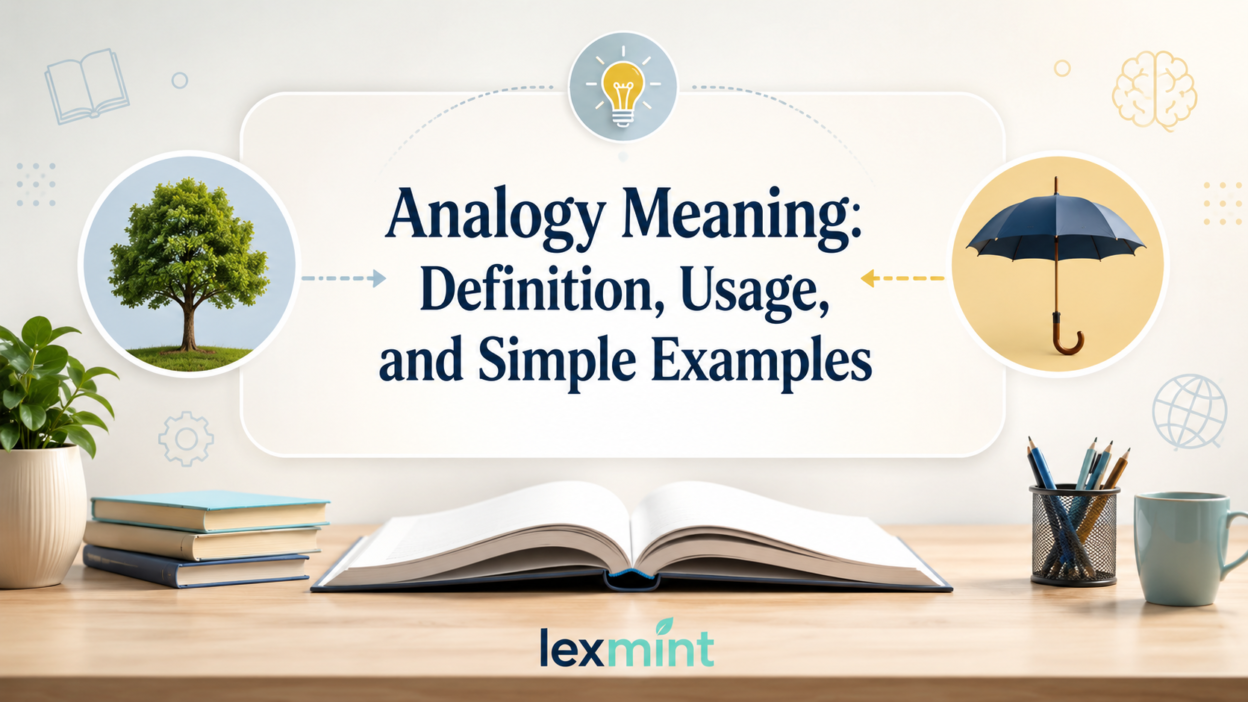
An analogy is a comparison between two different things that share a useful similarity. People use analogies to explain ideas, make points clearer, and help readers understand something unfamiliar.
You may see the word analogy in English class, writing lessons, test questions, speeches, articles, or everyday conversation. Cambridge defines analogy as a comparison between things that have similar features, often used to help explain a principle or idea.
This guide explains analogy meaning in plain English. You will learn how to pronounce it, how it works, how to use it correctly, and how it differs from metaphor and simile.
Quick Answer
Analogy means a comparison between two different things that share a meaningful similarity. People use analogies to explain an idea, make a point, or help someone understand something unfamiliar through something familiar.
TL;DR
- An analogy is a comparison.
- It explains one idea through another.
- The word is usually a noun.
- The plural is analogies.
- It is not slang.
- Good analogies make meaning clearer.
- Weak analogies can confuse or mislead.
What Analogy Means In Plain English
An analogy is a helpful comparison. It shows how one thing is like another thing in a specific way.
The two things do not need to be the same. They only need to share one clear relationship.
Example:
- Learning a new language is like building muscle.
This analogy works because both language learning and muscle building require steady practice over time. One huge effort is not enough.
Analogy is not just decorative language. Its main job is to explain.
Merriam-Webster defines analogy as a comparison of two otherwise unlike things based on resemblance in a particular aspect.
Analogy Definition, Pronunciation, And Part Of Speech
Analogy is a noun. It names a comparison used to explain a point or show a relationship.
Pronunciation:
uh-NAL-uh-jee
Cambridge gives the UK and US pronunciation as /əˈnæl.ə.dʒi/.
Plural form:
analogies
Merriam-Webster lists the plural as analogies, and Oxford also gives analogies as the plural form.
Common forms:
- an analogy
- the analogy
- this analogy
- several analogies
- draw an analogy
- make an analogy
- use an analogy
- explain by analogy
Example:
- “The teacher used an analogy to explain electricity.”
Here, analogy names the comparison the teacher used.
The word is not slang. It is standard English used in school, work, essays, speeches, and everyday explanation.
How An Analogy Works
An analogy usually has two parts:
- The idea you want to explain
- The familiar thing used to explain it
Example:
- A password is like a house key.
The idea being explained is password.
The familiar thing is house key.
The shared relationship is access.
A key lets you enter a house. A password lets you enter an account.
A good analogy makes the shared relationship easy to see. A weak analogy makes the reader guess too much.
How To Identify An Analogy
To identify an analogy, ask three questions:
- Are two different things being compared?
- Is the comparison used to explain an idea?
- Is there a clear shared relationship?
Example:
- “A phone battery is like a gas tank because both store energy that gets used over time.”
This is an analogy because it compares two different things and explains the shared idea: stored energy.
Not every comparison is a strong analogy. The best analogies explain something clearly.
Common Contexts For Analogy
People use analogies anywhere clear explanation matters.
| Context | Best Choice | Why |
|---|---|---|
| Classroom lesson | simple analogy | Helps beginners understand |
| Essay or speech | clear analogy | Supports a point |
| Work explanation | familiar analogy | Makes complex ideas easier |
| Test question | word analogy | Checks relationships |
| Casual talk | short analogy | Explains feelings or situations |
Example in conversation:
- “This project is like cleaning a garage. It looks messy first, but each step makes it clearer.”
That analogy works because both tasks can feel overwhelming at the start but improve through organized effort.
Analogy Examples In Everyday English
Here are simple analogy examples with short explanations.
| Analogy | Shared Idea |
| A good teacher is like a good coach. | Both guide people, correct mistakes, and help them improve. |
| Saving money is like planting a tree. | Small actions grow into something larger over time. |
| A phone battery is like a gas tank. | Both store energy that runs out with use. |
| A busy inbox is like a crowded desk. | Both need sorting before work feels manageable. |
| Trust is like glass. | Once broken, it may be hard to restore fully. |
| The brain is like a control center. | It receives information and helps direct the body. |
These examples do more than say two things are alike. They explain the shared idea that connects them.
Analogy Vs Simile And Metaphor
Analogy, simile, and metaphor all use comparison. The difference is how they work.
| Term | Basic Meaning | Example |
| Analogy | Explains through comparison | “A schedule is like a map because it guides your day.” |
| Simile | Compares using like or as | “Her voice was like music.” |
| Metaphor | Says one thing is another | “Time is a thief.” |
A simile can be short. A metaphor can be direct and poetic. An analogy usually explains the comparison more fully.
Compare:
- Simile: “His room is like a zoo.”
- Metaphor: “His room is a zoo.”
- Analogy: “His room is like a zoo because everything is loud, crowded, and out of place.”
The analogy gives the reason behind the comparison.
Analogy Vs Example
An example shows one case of an idea. An analogy explains an idea by comparing it with something else.
Example:
- “A password should be strong, such as X7!mP29.”
Analogy:
- “A password is like a lock on your front door.”
The example shows what a strong password may look like. The analogy explains how a password works.
How To Use Analogy Correctly
Use an analogy when your reader may not understand an idea right away. Start with the hard idea, then compare it to something familiar.
A simple pattern is:
[Hard idea] is like [familiar thing] because [shared point].
Example:
- “Editing a draft is like polishing a mirror because each pass makes the message clearer.”
You can also use common phrases:
- “Let me use an analogy.”
- “To use an analogy, think of a phone battery.”
- “The analogy is simple.”
- “She drew an analogy between teamwork and rowing a boat.”
- “The teacher made an analogy between the heart and a pump.”
Oxford gives common patterns such as draw an analogy, make an analogy, and by analogy with.
Strong Vs Weak Analogies
A strong analogy has a clear shared relationship.
Strong:
- “A password is like a key because both give access.”
This works because the shared idea is clear.
A weak analogy compares two things without enough meaningful similarity.
Weak:
- “Life is like a pencil.”
This may sound interesting, but the meaning is unclear.
Better:
- “Life is like a pencil because mistakes can be corrected, but pressure can still leave marks.”
The better version explains the connection.
Analogy Is Not Proof By Itself
An analogy can help explain an idea, but it does not prove the idea by itself.
Weak argument:
- “A company is like a family, so every employee should sacrifice equally.”
This analogy may sound emotional, but it can mislead. A company is not exactly a family. Workers have roles, contracts, limits, and rights.
Better:
- “A company can feel like a team, but workplace roles and personal limits still matter.”
A good analogy supports understanding. It should not replace evidence.
Word Analogies
A word analogy is a test-style comparison that shows a relationship between words.
Example:
- Bird is to nest as dog is to kennel.
This means:
- A bird lives in a nest.
- A dog lives in a kennel.
Common word analogy patterns include:
- part to whole
- cause to effect
- tool to use
- worker to workplace
- object to function
- synonym to synonym
- antonym to antonym
Example:
- Pen is to write as knife is to cut.
The shared relationship is tool and action.
Synonyms, Antonyms, And Related Terms
The closest synonyms for analogy depend on context.
Useful synonyms:
- comparison — the broadest match
- parallel — a similar pattern or situation
- correspondence — a matching relationship
- likeness — a shared similarity
- similarity — a point in common
Example:
- “The writer made a comparison between memory and a filing cabinet.”
There is no perfect everyday antonym for analogy. Possible opposites include:
- difference
- contrast
- dissimilarity
Related terms:
- analogous — similar in a way that makes comparison possible
- simile — comparison using like or as
- metaphor — direct figurative comparison
- allegory — a story with a deeper symbolic meaning
Oxford defines analogous as similar in some way to another thing or situation and therefore able to be compared with it.
Common Mistakes With Analogy
Using An Analogy That Is Too Vague
Weak:
- “Life is like a pencil.”
Better:
- “Life is like a pencil because mistakes can be corrected, but pressure can still leave marks.”
The better version explains the shared point.
Treating An Analogy As Proof
An analogy can support an idea, but it does not prove it alone.
Weak:
- “The brain is like a computer, so people should be able to delete memories.”
Better:
- “The brain can be compared to a computer in some ways, but memory in humans is more complex.”
Forcing The Comparison Too Far
Analogies are limited. Two things may be similar in one way but different in many others.
Example:
- A password is like a house key because both give access.
- A password is not like a house key in every possible way.
Confusing Analogy With Metaphor
A metaphor can be short and figurative. An analogy usually explains a relationship more fully.
Metaphor:
- “The mind is a computer.”
Analogy:
- “The mind is like a computer because it stores, processes, and retrieves information.”
Using Too Many Analogies At Once
Too many analogies can confuse readers.
Too much:
- “Learning grammar is like building muscle, planting a garden, fixing a car, and climbing a mountain.”
Better:
- “Learning grammar is like building muscle because regular practice matters more than one long session.”
Mini Quiz
Choose the best answer.
1. What is an analogy?
A. A comparison used to explain
B. A spelling error
C. A punctuation mark
2. Which sentence uses an analogy?
A. “The door is red.”
B. “A password is like a key because it gives access.”
C. “She walked home.”
3. What part of speech is analogy?
A. Verb
B. Adjective
C. Noun
4. Which is the plural form?
A. analogys
B. analogies
C. analogys’
5. What makes an analogy strong?
A. A clear shared relationship
B. A very long sentence
C. A confusing comparison
Answer Key:
- A
- B
- C
- B
- A
FAQs
What is analogy in simple words?
An analogy is a comparison that explains one thing by connecting it to another thing. It helps people understand something new through something familiar.
What is an example of an analogy?
An example is: A phone battery is like a gas tank. Both store energy that gets used over time.
How do you use analogy in a sentence?
You can say, “The teacher used an analogy to explain how the heart works.” You can also say, “Let me draw an analogy between teamwork and rowing a boat.”
Is an analogy the same as a metaphor?
No. A metaphor says one thing is another thing. An analogy explains how two things are similar to make a point clearer.
Is analogy a literary device?
Yes. Analogy can be used as a writing, literary, and rhetorical device. Writers use it to explain ideas, support arguments, and make abstract thoughts easier to understand.
Why do people use analogies?
People use analogies to make difficult ideas easier. A strong analogy gives readers a familiar picture, so the meaning becomes clearer.
What is a weak analogy?
A weak analogy compares two things that do not share enough meaningful similarity. It may sound clever, but it can confuse or mislead the reader.
What is a word analogy?
A word analogy compares relationships between words. Example: Bird is to nest as dog is to kennel. The relationship is animal and home.
What does analogous mean?
Analogous means similar in a way that makes comparison possible. Example: “The two situations are roughly analogous.”
Conclusion
Analogy meaning is simple: it is a useful comparison that explains an idea. The best analogies are clear, familiar, and focused on one strong connection.
Use analogies when you want readers to understand something faster and remember it longer. A good analogy does not just compare two things. It shows why the comparison helps.