You may see the word sans in books, articles, menus, product copy, fashion writing, captions, and font names. It is a short word, but it can feel unusual because most people say without instead.
The word matters because it changes the tone of a sentence. Sans can sound stylish, literary, humorous, or slightly formal. In some places, it works well. In others, it can sound forced or unclear.
This guide explains sans meaning in English. You will learn its definition, pronunciation, part of speech, origin, common uses, examples, related terms, and mistakes to avoid. By the end, you will know when sans works and when without is better.
Quick Answer
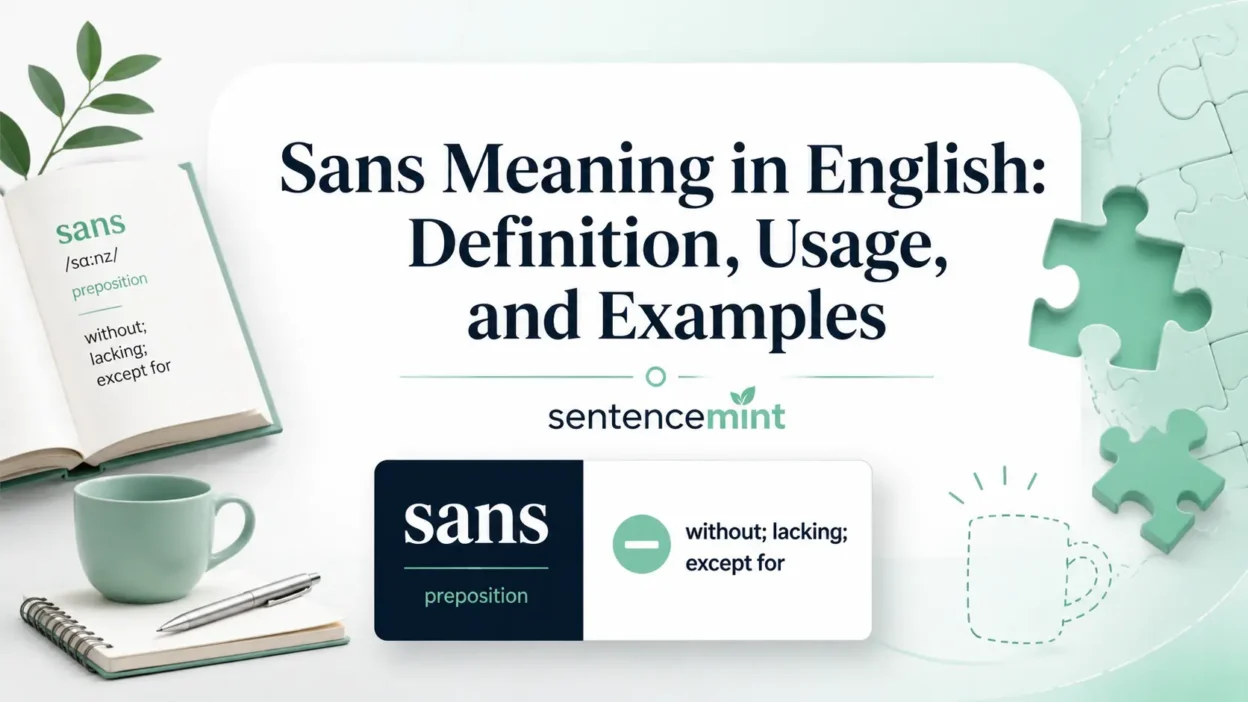
Sans means without. It is mainly used as a preposition, as in sans sugar, sans makeup, sans permission, or sans explanation.
TL;DR
- Sans means without.
- It is mainly a preposition.
- It is usually pronounced sanz.
- It sounds stylish, literary, humorous, or slightly formal.
- Without is usually clearer in everyday English.
- Sans serif means without serifs.
What Does Sans Mean In English?
Sans means without, lacking, or not including something. It shows that a thing is absent or left out.
In plain English, sans tells you what is missing.
Examples:
- coffee sans sugar = coffee without sugar
- a speech sans notes = a speech without notes
- a photo sans filter = a photo without a filter
- a burger sans onions = a burger without onions
Sans is not common slang in American English. In captions, menus, and creative writing, it may feel trendy, polished, or playful. Still, the meaning stays the same: without.
Sans Pronunciation And Part Of Speech
Sans is usually pronounced:
sanz
It rhymes closely with cans. In everyday American English, you do not need to use a French-style nasal sound.
The main part of speech is preposition. A preposition links one idea to another. Here, sans connects a sentence to something that is missing or absent.
Examples:
- “She arrived sans coat.”
- “The burger came sans onions.”
- “He spoke sans notes.”
- “The report was submitted sans explanation.”
In design, sans can also be used informally as a short noun for a sans-serif typeface. That use mostly appears in font and design talk.
How To Use Sans Correctly
The simplest pattern is:
sans + noun
Put sans before the thing that is missing.
Examples:
- tea sans milk
- dinner sans dessert
- a reply sans details
- a room sans windows
- an outfit sans jewelry
- a message sans context
Use sans when the missing thing is a noun or noun phrase.
Correct:
“She posted a photo sans filter.”
Correct:
“The article appeared sans headline.”
Do not use sans before a full clause. Without is more flexible there.
Awkward:
“She left sans saying goodbye.”
Better:
“She left without saying goodbye.”
When To Use Sans And When To Avoid It
Use sans when you want a short, stylish, or slightly witty way to say without. It fits best in writing, captions, menus, headlines, reviews, and creative descriptions.
Use without when clarity matters more than style. It is better for school essays, workplace notes, instructions, and everyday speech.
| Context | Best Choice | Why |
|---|---|---|
| Everyday speech | without | It sounds natural |
| Menu wording | sans | It can sound neat and brief |
| Formal instructions | without | It avoids confusion |
| Fashion caption | sans | It can sound stylish |
| School writing | without | It is clearer for readers |
| Product copy | sans | It can sound concise |
| Legal or safety writing | without | It is more direct |
Compare:
- Casual: “I ordered coffee without sugar.”
- Stylish: “I ordered coffee sans sugar.”
Both are correct. The second sounds more polished or playful.
Common Contexts And Examples
Sans often appears where writers want fewer words. It can also add a polished, witty, or literary touch.
Common contexts include:
- Food: coffee sans cream
- Fashion: a look sans jewelry
- Writing: a report sans sources
- Events: a party sans music
- Design: a logo in sans
- Social media: selfie sans filter
More examples:
- “I ordered tacos sans cilantro.”
- “The room looked calm sans clutter.”
- “She posted a photo sans filter.”
- “The team worked sans manager for a day.”
- “The email arrived sans attachment.”
- “He gave the speech sans notes.”
- “The outfit looked elegant sans accessories.”
Sans works best when the sentence is short and the missing item is easy to understand.
Sans In Sans Serif And Design
You may know sans from the phrase sans serif. In that phrase, sans means without.
A serif is a small finishing stroke at the end of a letter. A sans-serif typeface has letters without those extra strokes.
Examples of sans-serif fonts:
- Arial
- Helvetica
- Calibri
- Verdana
In design talk, people may say a sans to mean a sans-serif typeface.
Example:
“The designer chose a clean sans for the website.”
For general readers, sans-serif font or sans-serif typeface is clearer.
Origin Of Sans
English borrowed sans from French, where it means without. That origin helps explain why the word can sound more stylish or literary than the everyday English word without.
You may also see sans in a few borrowed French-style phrases, but it is most useful in English as a concise replacement for without.
Example:
- “The meal was served sans sauce.”
- “The speech was delivered sans preparation.”
Because of its French origin, sans can add a slightly elegant or playful tone. However, overusing it can make writing sound affected.
Sans Vs Without
Sans and without can mean the same thing, but they do not always sound the same.
| Word | Meaning | Tone | Best Use |
| sans | without | stylish, literary, witty, formal | captions, menus, creative writing |
| without | not having or including | clear, common, natural | everyday speech and most writing |
Examples:
- “She arrived without a coat.”
- “She arrived sans coat.”
Both mean the same thing. The first sounds natural. The second sounds more stylized.
In most beginner writing, without is the safer choice. Use sans when tone matters.
Synonyms, Antonyms, And Related Terms
The closest synonym for sans is without. It is the safest choice in most sentences.
Close Synonyms
- without — clear and common
- minus — casual and direct
- lacking — more descriptive
- free of — useful for unwanted things
- in the absence of — formal and longer
Examples:
- “coffee sans sugar”
- “coffee without sugar”
- “coffee minus sugar”
Closest Opposites
There is no perfect one-word antonym for every use of sans. The best opposite depends on context.
Useful opposites include:
- with
- including
- containing
- plus
- featuring
Examples:
- “tea sans milk” = tea without milk
- “tea with milk” = tea including milk
Related Terms
- sans serif
- without
- missing
- absent
- lacking
- free of
Common Mistakes With Sans
Mistake 1: Using Sans When Without Is Clearer
Sans can feel affected in ordinary conversation.
Weak:
“I forgot my keys and came sans them.”
Better:
“I forgot my keys and came without them.”
Mistake 2: Using Sans Before A Verb Phrase
Use without before verbs ending in -ing.
Weak:
“He finished the test sans checking his answers.”
Better:
“He finished the test without checking his answers.”
Mistake 3: Treating Sans As A Common Text Shortcut
Sans is not a normal American English text shortcut. It is a real word meaning without.
Weak:
“Going sans phone today lol.”
Better:
“I’m going without my phone today.”
Stylish caption:
“Weekend plans, sans phone.”
Mistake 4: Overusing Sans
Using sans too often can make writing sound unnatural.
Forced:
“We ate dinner sans soup, watched a movie sans snacks, and walked home sans umbrellas.”
Better:
“We ate dinner without soup, watched a movie without snacks, and walked home without umbrellas.”
Use it sparingly for effect.
Examples Of Sans In Real Sentences
- “The salad came sans dressing.”
- “She arrived sans makeup.”
- “The room looked better sans clutter.”
- “He gave the presentation sans slides.”
- “The article was published sans author name.”
- “The actor appeared on stage sans costume.”
- “The logo uses a bold sans-serif font.”
- “The party felt strange sans music.”
- “She posted the selfie sans filter.”
- “The proposal was rejected because it arrived sans details.”
Mini Quiz
Choose the best answer.
1. What does sans mean?
A. With
B. Without
2. Which sentence sounds most natural?
A. “I ordered coffee sans sugar.”
B. “I ordered coffee sans that I wanted sugar.”
3. What part of speech is sans most often?
A. Preposition
B. Adjective
4. Which word is usually clearer in everyday speech?
A. Without
B. Sans
Answer Key
- B
- A
- A
- A
FAQs
What does sans mean?
Sans means without. It shows that something is missing, absent, or not included.
For example, a meal sans bread is a meal without bread.
Is sans a real English word?
Yes, sans is a real English word. English borrowed it from French.
It has been used in English for a long time. Today, it appears more often in writing than in everyday speech.
How do you pronounce sans?
Pronounce sans like sanz. It rhymes closely with cans.
In everyday American English, you do not need to force a French nasal pronunciation.
Is sans formal or informal?
Sans can feel literary, stylish, humorous, or slightly formal. The tone depends on the sentence.
In a work email, without is usually safer. In a caption, menu, headline, or design note, sans may sound natural.
What does sans mean in sans serif?
In sans serif, sans means without. A sans-serif typeface has letters without serifs.
Serifs are small strokes at the ends of letters. Sans-serif fonts often look clean and modern.
Is sans slang in text?
No, sans is not common American text slang. It is a standard word that means without.
Some people use it in captions for style, but the meaning does not change.
Can I use sans in daily sentences?
You can use sans in daily sentences, but use it carefully. It sounds best when the tone is playful, polished, brief, or creative.
For daily speech, without is usually better because it is simpler and more natural.
What is another word for sans?
The best everyday synonym for sans is without.
Other possible alternatives include minus, lacking, free of, and in the absence of, depending on context.
Conclusion
Sans meaning is simple: without.
Use sans when you want a stylish, concise, or slightly playful tone. Choose without when you want the clearest and most natural word for everyday English.