You may see the word capricious in books, news articles, school reading, legal writing, or vocabulary lessons. It usually describes someone or something that changes suddenly, often without a clear reason.
The word matters because it has a sharper tone than simple words like changeable or unpredictable. A capricious boss, rule, mood, or decision can feel frustrating and hard to trust.
This guide explains capricious meaning in simple English. You will learn the definition, pronunciation, grammar, examples, related words, and common mistakes.
Quick Answer
Capricious means likely to change suddenly, unpredictably, and often without a clear reason. It is usually an adjective and often has a negative tone.
TL;DR
- Capricious means sudden, impulsive, and unpredictable.
- It is usually an adjective.
- It often describes behavior, moods, rules, or decisions.
- It can also describe weather, markets, or changing conditions.
- It is not common slang.
- Close synonyms include fickle, erratic, and unpredictable.
- It often sounds critical.
What Capricious Means
Capricious means controlled by sudden changes, impulses, or whims. A capricious person may change plans, moods, or choices quickly and without warning.
The word often suggests that the change feels unreasonable or poorly explained. It can describe people, leaders, decisions, weather, markets, rules, or events.
Examples:
- “The manager made a capricious decision.”
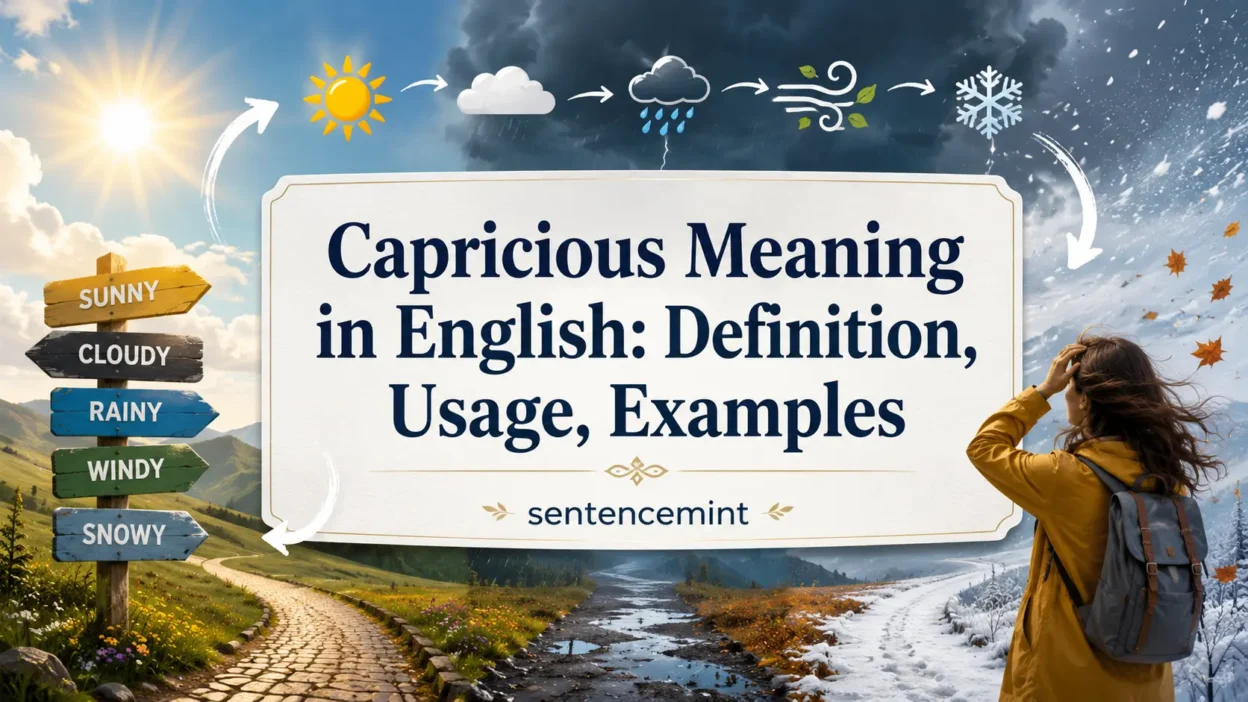
- “Spring weather can be capricious.”
- “Her capricious mood made the meeting tense.”
- “The policy felt capricious and unfair.”
- “Investors were nervous about the capricious market.”
Capricious usually suggests more than simple change. It suggests change that feels impulsive, unstable, or hard to trust.
Capricious Definition In Plain English
In plain English, capricious means changing suddenly in a way people cannot predict. It often describes behavior that feels unstable, impulsive, or hard to explain.
Use it when the change seems based on a whim, mood, or impulse rather than careful thought.
A simple definition:
- Capricious = sudden, unpredictable, and not clearly reasonable
This word is stronger than changeable.
- Changeable can be neutral.
- Capricious usually sounds critical.
For example, changing weather may simply be changeable. A leader who keeps changing rules for no clear reason may be capricious.
Pronunciation And Part Of Speech
Capricious is pronounced:
kuh-PRISH-us
The stress falls on the second part: PRISH.
It is an adjective, which means it describes a noun.
Examples:
- a capricious child
- a capricious rule
- capricious weather
- capricious behavior
- a capricious leader
Related word forms include:
| Word | Part Of Speech | Meaning |
|---|---|---|
| capricious | adjective | sudden, unpredictable, and changeable |
| capriciously | adverb | in a sudden or unpredictable way |
| capriciousness | noun | the quality of being capricious |
| caprice | noun | a sudden whim or impulse |
How To Use Capricious In A Sentence
Use capricious before a noun or after a linking verb. It works well in formal, literary, legal, or serious writing.
Pattern 1: Capricious + Noun
- a capricious leader
- a capricious market
- a capricious decision
- a capricious rule
- a capricious attitude
Pattern 2: Noun + Is/Was/Seems + Capricious
- “The rule seems capricious.”
- “His behavior was capricious.”
- “The weather is capricious today.”
- “Her moods can be capricious.”
A common mistake is confusing the adjective and adverb forms.
Wrong:
“He capricious changed the plan.”
Correct:
“He changed the plan capriciously.”
Use capricious as an adjective. Use capriciously as an adverb.
Common Contexts For Capricious
Capricious often appears in serious writing. It can sound too formal for casual speech.
| Context | Best Choice | Why |
| Everyday talk | unpredictable | Clear and simple |
| Formal writing | capricious | Precise and serious |
| Legal writing | arbitrary and capricious | Established legal phrase |
| Weather description | capricious | Good for sudden changes |
| Personality description | capricious | Strong and often critical |
| Market or policy discussion | capricious | Suggests instability |
You can use it for a person:
- “He was talented but capricious.”
- “The coach’s capricious style frustrated the team.”
- “Her capricious choices confused everyone.”
You can also use it for things:
- “The capricious wind changed the game.”
- “The market felt capricious all week.”
- “The company’s capricious policies upset employees.”
It is not a common slang word. In casual speech, people usually say unpredictable, moody, inconsistent, or all over the place.
Capricious In Legal Contexts
In law, capricious often appears in the phrase arbitrary and capricious. This phrase usually describes a decision that lacks a reasonable basis or fair explanation.
- It is common in discussions of courts, agencies, appeals, regulations, and official decisions. It does not mean “random” in a loose everyday way. It points to a decision made without proper reason, fair review, or logical support.
Example:
- “The court found the denial arbitrary and capricious.”
- “The agency’s action was challenged as arbitrary and capricious.”
For everyday writing, do not use this legal phrase unless the context really needs it. Use unfair, unreasonable, unsupported, or poorly explained when those words are clearer.
Capricious Vs Changeable, Fickle, And Erratic
- Capricious is close to several other words, but the meanings are not exactly the same.
| Word | Main Idea | Tone |
| capricious | sudden and unreasonable changes | often negative |
| changeable | likely to change | neutral |
| fickle | changing likes, feelings, or loyalty | negative |
| erratic | irregular and unpredictable | negative |
| impulsive | acting without enough thought | negative or neutral |
Capricious Vs Changeable
Changeable is broader and softer. Capricious sounds more critical.
- “The weather is changeable.”
- “The rules are capricious.”
Capricious Vs Fickle
Fickle often describes changing affection, loyalty, or taste.
- “The audience can be fickle.”
Capricious Vs Erratic
Erratic focuses on irregular behavior or movement.
- “The car made erratic turns.”
Capricious Vs Impulsive
Impulsive focuses on acting quickly without enough thought.
- “He made an impulsive purchase.”
Capricious often combines unpredictability with an unreasonable or whimsical quality.
Synonyms And Antonyms Of Capricious
Good synonyms depend on context. Not every synonym has the same tone.
Close Synonyms
- unpredictable
- erratic
- fickle
- mercurial
- impulsive
- inconsistent
- whimsical
- unstable
Useful Antonyms
- steady
- consistent
- predictable
- stable
- reliable
- constant
- dependable
- even-tempered
Be careful with whimsical. It can sound playful or charming. Capricious usually sounds more critical.
Example:
- “Her whimsical style was creative.”
- “Her capricious decisions upset the team.”
Those two words are not interchangeable in every sentence.
Common Mistakes With Capricious
A common mistake is using capricious for any kind of change. The word works best when the change feels sudden, unpredictable, or poorly reasoned.
Weak:
“The store changed its hours.”
Better:
“The store made capricious changes to its hours.”
Another mistake is using it as a noun.
Wrong:
“His capricious caused problems.”
Correct:
“His capriciousness caused problems.”
Also, avoid using it when a simpler word fits better.
Too formal:
“My lunch plans are capricious.”
Better:
“My lunch plans keep changing.”
Another mistake is using capricious in a positive way when the context is actually neutral or playful. The word often suggests criticism, not charm.
Examples Of Capricious In Real Sentences
- “The judge criticized the capricious rule.”
- “Her capricious moods made teamwork difficult.”
- “The boss seemed capricious and hard to please.”
- “The market remained capricious throughout the week.”
- “Spring weather in the mountains can be capricious.”
- “The child’s capricious behavior worried his parents.”
- “Investors dislike capricious leadership.”
- “The committee rejected the capricious policy changes.”
- “The wind was capricious and changed direction often.”
- “His capricious style made planning almost impossible.”
Mini Quiz
Choose the best answer.
1. What does capricious mean?
A. Very careful
B. Sudden and unpredictable
C. Very quiet
2. Which sentence is correct?
A. “The weather was capricious.”
B. “The weather capricious loudly.”
C. “The weather was capriciously sky.”
3. What part of speech is capricious?
A. Adjective
B. Verb
C. Pronoun
4. Which word is an antonym of capricious?
A. Steady
B. Fickle
C. Erratic
Answer Key:
- B
- A
- A
- A
FAQs
What does capricious mean?
Capricious means sudden, unpredictable, and often hard to explain. It usually describes behavior, decisions, moods, weather, or conditions that change without a clear reason.
Is capricious a negative word?
Capricious is often negative. It can suggest someone or something is unreliable, unstable, unfair, or hard to trust.
What is a capricious person?
A capricious person changes moods, plans, or choices suddenly. These changes may seem based on whim rather than reason.
Is capricious formal or informal?
Capricious is more formal than everyday words like moody, changeable, or unpredictable. It fits essays, literature, news, and serious writing.
What is a synonym for capricious?
Good synonyms include unpredictable, erratic, fickle, mercurial, and impulsive. The best choice depends on the sentence.
What is the opposite of capricious?
Common opposites include steady, consistent, stable, predictable, and reliable. These words suggest regular behavior or clear patterns.
What is the difference between capricious and caprice?
Capricious is an adjective. Caprice is a noun that means a sudden whim, impulse, or change of mind.
Can capricious describe weather?
Yes. Capricious can describe weather when it changes suddenly and unpredictably.
Example:
“Mountain weather can be capricious.”
Conclusion
Capricious meaning is simple: sudden, unpredictable, and often not clearly reasonable.
Use capricious when changeable feels too weak and you want to show that the change seems impulsive, unstable, or hard to trust. For casual writing, a simpler word like unpredictable may sound more natural. In formal writing, capricious is a sharp and useful word.