
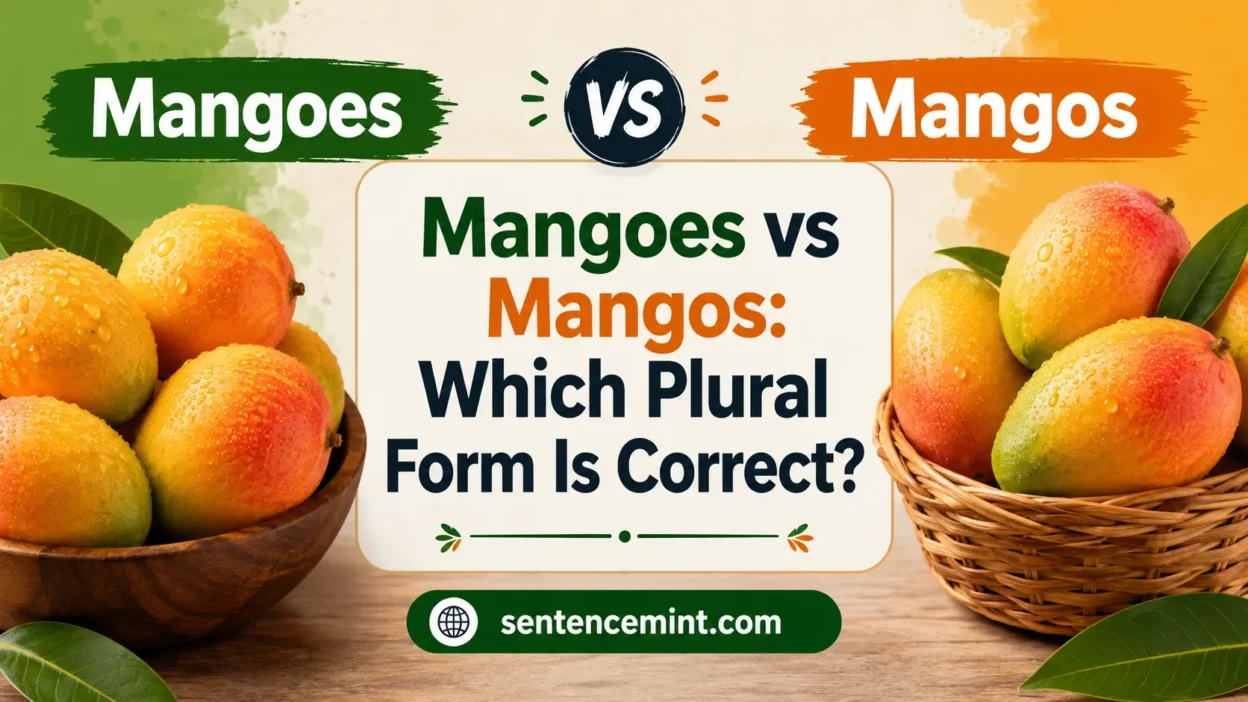
If you have ever written “mangoes” and wondered whether “mangos” was more correct, you are not alone.
English plural rules can feel inconsistent, especially for words ending in -o.
The good news:
Both “mangoes” and “mangos” are correct plural forms of “mango.”
They mean the same thing, sound the same, and function the same grammatically.
The difference comes down to spelling preference and style consistency.
Quick Answer
The plural of mango can be written two ways:
✓ mangoes
✓ mangos
Both forms are accepted in modern English.
For formal or edited writing, many writers choose mangoes.
For commercial use, branding, or shorter style preferences, mangos also appears regularly.
The most important rule:
Choose one spelling and stay consistent.
Why People Confuse Them
The confusion exists because English plural rules do not always follow one pattern.
Some nouns ending in -o add -es:
- tomato → tomatoes
- potato → potatoes
- hero → heroes
Others simply add -s:
- radio → radios
- piano → pianos
- avocado → avocados
“Mango” became one of the nouns where both plural spellings gained acceptance over time.
That flexibility creates uncertainty.
Key Differences At A Glance
| Context | Recommended Choice | Why |
|---|---|---|
| Formal writing | mangoes | Common in edited writing |
| General American English | both accepted | Style consistency matters |
| Commercial branding | mangos | Often appears in industry usage |
| School writing | mangoes | Slightly safer stylistically |
| House style requirements | follow guide | Consistency matters most |
Additional comparison:
| Feature | Mangoes | Mangos |
|---|---|---|
| Same meaning | Yes | Yes |
| Same pronunciation | Yes | Yes |
| Dictionary accepted | Yes | Yes |
| Grammar role | Plural noun | Plural noun |
| Modern English accepted | Yes | Yes |
Are They The Same Word?
Yes.
“Mangoes” and “mangos” are simply two accepted plural spellings of mango.
They share:
- identical meaning
- identical pronunciation
- identical grammatical role
Both refer to more than one mango fruit.
Examples:
We bought fresh mangoes for dessert.
We bought fresh mangos for dessert.
Both sentences are correct.
US Vs UK Preference
American English accepts both spellings.
British English also accepts both.
However, mangoes often appears more frequently in traditional edited writing.
Mangos also appears widely, especially in commercial contexts and industry usage.
Major dictionaries recognize both forms.
This is not mainly a US-versus-UK spelling issue.
Which Spelling Should You Use?
For school, business, academic, or professional writing:
Mangoes is often the safer editorial choice.
Use mangos if:
- your publication style prefers it
- your company style guide uses it
- your organization consistently applies it
The key rule:
Do not switch between spellings inside the same document.
Correct:
✓ We bought fresh mangoes for smoothies.
Correct:
✓ We bought fresh mangos for smoothies.
Avoid:
✗ We bought fresh mangoes and sliced ripe mangos.
When One Spelling Looks Wrong
People often assume the version they learned first must be the only correct one.
Someone familiar with:
mangoes
may think:
mangos
looks incomplete.
Someone accustomed to shorter plural forms may prefer:
mangos
Neither reaction changes grammar rules.
Both spellings remain correct.
Common Mistakes
Incorrect:
✗ I bought five mango’s.
Correct:
✓ I bought five mangoes.
✓ I bought five mangos.
Incorrect:
✗ Mangos is wrong English.
Correct:
Both plural forms are accepted.
Incorrect:
✗ Mangoes means one thing while mangos means another.
Correct:
They mean exactly the same thing.
Everyday Examples
The store received fresh mangoes this morning.
We bought frozen mangos for smoothies.
The market sells imported mangoes every summer.
She added sliced mangos to the fruit bowl.
Our family buys mangoes every weekend.
All examples follow modern English correctly.
Dictionary-Style Word Details
Noun
Mangoes
Plural noun meaning more than one mango fruit.
Mangos
Same plural noun meaning.
Different accepted spelling preference.
Synonyms
Closest alternatives:
- tropical fruit
- fresh fruit
Related food terms:
- produce
- fruit varieties
Example Sentences
The grocery store stocked fresh mangoes.
We blended ripe mangos into smoothies.
The restaurant served mangoes with dessert.
Local farms delivered mangos to the market.
Word History
English plural rules developed from multiple language influences.
Words ending in -o do not always follow identical plural patterns.
Over time, both mangoes and mangos gained dictionary acceptance.
Modern English recognizes both spellings as correct.
Phrases Containing
Common examples:
- fresh mangoes
- ripe mangoes
- sliced mangoes
- frozen mangos
- dried mangoes
- organic mangos
FAQs
Is mangoes or mangos correct?
Both are correct plural forms of mango.
What is the plural of mango?
The plural can be written:
- mangoes
- mangos
Both forms are accepted.
Is mangos wrong?
No.
Major dictionaries recognize mangos as correct.
Which spelling should I use in formal writing?
Many writers choose mangoes for formal writing because it often appears more naturally in edited English.
Why do some words ending in O use ES?
English plural rules developed from different language influences, so patterns vary between nouns.
Do mangoes and mangos sound different?
No.
Pronunciation remains identical.
Conclusion
The answer is simple:
Both “mangoes” and “mangos” are correct.
They share:
- the same meaning
- the same pronunciation
- the same grammar role
For formal writing, mangoes often feels safer.
For branding, commercial usage, or style preference, mangos also works.
The best choice is consistency.
Pick one style and use it throughout your writing.