Assume vs. Presume: What’s the Difference and When to Use Each
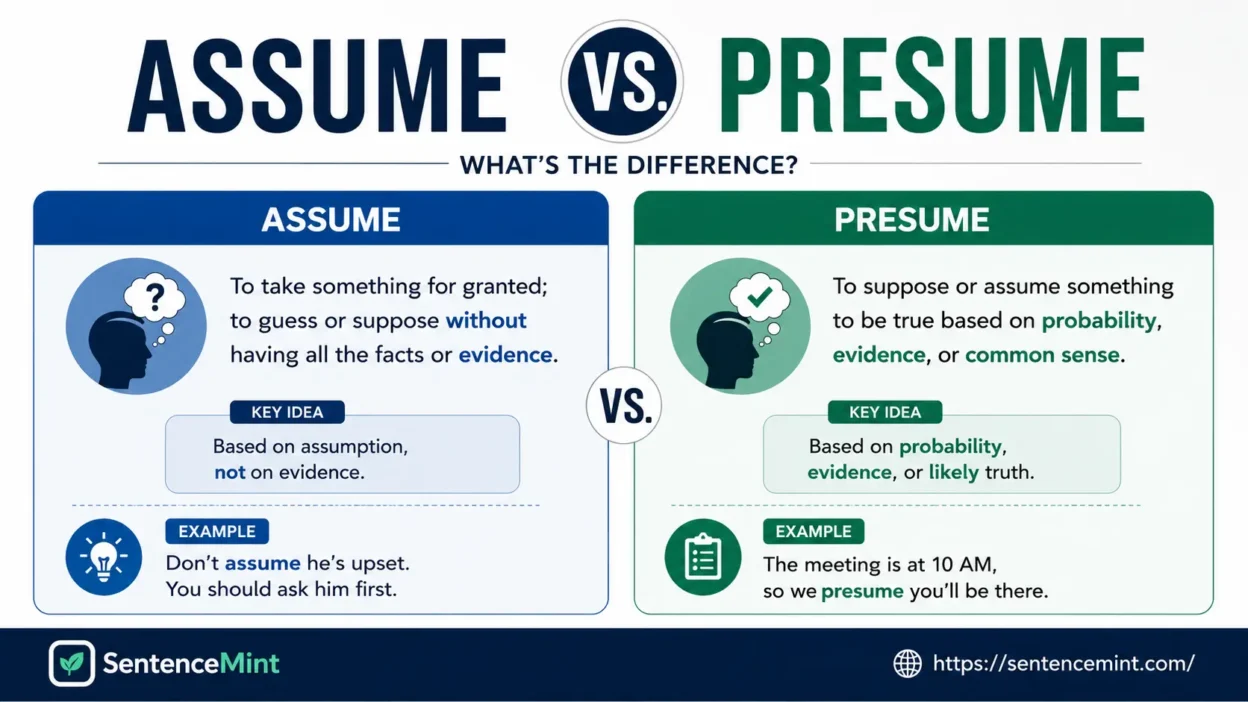
The confusion around assume vs. presume comes from how similar the two words sound and how often they overlap in everyday English. Both involve accepting or believing something, but they are not always interchangeable.
In many casual conversations, people use the words almost the same way. In formal, legal, and professional writing, though, the distinction becomes more important.
A simple way to start thinking about it is this:
- assume usually means accepting something without proof
- presume usually suggests there is at least some reason or likelihood behind the conclusion
For example:
- “I assumed he forgot the meeting.”
- “We presumed the meeting was canceled because nobody arrived.”
That small difference in confidence and evidence changes the tone of the sentence.
Quick Answer
Use assume when you are making a general guess or accepting something as true without clear evidence.
Use presume when there is some supporting reason, probability, expectation, or convention behind the conclusion.
Examples:
- “I assumed the store closed at 8.”
- “We presumed the store was closed because the lights were off.”
The words overlap in casual speech, but they are not always interchangeable in careful writing.
Why People Confuse Them
People confuse these words because they share very similar meanings and grammatical roles. Both are verbs connected to belief, expectation, and conclusion-making.
The overlap is especially common in conversation:
- “I assumed you were busy.”
- “I presumed you were busy.”
Both sentences sound natural. The second simply feels slightly more formal and slightly more reasoned.
Another reason for the confusion is that modern English does not always preserve a strict separation between the two. Many speakers use whichever word sounds more natural in the moment.
Still, context matters. Legal and professional writing often keeps the distinction clearer than everyday speech.
Key Differences At A Glance
| Context | Best Choice | Why |
|---|---|---|
| Guess without evidence | Assume | Focuses on acceptance without proof |
| Conclusion based on clues | Presume | Suggests some supporting basis |
| Casual conversation | Assume | Sounds more natural and common |
| Legal language | Presume | Implies formal expectation or inference |
| Hypothetical discussion | Assume | Common in reasoning and planning |
| Strong expectation | Presume | Carries more confidence |
Quick Comparison
| Feature | Assume | Presume |
|---|---|---|
| Evidence required | Little or none | Usually some basis |
| Tone | Neutral and everyday | More formal |
| Common contexts | Conversation, planning | Legal, professional |
| Confidence level | Moderate | Slightly stronger |
Meaning and Usage Difference
The real distinction between these words involves evidence, expectation, and tone.
Assume
Assume usually means accepting something as true without needing proof.
Examples:
- “I assumed the class started at noon.”
- “Let’s assume sales increase next quarter.”
- “She assumed he already knew.”
The word is flexible and common in everyday English.
It also has another meaning connected to taking on responsibility or roles:
- “She assumed leadership of the project.”
- “He assumed control of the company.”
Presume
Presume usually suggests a belief based on probability, expectation, or some supporting information.
Examples:
- “We presumed the flight was delayed because of the storm.”
- “I presume you received my email.”
- “The law presumes innocence until guilt is proven.”
In many cases, presume sounds more formal and more confident than assume.
The difference is subtle, not absolute. Native speakers sometimes use the words interchangeably in casual contexts.
Tone, Context, and Formality
Tone plays a major role in choosing between these words.
Assume in everyday English
Assume is far more common in normal conversation and informal writing.
Examples:
- “I assumed you were coming.”
- “Don’t assume everyone agrees.”
- “I assumed the office was closed.”
It sounds direct, conversational, and neutral.
Presume in formal English
Presume appears more often in:
- legal writing
- official communication
- academic writing
- formal speech
Examples:
- “The court presumes innocence.”
- “We presume compliance with company policy.”
- “I presume the documents were reviewed.”
The word can sound more authoritative or deliberate.
In polite conversation, it may also sound slightly more formal:
- “I presume you’ve already spoken with management.”
Which One Should You Use?
Choose assume when:
- you are making a general guess
- evidence is weak or unimportant
- the tone is casual
- you are discussing hypotheticals
Examples:
- “I assumed traffic would be heavy.”
- “Let’s assume the meeting lasts an hour.”
Choose presume when:
- there is some supporting evidence
- expectation matters
- the tone is formal
- the context is legal or professional
Examples:
- “We presumed the event had ended after the announcement.”
- “The policy presumes employee cooperation.”
A quick test helps:
- If the idea sounds like a simple guess, assume usually fits.
- If the idea sounds supported or expected, presume often works better.
When One Choice Sounds Wrong
Sometimes the wrong word creates a mismatch in logic or tone.
Evidence mismatch
Awkward:
- “We presumed the restaurant was open even though we had no information.”
Better:
- “We assumed the restaurant was open.”
Why? Because presume usually suggests some basis for the conclusion.
Legal mismatch
Less natural:
- “The defendant was assumed innocent.”
Better:
- “The defendant was presumed innocent.”
Legal English strongly favors presume.
Conversational mismatch
Overly formal:
- “I presume you took out the trash.”
More natural:
- “I assumed you took out the trash.”
In casual conversation, presume can sound stiff or dramatic.
Common Mistakes (and Quick Fixes)
Mistake 1: Treating them as exact synonyms
Not always ideal:
- “I presumed the bus would arrive on time.”
More natural in casual English:
- “I assumed the bus would arrive on time.”
Mistake 2: Overusing “presume” in everyday writing
Too formal:
- “I presume everyone enjoyed the movie.”
More natural:
- “I assume everyone enjoyed the movie.”
Mistake 3: Ignoring legal nuance
Less precise:
- “The suspect was assumed innocent.”
Preferred wording:
- “The suspect was presumed innocent.”
Quick memory aid
- Assume = accept
- Presume = expect with reason
This guideline helps, but real usage still depends on context.
Everyday Examples
- “I assumed the email had already been sent.”
- “We presumed the office was closed because the parking lot was empty.”
- “Don’t assume everyone understands the instructions.”
- “The court presumed the witness was telling the truth.”
- “I assumed you were working from home today.”
- “Management presumed the shipment would arrive by Friday.”
- “Let’s assume sales stay stable this month.”
- “Police initially presumed the fire was accidental.”
- “She assumed he was joking.”
- “I presume you’ve already reviewed the contract.”
Dictionary-Style Word Details
Verb
- assume: fully applies; means to accept as true, suppose, or take on responsibility
- presume: fully applies; means to suppose based on likelihood, expectation, or convention
Examples:
- “We assumed the meeting was canceled.”
- “The law presumes innocence.”
Noun
- assume: not commonly used as a noun
- presume: not commonly used as a noun
Both words function primarily as verbs in modern English.
Synonyms
Assume
Closest plain alternatives:
- suppose
- expect
- infer
- take for granted
Presume
Closest plain alternatives:
- conclude
- infer
- expect
- take as likely
The words share some synonyms, but tone and context still matter.
Example Sentences
Assume
- “I assumed the store closed early.”
- “She assumed responsibility for the project.”
Presume
- “We presumed the road was blocked because of the accident.”
- “The judge presumed the statement accurate.”
Word History
- assume comes from Latin roots connected to taking something upon oneself
- presume comes from Latin roots connected to anticipating or expecting beforehand
Their histories are related, which partly explains the overlap in meaning today.
Phrases Containing
Assume
- assume responsibility
- assume control
- assume the worst
Presume
- presumed innocent
- presumed dead
- presume too much
These phrases remain common in modern American English.
Similar confusion occurs with advice vs advise difference, where even native speakers often mix up noun and verb usage.
FAQ
What is the main difference between assume and presume?
The main difference is that assume usually means accepting something without proof, while presume often suggests there is some reason, evidence, or expectation behind the conclusion.
- “I assumed the train was late.”
- “We presumed the train was late because of the storm.”
Is presume stronger than assume?
Usually, yes. Presume can sound more confident or more supported by evidence than assume.
For example:
- “I assumed he forgot.”
- “I presumed he forgot after seeing the missed calls.”
Can assume and presume be interchangeable?
Sometimes. In casual conversation, many people use them almost interchangeably. In formal, legal, or professional writing, the distinction matters more.
Which word is more formal?
Presume generally sounds more formal than assume.
That is why legal and official writing often prefers presume.
Does presume always require evidence?
No. But it usually suggests some logical basis, expectation, or probability behind the conclusion.
Why is “presumed innocent” more common than “assumed innocent”?
Legal English traditionally uses presumed innocent because the phrase reflects an official legal expectation rather than a casual guess.
Is it rude to say “I presume”?
Not necessarily. But in some situations, I presume can sound more formal, confident, or slightly authoritative than I assume.
Example:
- “I presume you finished the report.”
Depending on tone, this may sound more forceful than:
- “I assume you finished the report.”
Which word is more common in everyday English?
Assume is much more common in everyday American English, especially in casual conversation and general writing.
Can assume mean more than “suppose”?
Yes. Assume can also mean taking on a role, duty, or responsibility.
Examples:
- “She assumed control of the project.”
- “He assumed office in January.”
How can I quickly remember the difference?
A simple guide is:
- Assume = accept without proof
- Presume = expect with some reason
This is a helpful shortcut, though real usage still depends on context.
Conclusion
The difference between assume vs. presume is mostly about evidence, expectation, and tone.
- Assume is broader, more casual, and often used without proof.
- Presume usually suggests some supporting reason or stronger expectation.
The words overlap in everyday speech, but careful writing often preserves the distinction. Once you focus on whether the conclusion is a simple guess or a reasoned expectation, choosing the right word becomes much easier.