
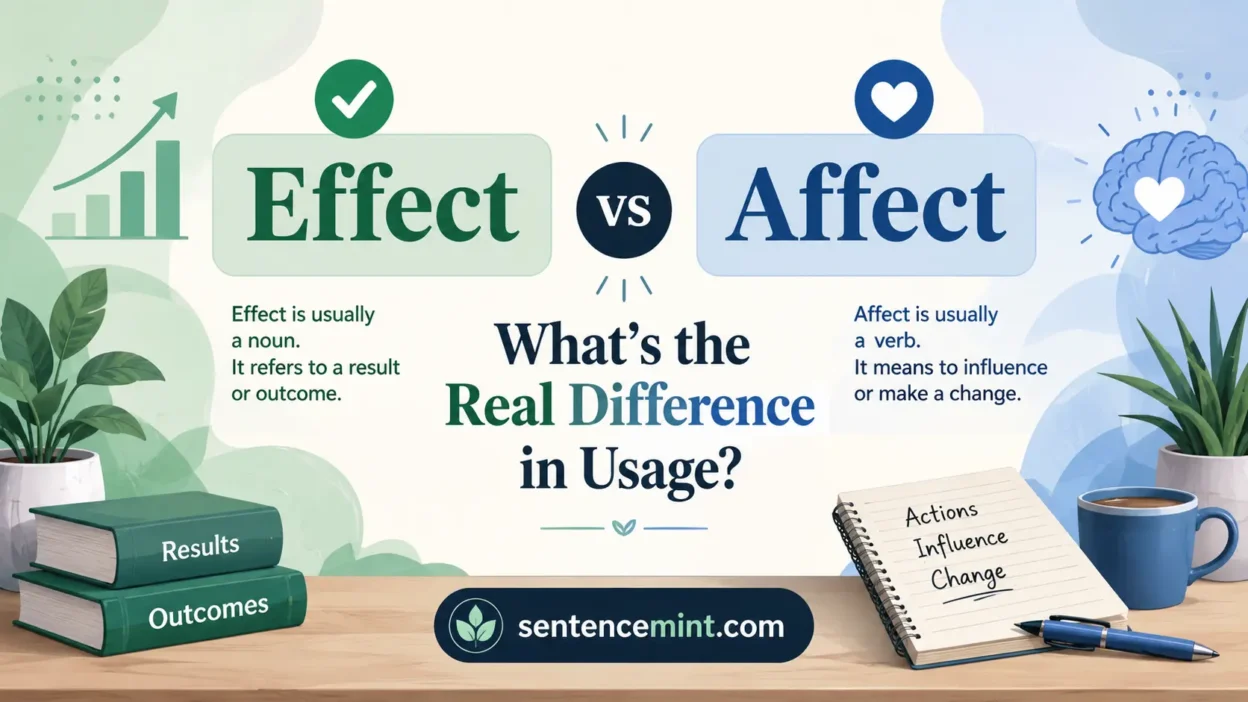
Many writers pause when choosing between effect vs affect. The words look similar, sound close, and both relate to change or influence.
That confusion leads to mistakes like this:
• Incorrect: The weather had a bad affect on traffic.
• Correct: The weather had a bad effect on traffic.
In everyday English, the difference usually comes down to grammar role and sentence structure. Once you understand how each word works, the choice becomes much easier.
Quick Answer
In most situations:
• “Affect” is a verb meaning “to influence.”
• “Effect” is a noun meaning “a result.”
Examples:
• The storm affected our travel plans.
• The storm had a major effect on travel.
A quick memory shortcut helps many people:
• Affect = Action
• Effect = End result
The shortcut works most of the time, though there are a few less common exceptions.
Why People Confuse Them
The confusion comes from three main things:
• similar spelling
• similar pronunciation
• related meanings
Both words deal with change, influence, or results.
Compare these two sentences:
• Long meetings affect employee focus.
• Long meetings have a negative effect on employee focus.
The meaning stays connected, but the grammar role changes.
Spoken English also adds confusion because the pronunciation difference is subtle in fast conversation.
Key Differences At A Glance
| Context | Best Choice | Why |
|---|---|---|
| Influencing something | affect | Usually functions as a verb |
| A result or outcome | effect | Usually functions as a noun |
| Business report | effect | Refers to consequences or results |
| Daily action | affect | Describes influence or change |
| Formal phrase “___ change” | effect | Rare verb meaning “bring about” |
| Psychology context | affect | Rare noun meaning emotional expression |
| Feature | effect | affect |
|---|---|---|
| Most common role | Noun | Verb |
| Core meaning | Result or outcome | Influence or change |
| Common example | side effect | affect behavior |
| Rare alternate use | Verb | Noun |
Meaning and Usage Difference
The main difference is simple:
• “Affect” usually describes an action.
• “Effect” usually describes a result.
Examples:
• Rising prices affect shopping habits.
• Rising prices have an effect on shopping habits.
In the first sentence, something is influencing behavior. In the second sentence, the focus is on the result.
Common use of “affect”
“Affect” most often means “to influence,” “to change,” or “to impact.”
Examples:
• Lack of sleep can affect concentration.
• Budget cuts affected several programs.
• Cold weather affects battery life.
Common use of “effect”
“Effect” usually means “result,” “outcome,” or “consequence.”
Examples:
• The medicine had little effect.
• The new policy produced positive effects.
• Stress can have long-term effects on health.
Rare exceptions
“Effect” can also work as a verb in formal writing.
Example:
• The board hopes to effect reform next year.
Here, “effect” means “to bring about.”
“Affect” can also appear as a noun in psychology or medical contexts.
Example:
• The patient displayed a flat affect.
In this case, it refers to visible emotional expression.
Tone, Context, and Formality
In everyday conversation, people mostly use:
• affect as a verb
• effect as a noun
That pattern appears in school writing, emails, news articles, and workplace communication.
Formal writing sometimes uses “effect” as a verb.
Example:
• The agreement may effect significant change.
This usage sounds more official and less conversational.
Technical or psychology writing may also use “affect” as a noun.
Example:
• Doctors observed reduced affect after treatment.
Most casual readers will rarely encounter that use outside specialized fields.
Which One Should You Use?
A quick question usually solves the problem:
“Is this word describing an action or a result?”
If it describes influence or change, choose “affect.”
Examples:
• Social media can affect attention spans.
• Weather affects flight schedules.
If it describes a result or outcome, choose “effect.”
Examples:
• The update had little effect on performance.
• The change produced positive effects.
Helpful editing shortcut:
• If you can replace the word with “influence,” you probably need “affect.”
• If you can replace it with “result,” you probably need “effect.”
When One Choice Sounds Wrong
Some sentences immediately sound awkward because the grammar role does not fit.
Incorrect:
• The new rule will effect attendance.
Correct:
• The new rule will affect attendance.
Why? Because the sentence needs a verb meaning “influence.”
Another example:
Incorrect:
• The medicine had a strong affect.
Correct:
• The medicine had a strong effect.
Here, the sentence needs a noun meaning “result.”
The rare exceptions can also sound strange if forced into casual writing.
Formal:
• The company hopes to effect change.
Natural everyday version:
• The company hopes to create change.
Common Mistakes (and Quick Fixes)
• Incorrect: The delay will effect delivery times.
Correct: The delay will affect delivery times.
• Incorrect: The speech had a powerful affect on voters.
Correct: The speech had a powerful effect on voters.
• Incorrect: The policy effected employee morale.
Correct: The policy affected employee morale.
• Incorrect: The team wants to affect reform.
Correct: The team wants to effect reform.
Quick reminder:
• Affect usually acts.
• Effect usually results.
Everyday Examples
• Bright screens can affect sleep quality.
• The storm had a serious effect on flights.
• Poor communication affects teamwork.
• The new schedule had a positive effect on productivity.
• Loud construction affected nearby businesses.
• The medicine’s side effects lasted two days.
• Rising gas prices affect commuting habits.
• The update had little effect on battery life.
• Stress can affect appetite.
• The training program had a noticeable effect on performance.
• Social pressure affects teenagers differently.
• The law could affect housing costs.
• The policy changes may have long-term effects.
• News coverage can affect public opinion.
Dictionary-Style Word Details
Verb
• effect: Fully applies. In formal usage, it means “to bring about” or “to cause to happen.”
Example: The agency hopes to effect change.
• affect: Fully applies. Most commonly means “to influence” or “to alter.”
Example: Noise can affect concentration.
Noun
• effect: Fully applies. Usually means “result,” “outcome,” or “consequence.”
Example: The medication had side effects.
• affect: Applies only in specialized contexts. In psychology, it refers to observable emotional expression.
Example: The patient showed little affect.
Synonyms
• effect:
– result
– consequence
– outcome
• affect:
– influence
– impact
– alter
These are closest plain alternatives, not perfect replacements in every sentence.
Example Sentences
• effect:
– The new policy had a positive effect on hiring.
– The treatment produced immediate effects.
– Leaders hope to effect long-term reform.
• affect:
– Heat can affect phone performance.
– The decision affected the entire staff.
– The psychologist noted a flat affect during the interview.
Word History
• effect: Comes through Latin and French roots connected to accomplishment, completion, and results.
• affect: Comes from Latin roots connected to influence, action, or acting upon something.
The modern distinction developed gradually through standard English usage.
Phrases Containing
• effect:
– cause and effect
– side effects
– take effect
– effect change
• affect:
– affect behavior
– flat affect
Some “affect” phrases are mainly used in psychology or technical writing.
If you still struggle with choosing the correct word in real sentences, this detailed breakdown of Affect vs Effect: How to Remember the Difference will help you master the distinction with simple rules and clear examples.
FAQ
What is the difference between affect and effect?
“Affect” is usually a verb meaning “to influence.”
“Effect” is usually a noun meaning “a result.”
Examples:
• The weather affected traffic.
• The weather had an effect on traffic.
Is affect always a verb?
No. “Affect” is usually a verb, but it can also be a noun in psychology or medical settings.
Example:
• The patient showed a flat affect.
In everyday English, though, “affect” is most commonly used as a verb.
Is effect usually a noun?
Yes. “Effect” most often works as a noun meaning “result” or “outcome.”
Example:
• The new rule had a positive effect.
This is the most common modern usage.
Can effect be used as a verb?
Yes. In formal writing, “effect” can mean “to bring about” or “to cause.”
Example:
• The organization hopes to effect change.
This use is less common in casual conversation.
Can affect and effect ever be interchangeable?
Not usually. They relate to similar ideas, but they serve different grammar roles in most sentences.
Incorrect:
• The decision had a strong affect.
Correct:
• The decision had a strong effect.
What is the easiest way to remember affect vs effect?
A simple memory trick is:
• Affect = Action
• Effect = End result
Example:
• Stress affects sleep.
• Stress has an effect on sleep.
The shortcut works for most everyday writing.
Why do people confuse affect and effect?
The words:
• look similar
• sound similar
• relate to influence and change
That combination makes them one of the most commonly mixed-up word pairs in English.
Which one is more common in formal writing?
Both appear often, but in different ways.
• “Affect” commonly appears as a verb.
• “Effect” commonly appears as a noun.
Formal writing may also use the rare verb form “effect,” especially in phrases like “effect change.”
What does “flat affect” mean?
In psychology, “flat affect” describes limited visible emotional expression.
Example:
• The doctor observed a flat affect during the interview.
This meaning is specialized and uncommon outside medical or psychology contexts.
Which sentence is correct: “affect change” or “effect change”?
“Effect change” is the standard formal phrase.
Correct:
• Leaders want to effect change.
Here, “effect” means “to bring about.”
“Affect change” usually means “influence change,” which creates a different meaning.
How can I quickly check if I picked the right word?
Ask yourself:
“Am I talking about an action or a result?”
• Action/influence → affect
• Result/outcome → effect
Examples:
• Lack of sleep affects memory.
• Lack of sleep has a negative effect on memory.
Conclusion
The difference between effect vs affect becomes much easier once you focus on sentence role.
In most cases:
• “Affect” influences something.
• “Effect” is the result.
Examples:
• Stress affects performance.
• Stress has a negative effect on performance.
The uncommon exceptions matter in formal or technical writing, but everyday usage usually follows the standard pattern. With a little practice, choosing the right word becomes much more natural.