
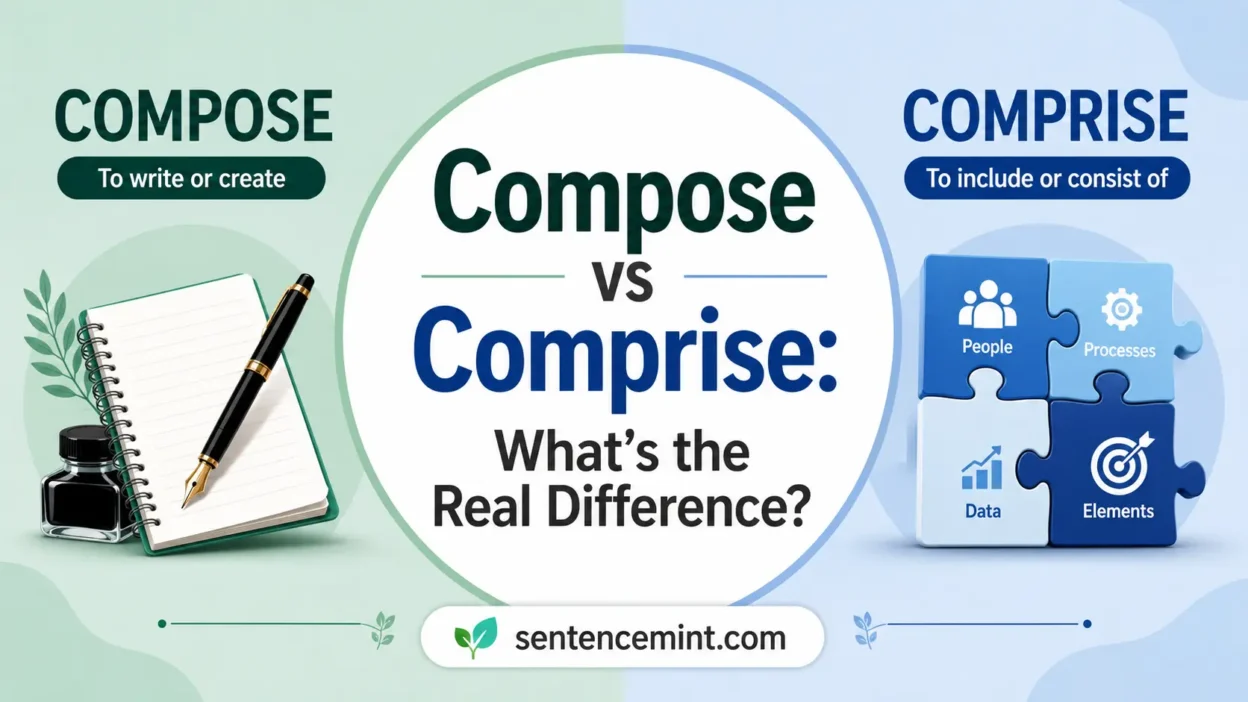
Compose vs Comprise: Meaning, Grammar, and Correct Usage
Many writers mix up “compose” and “comprise” because both words deal with parts and wholes. The confusion usually comes from sentence direction. One word focuses on the parts forming something larger, while the other focuses on the whole containing those parts.
For example:
- “Ten players compose the team.”
- “The team comprises ten players.”
Both sentences describe the same relationship, but the structure changes.
The issue becomes even more confusing when people use phrases like “comprised of,” which many readers accept in everyday English even though some editors still avoid it in formal writing. Understanding the difference helps your writing sound clearer and more polished.
Quick Answer
Use “compose” when the subject is the parts that form a whole.
- “Five sections compose the report.”
- “Three flavors compose the sauce.”
Use “comprise” when the subject is the whole that contains the parts.
- “The report comprises five sections.”
- “The sauce comprises three flavors.”
“Compose” also has a broader meaning. It can mean create or write.
- “She composed a piano piece.”
- “He composed the email carefully.”
The words overlap slightly, but they are not fully interchangeable because switching them changes the relationship between the subject and the object.
Why People Confuse Them
People confuse these words because they describe the same idea from opposite directions.
- Parts compose the whole.
- The whole comprises the parts.
The sentence structures also look very similar, which makes mistakes easy to miss.
Incorrect:
- “The committee is comprised by five members.”
Better:
- “The committee comprises five members.”
- “The committee is composed of five members.”
Another reason for confusion is the widespread use of “comprised of.” Many native speakers use it naturally in conversation, business writing, and news articles. Even so, some editors still prefer “composed of” in careful writing.
The result is a mix of traditional grammar advice and modern usage habits.
Key Differences At A Glance
| Context | Best Choice | Why |
|---|---|---|
| Parts forming a whole | compose | Focuses on the pieces |
| Whole containing parts | comprise | Focuses on the complete thing |
| Writing music or text | compose | Means create or write |
| Formal reports | comprise | Common in informational writing |
| “Made up of” meaning | composed of | Widely accepted structure |
| “Contains” meaning | comprises | Direct whole-to-part wording |
Quick Comparison
| Feature | compose | comprise |
|---|---|---|
| Main direction | Parts → whole | Whole → parts |
| Common meaning | Form or create | Include or contain |
| Creative meaning | Yes | No |
| Common phrase | composed of | comprised of |
| Formal sensitivity | Lower | Higher in edited writing |
Meaning and Usage Difference
The biggest difference is sentence direction.
When you use “compose,” the subject is usually the smaller parts.
- “Twelve tracks compose the album.”
- “Several neighborhoods compose the district.”
When you use “comprise,” the subject is usually the complete thing.
- “The album comprises twelve tracks.”
- “The district comprises several neighborhoods.”
“Compose” also has creative meanings that “comprise” does not have.
- “She composed a movie soundtrack.”
- “The editor composed a thoughtful response.”
In those examples, “compose” means create or produce.
“Comprise” normally means contain, include, or consist of.
- “The package comprises three services.”
- “The course comprises weekly workshops and quizzes.”
You may also see “comprised of.” Many readers understand it immediately, and it appears often in modern English. Still, some editors prefer alternatives like:
- “The group is composed of five students.”
- “The group comprises five students.”
In formal writing, those versions are usually safer.
Tone, Context, and Formality
“Compose” works naturally in both creative and structural contexts.
Creative:
- “The singer composed the melody last year.”
Structural:
- “Four departments compose the organization.”
“Comprise” appears more often in academic, legal, technical, and business writing.
- “The report comprises data from five states.”
- “The agreement comprises multiple payment terms.”
The phrase “comprised of” is where tone and audience matter most.
In casual writing, many people accept it without noticing. In highly edited work, some readers still see it as less precise. That does not mean it is universally wrong, but it can attract attention from strict editors.
A practical approach is simple:
- Use “comprises” when you want formal clarity.
- Use “composed of” when you need a passive structure.
- Use “comprised of” carefully if your audience is sensitive to style rules.
Which One Should You Use?
Start by identifying whether your subject is the whole or the parts.
If the subject represents individual pieces, use “compose.”
- “Five writers compose the panel.”
- “Several ingredients compose the dish.”
If the subject represents the complete thing, use “comprise.”
- “The panel comprises five writers.”
- “The dish comprises several ingredients.”
If you mean create, write, or arrange, only “compose” works.
- “She composed the graduation speech.”
- “He composed music for the documentary.”
For formal workplace or academic writing, many editors prefer these patterns:
- “The proposal comprises three sections.”
- “The proposal is composed of three sections.”
These structures sound clean and direct.
When One Choice Sounds Wrong
Sometimes the wrong word reverses the meaning completely.
Awkward or incorrect:
- “The members comprise the committee.”
Better:
- “The members compose the committee.”
- “The committee comprises the members.”
The first sentence sounds wrong because the smaller parts are acting like the whole.
Another example:
Awkward:
- “She comprised a symphony.”
Better:
- “She composed a symphony.”
“Comprise” does not carry the meaning of creating music, writing, or art.
This mistake also appears in business writing.
Awkward:
- “Three teams comprise the company.”
Better:
- “Three teams compose the company.”
- “The company comprises three teams.”
The logic becomes clearer when you ask:
Which thing contains the other?
Common Mistakes (and Quick Fixes)
Mistake: Reversing the whole and the parts
Wrong:
- “Ten chapters comprise the book.”
Quick fix:
- “Ten chapters compose the book.”
- “The book comprises ten chapters.”
Mistake: Using “comprise” to mean create
Wrong:
- “He comprised a new song.”
Quick fix:
- “He composed a new song.”
Mistake: Overcorrecting natural language
Some writers avoid “comprised of” so aggressively that their sentences become awkward.
Awkward:
- “The class comprises of twenty students.”
Better:
- “The class comprises twenty students.”
- “The class is composed of twenty students.”
Memory trick:
- Parts compose.
- Whole comprises.
That shortcut works in most situations.
Everyday Examples
- “Four roommates compose the household.”
- “The household comprises four roommates.”
- “The journalist composed the article overnight.”
- “The museum exhibit comprises artifacts from the 1990s.”
- “Three short films compose the series finale.”
- “The package comprises shipping, setup, and support.”
- “She composed a message to the client before lunch.”
- “The conference comprises speakers from across the country.”
- “Five counties compose the region.”
- “The region comprises five counties.”
- “The choir director composed a new arrangement for graduation.”
- “The training program comprises weekly online sessions.”
Dictionary-Style Word Details
Verb
- compose: To create, write, arrange, form, or make up something.
- comprise: To contain, include, or consist of parts.
Examples:
- “She composed the soundtrack.”
- “The guide comprises ten chapters.”
Noun
- compose: Rare as a direct noun form in modern English.
- comprise: Not commonly used as a noun.
Both words function mainly as verbs.
Synonyms
- compose: create, form, produce, make up
- comprise: include, contain, encompass
Some synonyms fit only certain contexts. For example, “create” works for music or writing but not for structural relationships.
Example Sentences
- compose: “Several local artists composed the mural project.”
- compose: “Three divisions compose the company.”
- comprise: “The company comprises three divisions.”
- comprise: “The collection comprises more than 200 photographs.”
Word History
- compose: Historically connected to the idea of putting things together or arranging them.
- comprise: Historically connected to containing or embracing multiple parts.
Both words developed around ideas of structure and combination, which explains why people still confuse them today.
Phrases Containing
- compose: compose a song, composed of, compose oneself
- comprise: comprises, comprised of, comprising
“Comprised of” remains common in modern English, even though some editors still prefer alternatives in formal writing.
If you often get confused between similar word pairs, you may also find this guide helpful: understanding the difference between “affect” and “effect” in real usage. Affect vs Effect: Complete Guide
FAQ
Is “comprised of” grammatically correct?
Many people use it naturally, and it appears often in modern English. However, some editors still prefer “comprises” or “is composed of” in formal writing.
What is the main difference between compose and comprise?
“Compose” usually describes parts forming a whole. “Comprise” usually describes a whole containing parts.
Can compose and comprise be interchangeable?
Not completely. Switching them often reverses the relationship between the whole and the parts.
Does compose always mean create?
No. It can also mean form or make up something larger.
Which phrase sounds more formal?
“Comprises” and “is composed of” are often preferred in edited business or academic writing.
Conclusion
The difference between compose vs comprise mainly comes down to direction. Parts compose the whole, while the whole comprises the parts.
“Compose” also has broader meanings connected to writing, arranging, and creating. “Comprise” stays more focused on inclusion and structure.
For example:
- “Five departments compose the company.”
- “The company comprises five departments.”
Once you focus on which thing is the whole and which thing is the parts, choosing the correct word becomes much easier.