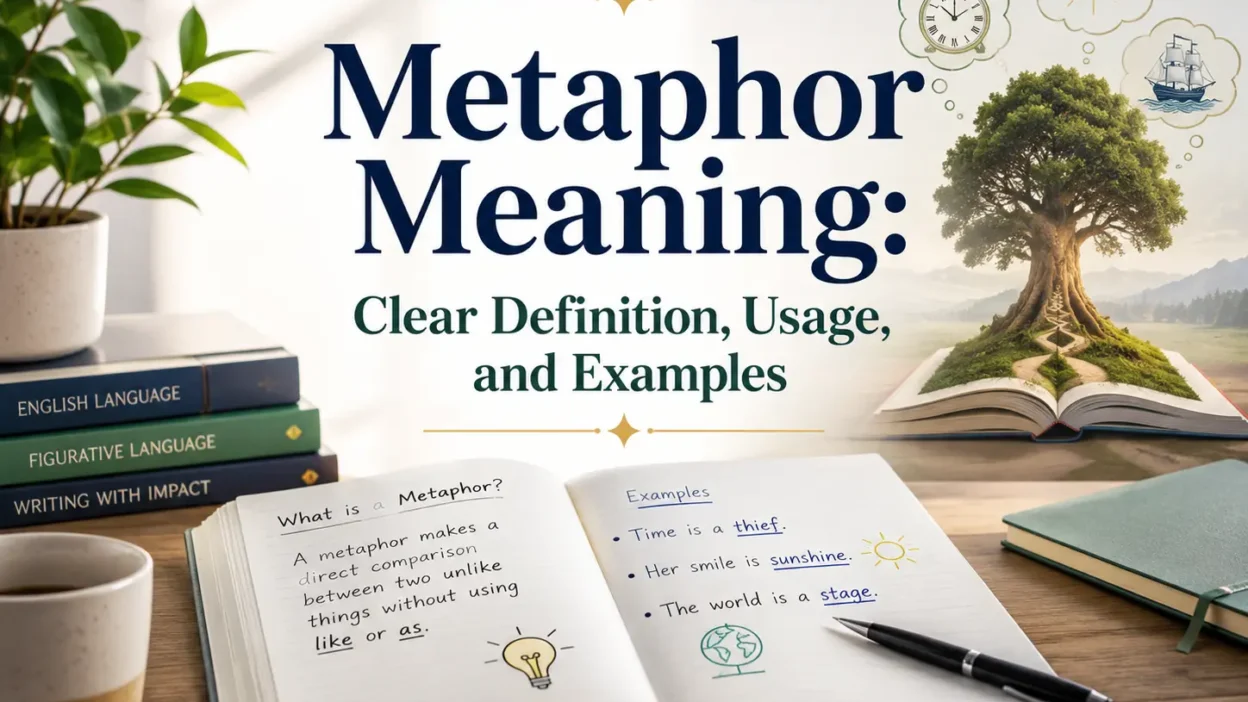
A metaphor is a figure of speech that describes one thing as another thing to show a shared quality. It is usually not meant literally. Instead, it helps make an idea clearer, stronger, or more memorable.
You may see metaphors in poems, songs, books, ads, speeches, movies, school lessons, and everyday conversation. For example, when someone says, “My room is a disaster,” they usually do not mean a real disaster happened. They mean the room is extremely messy. Cambridge defines a metaphor as an expression that describes a person or object by referring to something with similar characteristics.
This guide explains metaphor meaning in plain English. You will learn how metaphors work, how to use them, how they differ from similes, and how to avoid common mistakes.
Quick Answer
Metaphor meaning refers to a figure of speech that describes one thing as another thing to show a shared quality. A metaphor is usually figurative, not literal. It helps make an idea clearer, stronger, or more vivid.
TL;DR
- A metaphor makes a direct comparison.
- It usually does not use like or as.
- It is usually not literal.
- It can make writing more vivid.
- It is common in speech, literature, songs, and essays.
- “Time is money” is a metaphor.
What Does Metaphor Mean?
A metaphor means using one thing to describe another thing. The two things are usually different, but they share one important quality.
For example:
- “Her voice was music.”
This does not mean her voice became actual music. It means her voice sounded beautiful, pleasant, or soothing.
A metaphor helps readers or listeners understand an idea quickly. It turns an abstract thought into a clear image.
Examples:
- “The classroom was a zoo.”
Meaning: The classroom was noisy and chaotic. - “He is a rock during hard times.”
Meaning: He is strong and dependable. - “The idea was a spark.”
Meaning: The idea started something bigger.
Merriam-Webster defines metaphor as a figure of speech in which a word or phrase for one object or idea is used in place of another to suggest likeness or analogy.
Metaphor Definition In Plain English
A metaphor is a figure of speech that says one thing is another thing. It does this to show a similarity between them.
The key point is that a metaphor is figurative, not literal. It creates meaning through comparison.
Simple formula:
- Thing A is Thing B.
- Thing A has a quality like Thing B.
- The sentence makes that quality easier to feel or understand.
Example:
- “Her mind is a garden.”
This does not mean her mind has soil and flowers. It may mean her mind is full of growth, beauty, ideas, or care.
A strong metaphor should make sense in context. If the comparison is too strange or unclear, the reader may feel confused.
Pronunciation And Part Of Speech
Metaphor is pronounced:
MET-uh-for
The first syllable gets the strongest stress. Cambridge gives the US pronunciation as /ˈmet̬.ə.fɔːr/.
Metaphor is a noun. It names a type of figurative expression.
Examples:
- “That sentence uses a metaphor.”
- “The poem is built around a powerful metaphor.”
- “The storm is a metaphor for anger in the story.”
Related forms include:
- metaphorical — adjective
- metaphorically — adverb
Examples:
- “The phrase has a metaphorical meaning.”
- “She was speaking metaphorically, not literally.”
How A Metaphor Works
A metaphor works by carrying meaning from one idea to another. It asks the reader to notice a shared quality.
Take this sentence:
- “His words were knives.”
The words were not real knives. Still, the image tells us that the words were sharp, painful, or cruel.
A metaphor often has three parts:
| Part | Example From “His Words Were Knives” |
|---|---|
| Real subject | words |
| Image | knives |
| Shared quality | sharpness, pain, harm |
Metaphors are useful because they can explain feelings quickly.
Plain sentence:
- “I felt trapped and overwhelmed by homework.”
Metaphor:
- “I was drowning in homework.”
The metaphor makes the feeling easier to imagine.
How To Identify A Metaphor
To identify a metaphor, ask three questions:
- Does the sentence describe one thing as another thing?
- Is the meaning figurative instead of literal?
- Do the two things share a quality?
Example:
- “The test was a nightmare.”
Question: Was the test literally a nightmare during sleep?
Answer: No.
Meaning: The test was stressful, difficult, or unpleasant.
That makes it a metaphor.
More examples:
- “My backpack is a black hole.”
- “Her smile was sunshine.”
- “The city is a jungle.”
- “His heart is stone.”
Each sentence describes one thing as another to create a stronger image.
How To Use A Metaphor Correctly
Use a metaphor when you want a sentence to feel stronger, clearer, or more memorable.
A good metaphor should:
- fit the subject
- match the mood
- be easy to understand
- show a clear shared quality
- avoid confusing the reader
Clear example:
- “The project was a mountain.”
Meaning: The project felt large, difficult, or hard to climb.
Weak example:
- “The project was a sandwich.”
This comparison may confuse readers unless the context explains it.
Use metaphors in:
- essays
- stories
- speeches
- captions
- poems
- daily conversation
- school assignments
In formal writing, use metaphors carefully. One clear image is usually stronger than several images at once.
Better:
- “The budget gap became a warning light for the company.”
Too much:
- “The budget gap became a warning light, a storm cloud, and a ticking clock.”
The second version has too many images competing for attention.
Common Metaphor Examples
Metaphors are common in everyday English. Many people use them without thinking about the grammar name.
| Metaphor | Meaning |
| Time is money. | Time is valuable. |
| My teacher is a walking dictionary. | The teacher knows many words. |
| The internet is a window to the world. | It helps people see and learn many things. |
| Her smile was sunshine. | Her smile felt warm and cheerful. |
| The city is a jungle. | The city feels busy, wild, or hard to manage. |
| He has a heart of stone. | He seems cold or unkind. |
| The test was a nightmare. | The test was very stressful. |
| Hope is a light in the dark. | Hope helps during hard times. |
Notice that these sentences do not use like or as. They state the comparison directly.
Metaphor Vs Simile
A metaphor makes a direct comparison. A simile uses like or as.
Merriam-Webster explains that a simile often compares two unlike things using like or as, while a metaphor applies one thing to another to suggest similarity.
| Term | Example | How It Works |
| Metaphor | “The room was an oven.” | Says the room was an oven |
| Simile | “The room was like an oven.” | Compares the room to an oven using like |
| Metaphor | “Her voice was music.” | Says her voice was music |
| Simile | “Her voice was like music.” | Compares her voice to music using like |
Both create comparison. The difference is how direct the comparison sounds.
Metaphor Vs Symbol Vs Idiom
Metaphor is related to other language terms, but they are not the same.
| Term | Meaning | Example |
| Metaphor | Direct figurative comparison | “The classroom was a zoo.” |
| Simile | Comparison using like or as | “The classroom was like a zoo.” |
| Symbol | Object representing a larger idea | A dove can represent peace. |
| Idiom | Fixed phrase with a special meaning | “Break the ice” means make people comfortable. |
| Personification | Giving human qualities to nonhuman things | “The wind whispered.” |
A metaphor says one thing is another thing.
A symbol stands for a larger idea.
An idiom has a fixed meaning that may not be clear from the individual words.
Types Of Metaphors
Simple Metaphor
A simple metaphor makes one direct comparison.
Example:
- “Life is a journey.”
Meaning: Life has stages, changes, challenges, and destinations.
Extended Metaphor
An extended metaphor develops one comparison over several lines, sentences, or paragraphs.
Example:
- A poem may compare life to a road from beginning to end.
The same image continues for a longer section.
Implied Metaphor
An implied metaphor suggests a comparison without naming it directly.
Example:
- “He barked orders at the team.”
This compares the person to a dog without saying, “He was a dog.”
Dead Metaphor
A dead metaphor is so common that people may not notice the original image anymore.
Examples:
- “the foot of the mountain”
- “the hands of a clock”
- “the heart of the city”
These are still metaphorical, but they feel normal because they are familiar.
Common Mistakes With Metaphors
Taking A Metaphor Literally
If someone says, “I am buried in work,” they do not mean they are under a real pile of papers. They mean they have too much work.
Using An Unclear Comparison
Unclear:
- “Her plan was a purple chair.”
Clearer:
- “Her plan was a roadmap.”
The clearer version works because a roadmap suggests direction and planning.
Mixing Too Many Images
A mixed metaphor happens when two or more images clash.
Mixed:
- “We need to grab the bull by the horns and sail through the storm.”
Better:
- “We need to face the problem directly.”
The corrected version keeps the meaning clear.
Using Too Many Metaphors At Once
Too many metaphors can make writing feel crowded.
Too much:
- “Her idea was a spark, a seed, a bridge, and a key.”
Better:
- “Her idea was a spark that started the project.”
Overusing Familiar Metaphors
Phrases like heart of gold, time is money, and life is a journey are easy to understand. They are not wrong, but they may feel familiar.
For more original writing, try a fresher image.
Common:
- “He has a heart of gold.”
Fresher:
- “His kindness showed up quietly, like a light left on for others.”
When To Use A Metaphor
Use a metaphor when you want to:
- make an idea vivid
- explain a feeling
- add emotion
- make writing memorable
- help readers picture something
- show a theme in a story or poem
Good uses:
- “Fear was a shadow behind every choice.”
- “The classroom was a zoo before the teacher arrived.”
- “Her words were a bridge between the two sides.”
A metaphor works best when it makes the meaning clearer, not harder.
When Not To Use A Metaphor
Avoid metaphors when:
- the topic needs exact technical language
- the comparison may confuse readers
- the metaphor sounds forced
- the situation is serious and needs direct wording
- you already used too many images
Not best:
- “The legal deadline is a dragon sleeping under the paperwork.”
Better:
- “The legal deadline is serious and should not be missed.”
Sometimes direct language is stronger.
FAQs
What is a metaphor in simple words?
A metaphor describes one thing as another thing to show a shared quality. For example, “The baby is an angel” means the baby seems sweet or innocent.
What is an example of a metaphor?
“Life is a journey” is a metaphor. It compares life to a journey because both can have stages, challenges, changes, and goals.
Is a metaphor literal or figurative?
A metaphor is usually figurative. It does not usually mean exactly what the words say. It creates meaning through comparison.
How do you identify a metaphor?
Look for a sentence that describes one thing as another thing. Then ask whether the sentence is meant literally. If it is not literal and shows a shared quality, it is likely a metaphor.
What is the difference between metaphor and simile?
A metaphor makes a direct comparison. A simile uses like or as. “Her voice was music” is a metaphor. “Her voice was like music” is a simile.
Can a metaphor use “is”?
Yes. Many simple metaphors use is, was, or are.
Examples:
- “Time is money.”
- “The room was an oven.”
- “His words are weapons.”
Can a metaphor be one word?
Yes, a metaphor can be very short. One word can carry metaphorical meaning in context. For example, calling a strong person “a rock” uses one image to describe dependability.
What is an extended metaphor?
An extended metaphor is a metaphor developed over several lines, sentences, or paragraphs. Writers use it when one comparison shapes a larger part of a poem, story, speech, or essay.
Why do writers use metaphors?
Writers use metaphors to make ideas clearer, stronger, more emotional, and more memorable. A metaphor can turn an ordinary sentence into a vivid image.
Mini Quiz
Choose the best answer.
1. Which sentence uses a metaphor?
A. The room was like an oven.
B. The room was an oven.
C. The room was very hot.
2. What does “She is a rock” usually mean?
A. She is made of stone.
B. She is strong and dependable.
C. She is hard to move.
3. Which word often appears in a simile, not a metaphor?
A. like
B. is
C. was
4. Is “My backpack is a black hole” literal or figurative?
A. Literal
B. Figurative
C. Both always
Answer Key:
- B
- B
- A
- B
Conclusion
Metaphor meaning is simple once you remember the main idea: one thing is described as another thing to show a shared quality.
Use metaphors to make writing clearer, stronger, and more vivid. Start with simple examples like “The room was an oven” or “Hope is a light,” then practice writing your own. A strong metaphor does not just decorate a sentence. It helps readers understand and feel the idea.