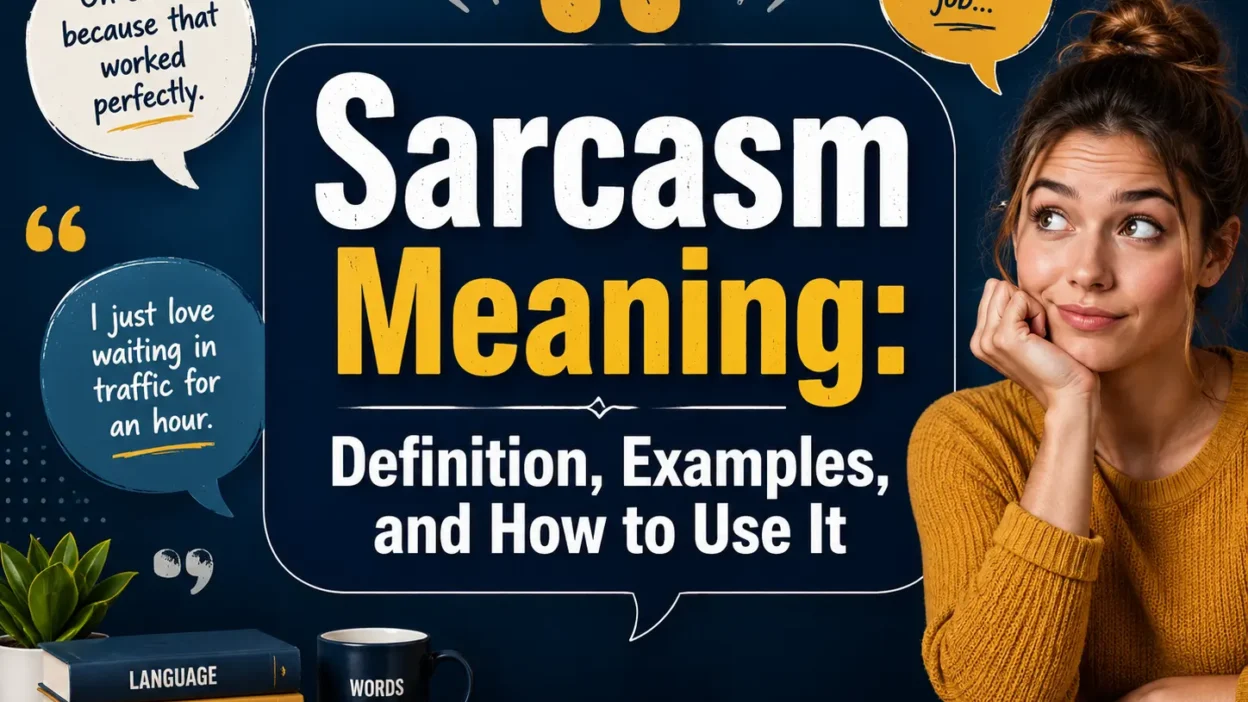
You’ve probably heard someone say “Oh, great, another Monday” in a flat, unimpressed voice. That’s sarcasm. It shows up in everyday conversation, TV shows, texts, and social media comments. People use it to joke, complain, or gently poke fun at something.
This guide breaks down what sarcasm really means, how it works, and how it’s different from irony. You’ll also see real examples, common mistakes, and quick answers to the questions people ask most.
Quick Answer
Sarcasm meaning, in simple terms, is saying the opposite of what you truly mean, usually in a mocking or joking tone. It’s used to criticize, tease, or express annoyance in a way meant to be understood as insincere.
TL;DR
- Sarcasm means saying the opposite of what you mean, often to mock or tease
- Tone of voice or context signals that it’s not literal
- It’s closely related to irony but usually sharper or more pointed
- Common in casual speech, texting, and online comments
- Written sarcasm can be marked with “/s” to avoid confusion
- Overusing it can come across as unkind
What It Means
At its core, sarcasm is the use of words that mean the opposite of what one intends to say, often to insult, show irritation, or be funny. Someone might say “Nice job” after a mistake, but their tone makes clear they mean the opposite. Cambridge Dictionary
Dictionaries describe it as remarks that clearly mean the opposite of what they say, made in order to hurt or criticize in a humorous way. So sarcasm isn’t just irony. It usually carries an edge. Dictionary.com
Part of Speech
“Sarcasm” is a noun. It names the concept or style of speech itself, not an action or description.
- Noun: “His reply was full of sarcasm.”
- Related adjective: “sarcastic” (“a sarcastic comment”)
- Related adverb: “sarcastically” (“she said it sarcastically”)
There’s no verb form. You don’t “sarcasm” someone; you speak sarcastically or use sarcasm.
Pronunciation
Sarcasm is pronounced SAR-kaz-um (three syllables, stress on the first). A common mix-up is dropping the middle syllable and saying “SAR-kzum.” Slowing down on the “kaz” part helps it come out clearly.
How It Works
Sarcasm relies on a gap between the literal words and the real meaning. That gap is usually signaled by:
- Tone of voice — flat, exaggerated, or slow delivery
- Facial expression — a raised eyebrow or smirk
- Context — the situation makes the literal meaning obviously false
- Timing — a pause before or after the remark
Because so much depends on tone, sarcasm can be tricky in writing, where these cues are missing.
Common Contexts
People use sarcasm in:
- Everyday conversation, especially among friends
- TV and movies, for comic characters or dry humor
- Text messages and social media, often marked with “/s”
- Workplace banter, though it can backfire in professional settings
When to Use It
Sarcasm works best with people who know you well and will catch the tone. It’s common between friends, in casual writing, or in comedy.
When Not to Use It
Avoid sarcasm with strangers, in formal writing, or in situations where tone could be misread, like emails or customer service messages. It’s also risky across cultures or languages, since sarcasm doesn’t always translate well.
Common mistake: Using sarcasm in a text without any signal, then getting upset when it’s taken literally.
Fix: Add context, a joking word, or the tag “/s” so the tone is clear.
Examples
- After someone spills coffee everywhere: “Smooth move.”
- When it’s freezing outside: “Wow, love this warm weather.”
- Replying to an obvious statement: “Really? I had no idea.”
- On a rough day: “This is exactly how I wanted my morning to go.”
Origin
The word traces back to the Greek verb sarkazein, which meant “to tear flesh”. That biting, cutting image carried over into the modern sense of sharp, mocking speech. The related word “sarcastic” didn’t appear in English until 1695, well after “sarcasm” itself was already in use. Vocabulary.comEncyclopedia Britannica
Related Terms and Common Confusions
| Context | Best Choice | Why |
|---|---|---|
| Mocking or insulting someone through opposite meaning | Sarcasm | Has a pointed, often unkind edge |
| Situation or statement contradicting expectations | Irony | Broader, not necessarily mocking |
| Exposing flaws in people or institutions through humor | Satire | Often political or social commentary |
Sarcasm is a form of expression, not a situation, so it’s something a person does, not something that just happens. Irony, by contrast, can exist without anyone intending it. Grammar.com
Synonyms and Antonyms
Synonyms: irony (close, though less pointed), mockery, derision, sneering, cynicism
Antonyms: sincerity, earnestness — there’s no exact one-word opposite, but these capture the idea of speaking plainly and meaning what you say.
Mini Quiz
- What does sarcasm usually rely on to be understood? (tone/context)
- True or false: sarcasm and irony always mean the same thing.
- What Greek word does “sarcasm” come from?
- Give one example of a sarcastic remark about bad weather.
- What symbol is often used to mark sarcasm in texting?
Answer key: 1) tone of voice and context; 2) false; 3) sarkazein; 4) any opposite-meaning weather comment (“lovely weather” during a storm); 5) /s
FAQs
What is the true meaning of sarcasm?
It means saying something but intending the opposite, usually to mock, criticize, or joke.
What is an example of sarcasm?
Saying “Oh fantastic” after something goes wrong is a classic example.
Is sarcasm a form of irony?
Yes. Sarcasm is an ironic remark meant to mock by saying something different from what the speaker really means. Columbia Journalism Review
What is the difference between sarcasm and irony?
Irony can apply to situations and isn’t necessarily mocking. Sarcasm is spoken with intent to mock or criticize.
How do you know if someone is being sarcastic?
Watch for a flat or exaggerated tone, an odd pause, or a statement that clearly contradicts the situation.
What does “/s” mean in texting?
It’s a tag people add after a sentence to flag that the line was sarcastic, since tone doesn’t come through in text.
Is sarcasm rude or a form of humor?
It can be either. Light sarcasm among friends often reads as humor, but the same words can feel rude in the wrong setting.
Conclusion
Sarcasm meaning boils down to saying one thing while meaning another, usually with a mocking or teasing edge. Once you can spot the tone and context behind it, sarcasm becomes easy to recognize and use well. Try noticing it the next time someone answers an obvious question with “Really? I had no idea.”