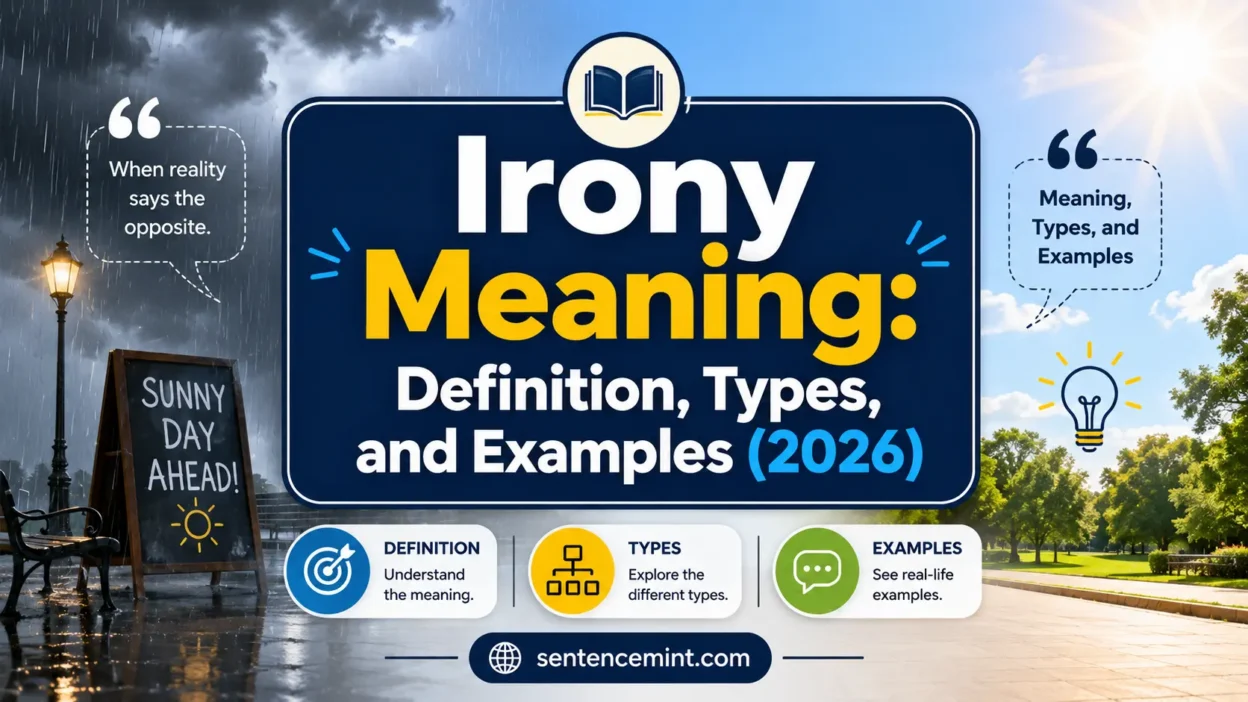
You hear the word “irony” in movies, songs, and everyday conversation. Someone spills coffee on a “wrinkle-free” shirt and calls it ironic. A rainstorm hits on a sunny-day picnic, and someone jokes about the irony.
But irony has a precise meaning, and it is often used loosely. This guide breaks down what irony actually means, the different types you will run into, and how to use the word correctly. You will also see common mixups, like confusing irony with coincidence or sarcasm.
Quick Answer
Irony is a contrast between what is expected and what actually happens, or between what someone says and what they really mean. It shows up in speech as verbal irony and in real-life or story events as situational and dramatic irony.
TL;DR
- Irony means a gap between expectation and reality, or between words and true meaning.
- The three main types are verbal, situational, and dramatic irony.
- Irony is not the same as coincidence, though the two are often confused.
- Sarcasm is a sharp, biting form of verbal irony.
- Irony works as a noun; “ironic” is the matching adjective.
- The word traces back to a Greek term for a person who hides their true meaning.
What Irony Means
At its core, irony describes a mismatch. Something is said, expected, or set up one way, but the outcome or true meaning goes the other direction. Major dictionaries generally describe irony in two related senses: using words to mean the opposite of what they literally say, and a situation that turns out opposite to what was expected.
A simple example: someone steps outside during a downpour and says, “Lovely weather we’re having.” The words say one thing; the speaker means the opposite. That is irony in action.
Part of Speech
“Irony” is a noun. It names a concept or quality, as in “the irony of the situation” or “she spoke with irony.”
The related adjective is “ironic,” used to describe something that displays irony, as in “an ironic twist” or “an ironic comment.” There is no common verb form; people typically say something “is ironic” rather than that someone “ironizes.”
The Three Main Types of Irony
Most teachers and writing guides group irony into three core categories. A few also mention two extra, less common subtypes.
Verbal Irony
Verbal irony happens when someone says one thing but means another, usually the opposite. It is intentional. If a friend fails a test and says, “Well, that went great,” they are using verbal irony.
Verbal irony often shows up as:
- Understatement — calling a disaster “a bit of a mess”
- Overstatement — calling a light drizzle “a monsoon”
Situational Irony
Situational irony occurs when the actual outcome of an event is the opposite of what was expected, and neither the audience nor the people involved saw it coming. A fire station burning down is a classic example. Both the people involved and any onlookers are equally surprised.
Dramatic Irony
Dramatic irony happens in stories, films, or plays when the audience knows something important that a character does not. This creates tension, because the reader or viewer waits to see when and how the character will find out the truth.
Less Common Types
Some guides also mention:
- Cosmic irony — a severe form of situational irony where fate or the universe seems to work against someone, often in tragic ways.
- Socratic irony — when someone pretends not to know something to draw out another person’s flawed reasoning, named after the philosopher Socrates.
How to Use It
Use “irony” or “ironic” when there is a genuine contrast between expectation and reality, or between literal words and intended meaning. It fits naturally in sentences describing:
- A twist ending in a story
- A comment that means the opposite of what it says
- A situation where the outcome undercuts the original goal
Example: “It was ironic that the copy editor’s article was full of typos.”
When Not to Use It
Avoid calling something “ironic” simply because it is a coincidence, bad luck, or an unfortunate timing issue with no real contrast in meaning. Calling your friend right as they call you is a coincidence, not irony, since there is no reversed expectation built into the moment. This distinction is debated even among careful writers, but sticking to it will make your writing more precise.
Common Contexts
You will see “irony” and “ironic” used in:
- Literature classes, discussing plot devices and character speech
- Film and TV reviews, describing twist endings or dark humor
- Everyday conversation, often loosely, to describe odd coincidences
- Journalism and commentary, pointing out contradictions in events or policy
Irony vs. Sarcasm vs. Satire
These three words get mixed up often, but they are not interchangeable.
| Context | Best Choice | Why |
|---|---|---|
| Saying the opposite of what you mean, gently or humorously | Irony | Focuses on the contrast between words and meaning |
| Saying the opposite of what you mean, with a harsh or mocking edge | Sarcasm | Sarcasm is delivered to cut or mock, often through tone of voice |
| A larger work that mocks people, institutions, or ideas | Satire | Satire is a genre or technique, often using irony as one tool |
Sarcasm always involves speech and intends to needle someone. Irony can appear in speech or in real events, and it does not have to be unkind. Satire is broader still, often a full piece of writing or media built around ridicule.
Origin
The word traces back to the Greek “eirōneia,” related to “eirōn,” meaning someone who plays down or hides their true intent. It passed through Latin and French before entering English in the early 1500s. Early uses centered on the idea of saying less than you mean, or pretending to know less than you do, which is close to today’s verbal irony.
Related Terms
- Paradox — a statement that seems to contradict itself but may hold truth
- Coincidence — an unplanned, unexpected event, without the built-in reversal that defines irony
- Sarcasm — a cutting, mocking form of verbal irony
- Satire — a technique or genre using irony and exaggeration to critique
Synonyms and Antonyms
Close synonyms include sarcasm (in speech, though harsher), and incongruity (for the situational sense). There is no single, exact antonym for irony. Words like “sincerity” or “literalness” describe the opposite of verbal irony, since they mean saying exactly what you intend.
Common Mistakes
Mistake: Calling any bad luck “ironic.” Correction: Reserve “ironic” for situations with a genuine reversed expectation, not just misfortune.
Mistake: Confusing irony with sarcasm. Correction: Sarcasm is a sharp, often unkind form of verbal irony. Not all irony is sarcastic.
Mini Quiz
- A fire station burns down. What type of irony is this?
- A character in a play walks into a trap the audience already knows about. What type of irony is this?
- Someone says “Nice job” to a friend who just made a mistake. What type of irony is this?
- True or false: Coincidence and irony always mean the same thing.
- What part of speech is “irony”?
Answer Key: 1. Situational irony 2. Dramatic irony 3. Verbal irony 4. False 5. Noun
FAQs
What does irony mean in simple terms? Irony means a gap between what is expected or said and what actually happens or is meant. It often creates humor, tension, or a sense of contradiction.
What are the three types of irony? The three main types are verbal irony (saying the opposite of what you mean), situational irony (an outcome opposite to what was expected), and dramatic irony (the audience knows something a character does not).
Is irony the same as coincidence? Not exactly. Irony involves a reversed expectation built into the situation, while coincidence is simply an unplanned event happening at a notable time. Many everyday uses of “ironic” actually describe coincidences.
Is irony always meant to be funny? No. Irony can be humorous, but it can also be tragic, bitter, or thought-provoking, especially in dramatic or cosmic irony.
What is the difference between irony and sarcasm? Sarcasm is a harsher, mocking form of verbal irony, usually aimed at a person. Irony is broader and does not require a cutting or mocking tone.
Can irony describe a situation as well as a statement? Yes. Situational and dramatic irony describe real or story events, not just spoken words.
Conclusion
Irony meaning boils down to one idea: a real contrast between expectation and reality, or between words and true intent. Once you can tell verbal, situational, and dramatic irony apart, spotting irony in books, movies, and daily life becomes much easier. Next time you notice a twist that flips expectations, you will know exactly what to call it.