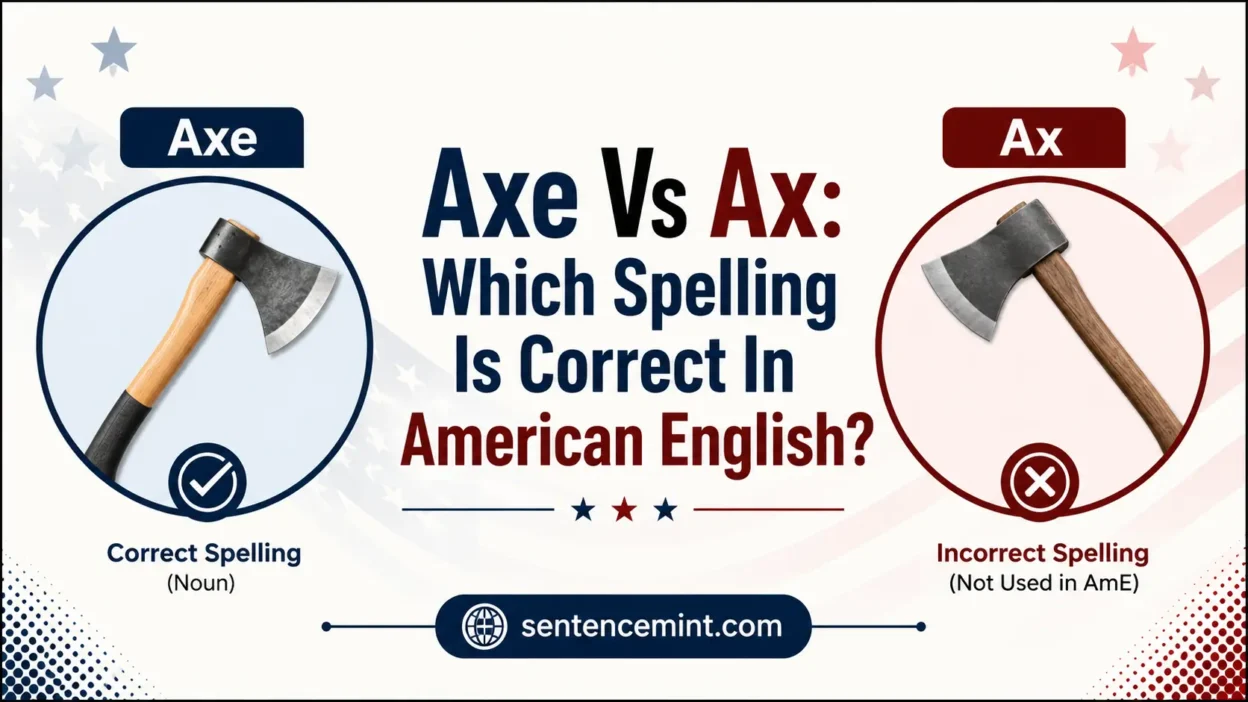
Many people wonder whether the correct spelling is axe or ax. The short answer is simple: both spellings are correct.
In American English, ax is often preferred in journalism, headlines, and simplified style systems. At the same time, axe remains fully accepted in the United States and is still widely used in books, branding, product names, and everyday writing.
The two spellings share the same meaning, pronunciation, and grammar. The difference mainly comes down to regional habits, house style, and personal preference.
Quick Answer
Both axe and ax are correct spellings of the same word.
- Ax is more common in shorter American style systems, including some newsroom and AP-style writing.
- Axe is the traditional spelling and remains common in both American and British English.
- Neither spelling changes the meaning or pronunciation.
If you are writing for a US audience, either form works as long as you stay consistent throughout the piece.
Why People Confuse Them
People often assume there must be one “correct” spelling because the words look noticeably different.
The confusion usually comes from three things:
- Many Americans grow up seeing ax in headlines and newspapers.
- British English more commonly uses axe.
- The extra “e” makes some readers think one spelling must be formal while the other is simplified.
In reality, modern dictionaries recognize both spellings as standard English.
Another reason for confusion is that many English spelling comparisons involve true regional differences, such as “color” vs “colour.” With axe and ax, however, the situation is more flexible because both forms appear in American English.
Key Differences At A Glance
| Context | Preferred Spelling | Why |
|---|---|---|
| US journalism and headlines | ax | Shorter style often preferred |
| General American writing | ax or axe | Both are accepted |
| British English | axe | More traditional and common |
| Product branding | depends on company | Branding choice varies |
| Academic or business writing | either | Consistency matters most |
| Outdoor and tool marketing | often axe | Traditional visual style |
Quick Comparison
| Feature | Axe | Ax |
| Meaning | Same | Same |
| Pronunciation | Same | Same |
| Accepted in US English | Yes | Yes |
| Common in UK English | Very common | Less common |
| Common in AP-style writing | Less common | More common |
| Style feel | Traditional | Simplified |
Are They The Same Word?
Yes. Axe and ax are two accepted spellings of the same word.
Both forms work as:
- a noun
- a verb
As a noun, the word refers to a cutting tool with a heavy blade.
Examples:
- He kept an ax in the truck during winter.
- She bought a camping axe before the hiking trip.
As a verb, the word means:
- to cut
- to remove
- to cancel
- to eliminate
Examples:
- The company decided to ax the project.
- Producers may axe the show after this season.
The pronunciation stays exactly the same regardless of spelling.
US Vs UK Preference
In British English, axe is generally the standard spelling.
In American English, the situation is more mixed.
Many US newspapers and style-focused publications prefer ax because American English has a long history of simplified spelling forms. That preference became especially visible in headlines, where shorter spellings save space.
However, axe is still extremely common in the United States. Many Americans use it naturally, and major US dictionaries fully recognize it.
This means:
- axe is not wrong in American English
- ax is not informal or incorrect
- both spellings are considered standard
The real deciding factor is usually publication style rather than grammar.
Which Spelling Should You Use?
The best spelling depends on your audience and writing style.
Use “Ax” If:
- you follow AP style or newsroom conventions
- you prefer shorter American spellings
- your publication already uses “ax”
- you want cleaner headline formatting
Use “Axe” If:
- you prefer traditional spelling
- you write for international readers
- your brand or publication already uses “axe”
- you work in outdoor, historical, or product-focused writing
For most writers, consistency matters more than the spelling itself.
Switching between forms inside the same article usually looks careless.
When One Spelling Looks Wrong
Readers often judge spelling based on familiarity rather than correctness.
Someone who regularly reads American newspapers may think axe looks overly formal or old-fashioned. Meanwhile, readers used to British English may think ax looks incomplete.
Neither reaction reflects an actual grammar rule.
The same pattern appears in related forms:
- axed
- axing
- axe handle
- fire ax
- battle-axe
Some compound terms developed strong spelling traditions over time. For example, “battle-axe” appears more often with the traditional spelling, while “get the ax” commonly appears in American idioms and headlines.
Common Mistakes
Mixing Spellings In The Same Piece
Incorrect:
- He grabbed an ax and sharpened the axe.
Better:
- He grabbed an ax and sharpened the ax.
- He grabbed an axe and sharpened the axe.
Assuming One Spelling Is Wrong
Incorrect idea:
- “Axe” is British, so Americans should never use it.
Correct:
- Americans regularly use both spellings.
Using Awkward Verb Forms
Many writers hesitate with forms like:
- axed
- axing
These are fully accepted in American English.
Writers using “axe” usually choose:
- axed
- axing
The form “axeing” is uncommon and usually avoided.
Everyday Examples
These examples reflect natural modern usage in American English.
- We keep an ax in the garage for storm cleanup.
- The camper used an axe to split firewood.
- The network decided to ax the series after two seasons.
- She bought a lightweight camping axe online.
- The city plans to ax several outdated programs.
- A firefighter carried the fire ax into the building.
- The editor axed three unnecessary paragraphs.
- He displayed an antique axe above the fireplace.
Dictionary-Style Word Details
Verb
axe
To cut, remove, cancel, or eliminate something.
ax
The same verb with a shorter spelling commonly seen in American writing.
Examples:
- The company axed several positions.
- Executives may ax the proposal next month.
Noun
axe
A tool with a heavy blade attached to a handle for chopping or cutting.
ax
The same noun spelled differently.
Examples:
- He sharpened the ax before camping season.
- The old axe belonged to his grandfather.
Synonyms
Tool-Related Synonyms
- hatchet
- splitter
- chopping tool
- cutting tool
Verb-Related Synonyms
- remove
- cancel
- eliminate
- cut
- terminate
Example Sentences
With “Axe”
- She carried an axe during the forest tour.
- The studio may axe the movie sequel.
- A new survival brand launched a premium camping axe.
With “Ax”
- The firefighter grabbed the ax immediately.
- The magazine decided to ax the section.
- Reporters expected the network to ax the late-night show.
Word History
The older traditional spelling was axe, which appeared in English for centuries.
The shorter spelling ax became more popular during spelling-simplification movements connected to American publishing and editorial style. Over time, both forms remained accepted in US English.
That is why modern dictionaries continue to list both spellings as correct rather than replacing one entirely.
Phrases Containing
Common phrases and compounds include:
- get the ax
- battle-axe
- ax murderer
- fire ax
- axe handle
- pickaxe
- grind an ax
- guitar axe
Some phrases lean toward one spelling because of publishing tradition or long-term usage patterns rather than grammar rules.
FAQs
Is axe or ax correct in American English?
Both “axe” and “ax” are correct in American English. However, “ax” is more commonly used in modern US style guides, while “axe” is also fully accepted.
What is the difference between axe and ax?
There is no difference in meaning or pronunciation. Both words refer to the same tool or verb. The only difference is spelling preference.
Which spelling is more common in the US: axe or ax?
In American English, “ax” is slightly more common in newspapers, headlines, and simplified writing styles. “Axe” is still widely used in general writing and dictionaries.
Is axe British and ax American?
Not exactly. “Axe” is more traditional and commonly used in British English, while “ax” is often preferred in American English. But both spellings are accepted in both regions.
Is ax a correct spelling or a mistake?
“Ax” is a correct and accepted spelling in American English. It is not a mistake, even though “axe” is also widely used.
Why are there two spellings: axe and ax?
The difference comes from historical spelling simplification in American English. Over time, some writers dropped the “e” to create a shorter form, but both versions remained in use.
Do axe and ax have different meanings?
No. Both spellings mean the same thing:
- a cutting tool used for chopping wood
- a verb meaning to remove, cancel, or eliminate something
Is axe or ax used in formal writing?
Both can appear in formal writing, but consistency matters more than choice. Many style guides prefer “ax” for simplicity, while others allow “axe.”
Can axe and ax be used as verbs?
Yes. Both can be used as verbs:
- The company decided to ax/axe the project.
- They may ax/axe the program next year.
How do I remember which spelling to use?
A simple rule:
- Use “ax” for American-style simplified writing
- Use “axe” if you prefer traditional spelling
Just stay consistent within the same text.
Conclusion
Both axe and ax are correct spellings in modern English.
In the United States, ax often appears in journalism and simplified style systems, while axe remains fully accepted and widely used across books, brands, tools, and everyday writing.
There is no difference in meaning or pronunciation. The best choice usually depends on audience, style guide, and consistency.
If you write for American readers, you can confidently use either spelling as long as you stick with one form throughout your piece.