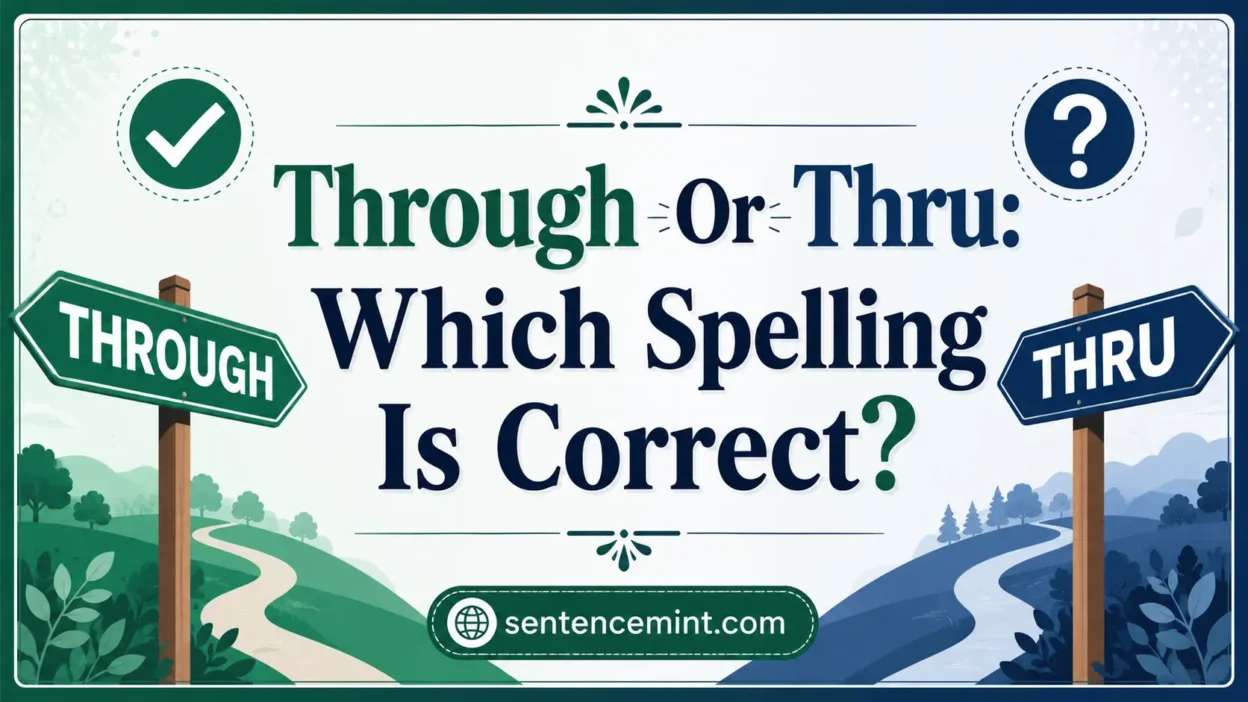
The words “through” and “thru” mean the same thing, but they are not used in the same way.
One is the standard spelling used in formal writing. The other is a shortened informal version often seen in signs, branding, and casual messaging.
Understanding when to use each depends on context, not meaning.
Quick Answer
✅ Through = standard spelling (US and UK English)
⚠️ Thru = informal abbreviation used mainly in signage and casual contexts
Examples:
- I walked through the park.
- Drive thru coffee shop (signage style)
If you are unsure, always choose through.
Why People Confuse Them
People often see “thru” on everyday signs like:
- “Drive Thru”
- “Walk Thru Entrance”
Because of this exposure, it starts to feel like a normal spelling. Since both words sound identical, many writers assume the shorter version is acceptable everywhere.
But in formal writing, English still uses the full spelling: through.
Key Differences At A Glance
| Context | Best Choice | Why |
|---|---|---|
| Essays & academic writing | through | Standard spelling required |
| Business emails | through | Professional clarity |
| Road signs & branding | thru | Space-saving style |
| Apps & UI labels | thru / through | Depends on brand tone |
| Casual texting | thru or through | Both understood |
| Feature | through | thru |
|---|---|---|
| Standard English | Yes | No |
| Formal writing | Required | Not recommended |
| Signage use | Rare | Common |
| Meaning | Same | Same |
Are They The Same Word?
Yes.
Both “through” and “thru” express:
- movement from one side to another
- completion of an action
- continuation until an end point
Examples:
- She walked through the door.
- She walked thru the drive-thru.
The meaning does not change. Only spelling and formality change.
US Vs UK Preference
Both American and British English use:
✅ through
There is no standard British use of “thru” in formal writing.
However, “thru” appears mainly in American informal contexts, especially:
- fast-food branding
- road signage
- casual messaging
This is more about style than grammar rules.
Which Spelling Should You Use?
Use through in:
- school essays
- professional writing
- emails
- reports
- published content
Use thru only when:
- matching signage (Drive Thru)
- writing casual messages
- following brand style choices
If you are unsure:
➡️ choose through
When One Spelling Looks Wrong
Using “thru” in formal writing can look unprofessional or incorrect.
Example:
- ❌ I read thru the document carefully.
- ✅ I read through the document carefully.
On the other hand, using “through” on a fast-food sign may feel visually too long for branding design.
Context determines what looks appropriate.
Common Mistakes
Mistake 1: Using “thru” in essays
❌ She walked thru the tunnel.
✅ She walked through the tunnel.
Mistake 2: Treating “thru” as a standard spelling
❌ Thinking it is always correct
✅ It is only informal or branding-based
Mistake 3: Overusing “thru” in professional writing
❌ Please go thru the report
✅ Please go through the report
Quick Memory Rule
- through = safe for all writing
- thru = only for signs or casual use
Everyday Examples
- I read through the entire article.
- The team worked through the night.
- Go through the instructions carefully.
- Drive Thru Coffee is open 24 hours.
- Please walk through the gate.
- Order thru the app (informal branding style)
Dictionary-Style Word Details
Verb
through
Used in phrasal verbs and expressions like:
- go through
- look through
- break through
Example:
- She went through the documents carefully.
thru
Informal spelling of the same usage, mainly in signage.
Example:
- Drive thru service is open.
Noun
Neither “through” nor “thru” commonly functions as a noun in standard English.
Synonyms
Context-based alternatives:
- via
- across
- throughout
- from one side to another
(Note: These depend on sentence structure, not direct replacements.)
Example Sentences
- She walked through the building slowly.
- The package went through customs quickly.
- The system processes orders through the app.
- Drive thru service is available 24/7.
- He looked through the window.
Word History
Through comes from Old English and has been used in its full form for centuries in formal writing.
Thru developed later as a shortened form used for:
- signage space-saving
- branding efficiency
- informal communication
It became especially common in American commercial contexts.
Phrases Containing
Through:
- go through
- break through
- see through
- push through
Thru:
- drive thru
- walk thru
- cash thru (branding variation)
FAQs
Is “thru” correct English?
“Thru” is not considered standard English in formal writing. It is mainly used informally, especially in signs like “drive thru” or casual texting.
Which is correct: through or thru?
“Through” is the correct and standard spelling in both US and UK English. “Thru” is an informal variant used in limited contexts.
When should I use “thru” instead of “through”?
Use “thru” only in informal situations such as signage, branding (e.g., “drive thru”), or casual messages. In all formal writing, use “through.”
Is “thru” acceptable in school or professional writing?
No. In essays, reports, emails, and professional documents, “through” is the required standard form.
Do “through” and “thru” have different meanings?
No. Both words have the same meaning. The only difference is spelling style and formality.
Why do people use “thru”?
People use “thru” because it is shorter, quicker to type, and commonly seen on signs and informal online communication.
Is “thru” used in American English?
Yes, but only informally. American English still treats “through” as the correct standard spelling in formal contexts.
Can I use “thru” in texting?
Yes, “thru” is commonly used in casual texting and social media, but it is not recommended in formal communication.
Conclusion
“Through” is the correct and standard spelling in English.
“Thru” is an informal shortcut used mainly in signage, branding, and casual writing.
If you are writing for school, work, or publication, always choose through.