Many English learners grow up hearing corrections like, “Don’t say Can I go to the bathroom? Say May I go to the bathroom?” That advice explains why can vs may remains one of the most confusing comparisons in English.
These two modal verbs sometimes overlap, but they do not always mean the same thing. One often focuses on ability or capability. The other commonly expresses permission or possibility.
Understanding the difference helps make school writing, workplace communication, and everyday conversations clearer.
Examples:
- Can I leave early?
- May I leave early?
Those questions sound similar, but they can create slightly different tones.
Quick Answer
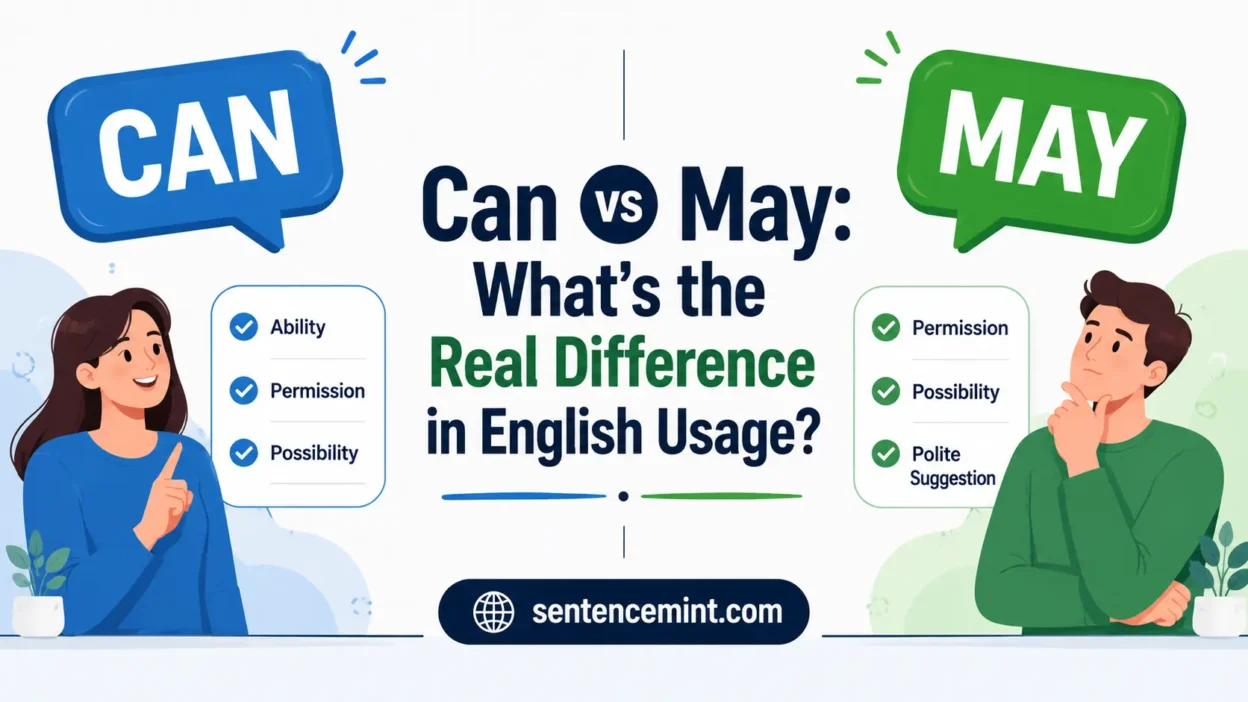
Can usually shows:
- ability
- capability
- informal permission
Example:
She can swim.
May usually shows:
- permission
- possibility
- a more formal or polite tone
Example:
May I ask a question?
They sometimes overlap, especially when asking permission, but they are not always interchangeable.
Why People Confuse Them
People confuse these words because both appear in permission questions.
Examples:
- Can I borrow your notebook?
- May I borrow your notebook?
Traditional classroom teaching often presents a simple rule:
- can = ability
- may = permission
Real American English is more flexible.
Modern speakers commonly use can when asking permission in casual conversation.
Another source of confusion is that both words are modal verbs, which means they help express ideas rather than acting as regular action verbs.
Key Differences At A Glance
| Context | Best Choice | Why |
|---|---|---|
| Talking about ability | can | Shows capability |
| Asking formal permission | may | Sounds more polite |
| Casual permission request | can | Common in everyday speech |
| Expressing possibility | may | Shows uncertainty |
| Describing what something is able to do | can | Shows function or capability |
| Feature | can | may |
|---|---|---|
| Main meaning | Ability or capability | Permission or possibility |
| Tone | Often casual | Often more formal |
| Permission use | Common in conversation | Common in polite settings |
| Possibility meaning | Limited | Common |
| Modal verb | Yes | Yes |
Meaning and Usage Difference
Can mainly expresses ability, capability, or informal permission.
Examples:
- I can drive.
- This software can open large files.
- Can I sit here?
Ability is usually the clearest signal.
If someone says:
She can speak Spanish.
The meaning is capability.
May commonly expresses permission or possibility.
Examples:
- May I leave early today?
- It may snow tonight.
In the first sentence, may asks permission.
In the second sentence, may shows possibility.
Overlap exists.
Both words sometimes work for permission:
- Can I use your charger?
- May I use your charger?
The second version sounds more polite or formal.
Tone, Context, and Formality
American English often uses can naturally in everyday speech.
Friend conversation:
Can I borrow your headphones?
Workplace example:
May I schedule a meeting for Friday?
School example:
May I ask a question?
Formal writing sometimes prefers may for permission requests.
That does not mean can is wrong.
Context matters.
Professional emails and polite requests often sound smoother with may.
Casual conversations often favor can.
Which One Should You Use?
Use this shortcut:
- Ability → can
- Capability → can
- Formal permission → may
- Possibility → may
- Everyday permission → often can
Examples:
She ___ finish the report today.
Correct answer:
can
___ I leave ten minutes early?
Formal workplace setting:
May
It ___ rain tomorrow.
Correct answer:
may
Always think about what the sentence means before choosing.
When One Choice Sounds Wrong
Sometimes changing the word creates awkward meaning.
Incorrect:
She may swim very fast.
Better:
She can swim very fast.
Why?
Swimming speed shows ability.
Incorrect:
The printer may print color pages.
Better:
The printer can print color pages.
Capability needs can.
Another example:
Very formal:
May I enter?
Casual conversation:
Can I come in?
Both can work, but tone changes.
Common Mistakes (and Quick Fixes)
Mistake:
❌ May she run five miles?
✅ Can she run five miles?
Reason:
Running ability uses can.
Mistake:
❌ Can I leave early, Professor?
Formal improvement:
✅ May I leave early, Professor?
Mistake:
❌ Thinking can never expresses permission.
Quick fix:
Modern American English commonly uses can for permission.
Mistake:
❌ Using may too often in casual speech.
Quick fix:
Choose wording that matches the situation.
Everyday Examples
School:
- Can you solve this problem?
- May I use the restroom?
Work:
- Can this app export spreadsheets?
- May I move our meeting to Thursday?
Home:
- Can you help me carry these bags?
- May we order pizza tonight?
Public situations:
- Can I sit here?
- It may rain before the game starts.
Conversation:
- She can play guitar.
- You may need a jacket tonight.
Dictionary-Style Word Details
Verb
TERM_A — can
Modal verb.
Used for:
- ability
- capability
- permission
- limited possibility situations
TERM_B — may
Modal verb.
Used for:
- permission
- possibility
- polite requests
Noun
TERM_A — can
Not commonly used as a noun in this comparison.
TERM_B — may
Partly applies as a month name, but not relevant to this usage comparison.
Synonyms
TERM_A — can
Closest plain alternatives:
- be able to
- have the ability to
TERM_B — may
Closest plain alternatives:
- be allowed to
- might
Exact replacement depends on context.
Example Sentences
TERM_A — can
- He can lift heavy boxes.
- This phone can record video.
TERM_B — may
- May I join the discussion?
- Traffic may slow down during storms.
Word History
TERM_A — can
Origin relates historically to knowledge and ability.
TERM_B — may
Older modal verb historically connected to power and permission.
Phrases Containing
TERM_A — can
- can do
- can’t help
TERM_B — may
- may I
- may well
To explore this in detail, check our guide on Shall vs Will: What’s the Difference and When to Use Each for a clear breakdown of future tense usage and formal vs informal differences.
FAQs
What is the difference between can and may?
Can usually shows ability, capability, or informal permission.
Examples:
- She can drive.
- Can I borrow your pencil?
May usually shows permission, possibility, or a more polite tone.
Examples:
- May I open the window?
- It may rain later.
Can can and may be used interchangeably?
Sometimes.
Both can express permission, but context matters.
Examples:
Casual:
✅ Can I leave early?
More formal:
✅ May I leave early?
However, they are not always interchangeable.
Correct:
✅ She can swim.
Incorrect:
❌ She may swim (if talking about ability)
Is “Can I go to the bathroom?” grammatically correct?
Yes.
Modern American English commonly uses can for permission in everyday conversation.
Teachers sometimes prefer “May I go to the bathroom?” because it sounds more formal.
Both are acceptable depending on context.
Why do teachers say use “may” instead of “can”?
Traditional grammar teaching often separates the words like this:
- can = ability
- may = permission
That guideline helps students learn the difference, but modern English allows more overlap.
Is may more polite than can?
Usually, yes.
Example:
Less formal:
Can I ask a question?
More polite or formal:
May I ask a question?
Professional settings sometimes favor may.
Can both words express permission?
Yes.
Examples:
✅ Can I borrow your charger?
✅ May I borrow your charger?
The second example usually sounds more formal.
Can may express possibility?
Yes.
Example:
✅ It may snow tonight.
Here, may means something is possible.
Can can express ability?
Yes.
Ability is one of its main uses.
Examples:
✅ He can cook.
✅ They can speak Spanish.
Is may outdated?
No.
People still use may, especially in:
- professional writing
- formal requests
- polite conversation
- possibility statements
Example:
✅ You may begin the test now.
Which is more common in everyday American English: can or may?
For permission in casual conversation, can is usually more common.
Example:
✅ Can I sit here?
For formal situations, many speakers choose may.
Example:
✅ May I join the meeting?
What is an easy trick to remember can vs may?
Try this shortcut:
- Ability or capability → can
- Permission or possibility → may
Examples:
She ___ run fast. → can
It ___ rain tonight. → may
Conclusion
Understanding can vs may becomes easier once you focus on meaning instead of memorizing strict rules.
Can usually emphasizes ability, capability, or casual permission.
May commonly emphasizes permission, possibility, or a more polite tone.
Modern English allows overlap in some situations, but context still matters.
A quick reminder:
- She can swim.
- May I leave early?
Choose based on meaning, and your writing will sound more natural and clear.