Many English writers mix up “complement” and “compliment” because the words sound almost the same. One small spelling change creates a completely different meaning.
In everyday writing, this confusion appears in emails, social posts, school assignments, and even business communication. For example:
• “Your shoes complement your outfit.”
• “Your friend complimented your outfit.”
The first sentence means the shoes match or improve the outfit. The second means someone gave praise.
Understanding complement or compliment becomes much easier once you know the core difference.
Quick Answer
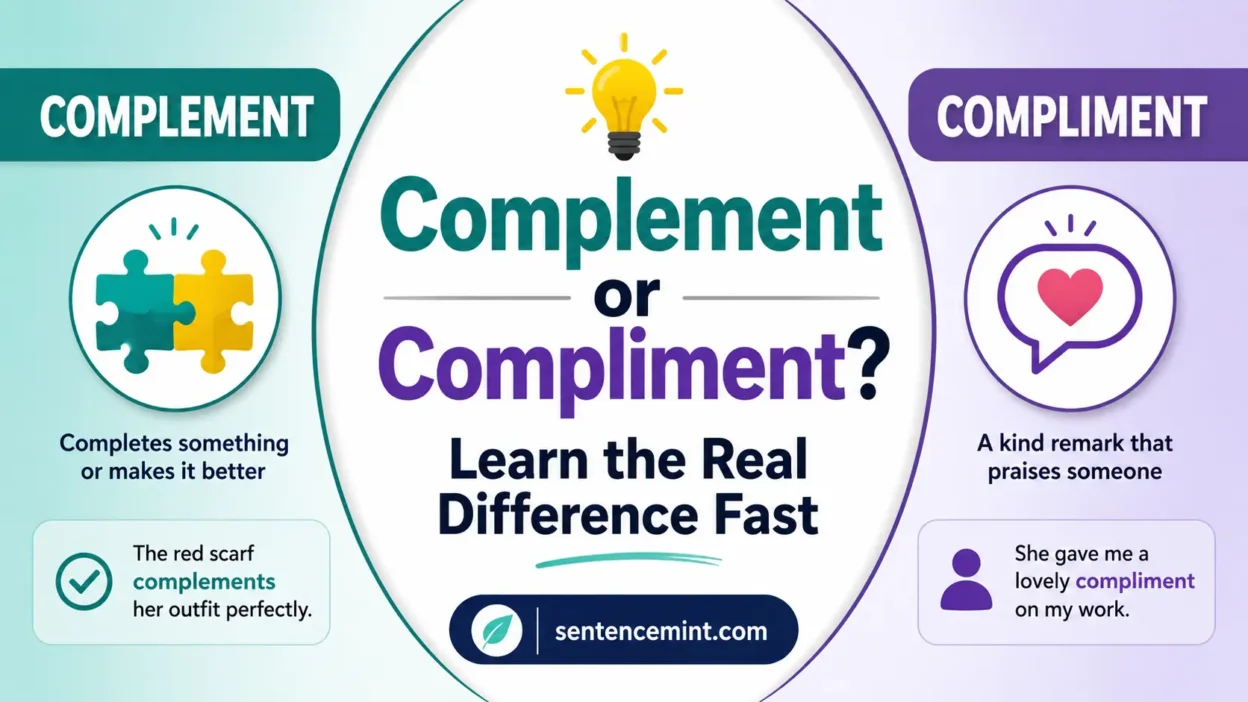
Use complement when something completes, improves, or matches something else well.
Use compliment when someone expresses praise or admiration.
Examples:
• “The sauce complements the pasta.”
• “She complimented my presentation.”
Quick memory trick:
• Compliment with an “i” relates to saying something nice.
• Complement with an “e” relates to enhancing or completing something.
They are not interchangeable.
Why People Confuse Them
The confusion mainly comes from pronunciation. In most American accents, “complement” and “compliment” sound nearly identical.
The spellings are also extremely close. Only one letter changes.
Fast typing, autocorrect, and casual online writing make the problem even more common. Someone may accidentally write:
• “Your shoes really compliment your suit.”
Even though the intended meaning is “match well,” not “praise.”
The words also share historical roots, which helps explain why they look and sound alike today. Still, their modern meanings are clearly different.
Key Differences At A Glance
| Context | Best Choice | Why |
|---|---|---|
| Matching colors | complement | Means enhance or go well together |
| Giving praise | compliment | Means admiration or approval |
| Food pairings | complement | Refers to improving another thing |
| Nice comment to a coworker | compliment | Refers to spoken or written praise |
| Grammar term | complement | Refers to a sentence structure role |
| Customer praise | compliment | Refers to positive feedback |
Quick Comparison
• Complement = complete, improve, match well
• Compliment = praise, admiration, polite approval
• Both can work as nouns and verbs
• They sound alike but mean different things
• Swapping them usually creates an obvious error
Meaning and Usage Difference
The word complement relates to completing, enhancing, or matching something successfully.
Examples:
• “The lighting complements the room design.”
• “Fresh herbs complement the soup.”
As a verb, it means “to improve” or “to pair well with.” As a noun, it can describe something that completes another thing.
In grammar, a complement also has a technical meaning. A subject complement, for example, gives more information about the subject.
Example:
• “The sky became dark.”
Here, “dark” functions as a subject complement.
The word compliment relates to praise or admiration.
Examples:
• “My manager complimented my report.”
• “That was a thoughtful compliment.”
As a verb, it means “to praise.” As a noun, it means a positive remark.
Even though the two words sound similar, their sentence patterns usually make the intended meaning clear.
Tone, Context, and Formality
Both words appear in formal and informal English.
Compliment commonly appears in conversations, customer service, emails, and workplace feedback.
Examples:
• “Thank you for the compliment.”
• “The client complimented our team’s work.”
Complement appears often in design, fashion, food, writing, business analysis, and grammar discussions.
Examples:
• “The gold frame complements the artwork.”
• “These features complement each other.”
Mistakes stand out strongly in professional writing because the meanings are so different.
Which One Should You Use?
Ask yourself one simple question:
Is the sentence about praise, or is it about matching/improving something?
If it is about praise, use compliment.
If it is about improving, completing, or pairing well, use complement.
Examples:
• “Your presentation complemented the report.”
• “Your boss complimented the presentation.”
Another quick check:
• People usually give compliments.
• Colors, flavors, and designs usually complement things.
When One Choice Sounds Wrong
Using the wrong word often creates an immediate meaning problem.
Incorrect:
• “The colors compliment the website.”
This sounds wrong because colors cannot praise a website.
Correct:
• “The colors complement the website.”
Another example:
Incorrect:
• “She complemented me on my speech.”
This sounds unnatural because the sentence is about praise, not enhancement.
Correct:
• “She complimented me on my speech.”
Readers usually notice the error quickly because the sentence meaning stops making sense.
Common Mistakes
Mistake:
• “Your tie really compliments your jacket.”
Quick fix:
• Use “complements” because the tie matches the jacket.
Mistake:
• “Thanks for the complement.”
Quick fix:
• Use “compliment” because someone gave praise.
Mistake:
• Confusing noun and verb forms.
Quick fix:
• Both words can be nouns and verbs, so focus on the meaning instead of only the grammar role.
Mistake:
• Relying only on spellcheck.
Quick fix:
• Read the sentence for meaning. Ask whether it involves praise or enhancement.
Everyday Examples
• “That scarf complements your coat perfectly.”
• “She gave me a compliment after the meeting.”
• “The music complements the mood of the movie.”
• “Our teacher complimented the class for working hard.”
• “The side dish complements the main course.”
• “He appreciated the compliment.”
• “These colors complement each other well.”
• “A customer complimented the restaurant staff.”
• “The soft lighting complements the room.”
• “Her skills complement the rest of the team.”
• “I received a compliment about my writing.”
• “The design complements the brand image.”
Dictionary-Style Word Details
Verb
• Complement: To complete, improve, enhance, or match well with something else. It can also appear in grammar-related usage.
• Compliment: To praise, admire, or express approval toward someone.
Noun
• Complement: Something that completes, improves, or fits well with another thing. In grammar, it may refer to a sentence element that completes meaning.
• Compliment: A statement of praise, admiration, or polite approval.
Synonyms
• Complement: Closest plain alternatives include enhance, complete, match, accompany.
• Compliment: Closest plain alternatives include praise, admiration, tribute, flattery.
Not every synonym works in every sentence.
Example Sentences
• Complement: “Fresh lemon complements grilled fish.”
• Complement: “The curtains complement the wall color.”
• Complement: “The adjective acts as a subject complement.”
• Compliment: “She complimented my writing skills.”
• Compliment: “He smiled after receiving the compliment.”
• Compliment: “Customers complimented the fast service.”
Word History
• Complement: Comes from Latin roots connected to completion and fulfillment.
• Compliment: Developed from language connected to courtesy, respect, and polite expression.
The words are historically related, which helps explain their similar spelling and pronunciation.
Phrases Containing
• Complement:
• complementary colors
• complement system
• subject complement
• Compliment:
• pay a compliment
• compliments of the chef
• receive a compliment
If you still find these words confusing, it helps to fully understand the difference between complement and compliment in real usage examples, which breaks down their meanings in a clearer, side-by-side way.
FAQs
Which is correct: “complement” or “compliment”?
Both are correct, but they mean different things.
- Complement = to complete, improve, or match well
- Compliment = praise or admiration
Example:
- “The wine complements the meal.”
- “She complimented my presentation.”
Can “complement” and “compliment” be interchangeable?
No. Swapping them usually changes the meaning completely.
Incorrect:
- “He complemented my haircut.”
Correct:
- “He complimented my haircut.”
How do you remember the difference?
A simple memory trick helps:
- Compliment has an “i” → think of “I like your work.”
- Complement has an “e” → think of “enhance” or “complete.”
The trick works best when combined with the real meanings.
Is “complement” used in grammar?
Yes. In grammar, a complement completes the meaning of a sentence.
Example:
- “She is happy.”
In this sentence, “happy” is a subject complement.
Can “compliment” be both a noun and a verb?
Yes.
As a noun:
- “That was a nice compliment.”
As a verb:
- “She complimented his cooking.”
Why do “complement” and “compliment” sound alike?
They are pronounced almost the same in modern American English, which is why many writers confuse them in emails, texts, and school writing.
Is this sentence correct: “Your shoes complement your outfit”?
Yes. Here, complement means the shoes match or improve the outfit’s appearance.
What does “compliments of the chef” mean?
It means the chef is offering something for free as a polite gesture or sign of appreciation.
Example:
- “Dessert was compliments of the chef.”
Which word should I use for praise?
Use compliment when talking about praise, admiration, or kind words.
Example:
- “Thanks for the compliment.”
Which word should I use for matching colors or design?
Use complement when things improve, balance, or match each other.
Example:
- “The blue curtains complement the wall color.”
Conclusion
The difference between complement or compliment becomes clear once you focus on meaning instead of spelling alone.
Complement relates to improving, matching, or completing something.
Compliment relates to praise and admiration.
For example:
• “The sauce complements the meal.”
• “The chef appreciated the compliment.”
A quick meaning check before you hit send can help you avoid one of the most common writing mix-ups in English.