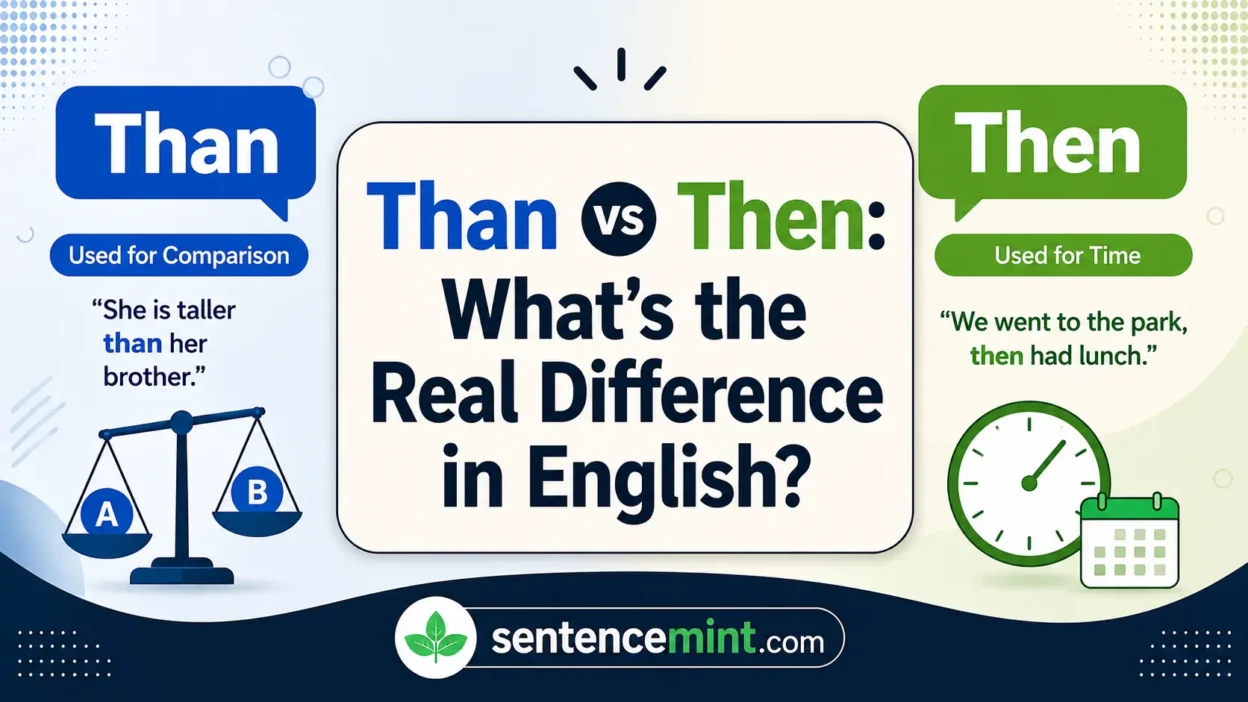
Many people confuse “than” and “then” because the words look alike and often sound similar in everyday speech. Even fluent English speakers sometimes type the wrong one by mistake.
Still, these words have very different jobs in a sentence.
“She is taller than me.”
“We ate dinner, then watched a movie.”
The first sentence compares two people. The second sentence shows time and sequence.
Understanding than vs then matters because the mistake is very noticeable in emails, school writing, work messages, and social media posts. Once you learn the difference, choosing the correct word becomes much easier.
Quick Answer
Use than for comparisons.
Use then for time, order, results, or what happens next.
Examples:
• “This movie is better than the first one.”
• “Finish your homework, then relax.”
A quick memory trick:
• Than goes with comparison words like “more,” “less,” and “better.”
• Then relates to time or sequence.
The words are not interchangeable in standard English, even though they sound similar in many American accents.
Why People Confuse Them
The confusion mostly comes from spelling and pronunciation. The words differ by only one letter, and in fast speech they can sound very close.
Typing speed also causes problems. Many people accidentally write:
• “more then”
instead of
• “more than”
Autocorrect does not always catch the mistake because both words are real English words.
Another reason is that both words often appear in short everyday sentences:
• “I’m taller than my brother.”
• “We went home, then we slept.”
Because the words appear so often, even small typing slips stand out quickly.
Key Differences At A Glance
| Context | Best Choice | Why |
|---|---|---|
| Comparing two things | than | Shows comparison |
| Talking about time | then | Refers to a moment or sequence |
| Giving next steps | then | Means “next” or “afterward” |
| Using “more” or “better” | than | Standard comparison structure |
| Logical result | then | Common in “if…then” patterns |
| Formal phrase “effect change” | then | Not related to comparison usage |
Quick Comparison Block
• Than = comparison
• Then = time, order, result
• “Better than” is correct
• “And then” is correct
• “Than” usually follows comparative words
• “Then” often starts or connects events
Meaning and Usage Difference
The real difference comes from grammar and sentence purpose.
“Than” mainly appears in comparisons.
Examples:
• “My laptop is faster than yours.”
• “She would rather walk than drive.”
• “This year feels busier than last year.”
In these examples, “than” connects two things being compared.
“Then” usually relates to time, order, or consequence.
Examples:
• “We ordered pizza, then watched a game.”
• “Back then, streaming services were new.”
• “If traffic gets worse, then we’ll leave early.”
“Then” can also help move a story forward or show the next step in a process.
Parts of speech matter here:
• “Than” mainly functions as a conjunction or preposition.
• “Then” is most commonly an adverb.
Pronunciation can also add confusion. In many American accents, the vowel sounds are close enough that listeners may not clearly hear the difference in casual speech.
Tone, Context, and Formality
Both words are completely standard in formal and informal English.
You will see them in:
• school essays
• business emails
• text messages
• news articles
• professional reports
Mistakes become especially noticeable in workplace writing.
For example:
Incorrect: “The new plan works better then the old one.”
Correct: “The new plan works better than the old one.”
Casual writing often creates typing mistakes:
• “I’ll call you then.”
• “This one costs less than that one.”
Spoken English may blur the pronunciation, but written English keeps the distinction very clear.
Which One Should You Use?
Ask yourself one simple question:
Am I comparing things, or am I talking about time/order?
Use than if you are comparing.
Examples:
• “More than enough”
• “Rather than argue”
• “Older than me”
Use then if something happens next or relates to time.
Examples:
• “Then what happened?”
• “We finished work, then got coffee.”
• “Back then, stores closed earlier.”
A practical editing shortcut:
If the sentence contains words like “better,” “more,” “less,” or “rather,” you almost always need than.
When One Choice Sounds Wrong
Native speakers usually notice mistakes like these immediately:
Incorrect: “This phone is cheaper then mine.”
Correct: “This phone is cheaper than mine.”
The sentence sounds wrong because “cheaper” creates a comparison.
Another example:
Incorrect: “We packed our bags than left.”
Correct: “We packed our bags then left.”
Here, the sentence describes sequence and timing, not comparison.
Reading sentences aloud can help:
• “More than” sounds natural.
• “More then” sounds awkward to most English speakers.
Many of these mistakes happen because of typing speed, not because the writer truly misunderstands the words.
Common Mistakes
Mistake: Using “then” after comparison words
Wrong: “She runs faster then me.”
Correct: “She runs faster than me.”
Mistake: Using “than” for sequence
Wrong: “We ate lunch than returned to work.”
Correct: “We ate lunch then returned to work.”
Mistake: Forgetting “if…then” structures
Correct: “If it rains, then we’ll stay inside.”
Mistake: Trusting autocorrect too much
Quick fix: Check every “than” and “then” during proofreading.
Fast editing checklist:
• Comparison? → use than
• Time or next step? → use then
Everyday Examples
• “This route is shorter than the highway.”
• “We checked in, then headed upstairs.”
• “She earns more than her brother.”
• “Back then, movie tickets were cheaper.”
• “I would rather stay home than drive in traffic.”
• “First save the file, then restart the computer.”
• “The test was easier than expected.”
• “Then we realized we forgot the keys.”
• “He spends less time online than before.”
• “We finished the meeting, then grabbed lunch.”
• “This coffee tastes stronger than the other one.”
• “If the package arrives today, then I’ll call you.”
• “Their new apartment is bigger than the old one.”
• “Then came the biggest surprise of the night.”
• “I’d rather text than call during work hours.”
Dictionary-Style Word Details
Verb
• TERM_A: “than” is not commonly used as a verb in standard English.
• TERM_B: “then” is also not commonly used as a verb.
Noun
• TERM_A: “than” is not commonly used as a noun.
• TERM_B: “then” may occasionally refer to a past period in expressions like “the then president,” but noun use is limited and uncommon.
Synonyms
• TERM_A: “than” has no true synonym because it mainly serves a grammatical comparison role.
• TERM_B: Closest plain alternatives for “then” may include “next,” “afterward,” or “at that time,” depending on context.
Example Sentences
• TERM_A:
“This book is longer than the first one.”
“I would rather stay home than drive.”
• TERM_B:
“We finished dinner, then left.”
“Back then, phones looked very different.”
“If traffic clears, then we can leave.”
Word History
• TERM_A: “Than” comes from Old English comparison structures connected to difference and contrast.
• TERM_B: “Then” comes from Old English words related to time and sequence.
Phrases Containing
• TERM_A:
more than
less than
rather than
other than
• TERM_B:
back then
every now and then
if…then
then again
To strengthen user understanding of commonly confused English words, you can connect this topic with other similar grammar mistakes. For example, learn how to correctly use there, their, and they’re in everyday writing to avoid one of the most common English errors.
FAQs
What is the difference between than and then?
“Than” is mainly used for comparisons. “Then” is mainly used for time, order, or results.
Examples:
• “She is taller than her sister.”
• “We finished dinner, then watched a movie.”
Which is correct: “better than” or “better then”?
“Better than” is correct because “better” creates a comparison.
Correct: “This phone is better than the old one.”
Incorrect: “This phone is better then the old one.”
Can “then” compare things?
No. Standard English uses “than” for comparisons, not “then.”
Correct: “He is faster than me.”
Incorrect: “He is faster then me.”
Is “than” always used after comparative words?
Usually, yes. Words like “more,” “less,” “better,” “worse,” and “rather” commonly pair with “than.”
Examples:
• “More than enough”
• “Rather than argue”
Why do spellcheckers miss than vs then mistakes?
Spellcheckers often miss the error because both words are spelled correctly on their own. The problem is grammar and context, not spelling.
Are than and then pronounced differently?
In many American accents, they sound very similar in casual speech. That pronunciation overlap is one reason people confuse them in writing.
Can “then” be used in logical statements?
Yes. “Then” commonly appears in “if…then” constructions.
Example:
“If the store closes early, then we’ll order online.”
Why does “more then” sound wrong?
“More” creates a comparison, so English grammar expects “than.”
Correct: “More than enough.”
Incorrect: “More then enough.”
Is “than” a conjunction or a preposition?
“Than” can function as both, depending on sentence structure, though it is most commonly associated with comparisons.
What is the easiest way to remember than vs then?
Use this shortcut:
• Comparison = than
• Time or sequence = then
Example:
• “Cheaper than before”
• “Finish work, then relax”
Conclusion
The difference between “than” and “then” becomes simple once you focus on sentence purpose.
Use than for comparisons:
• “This car is faster than mine.”
Use then for time, order, or results:
• “We finished dinner, then went home.”
When reviewing than vs then, remember this simple idea:
Comparison = than
Time or sequence = then
A quick proofreading check can prevent one of the most common writing mistakes in English.