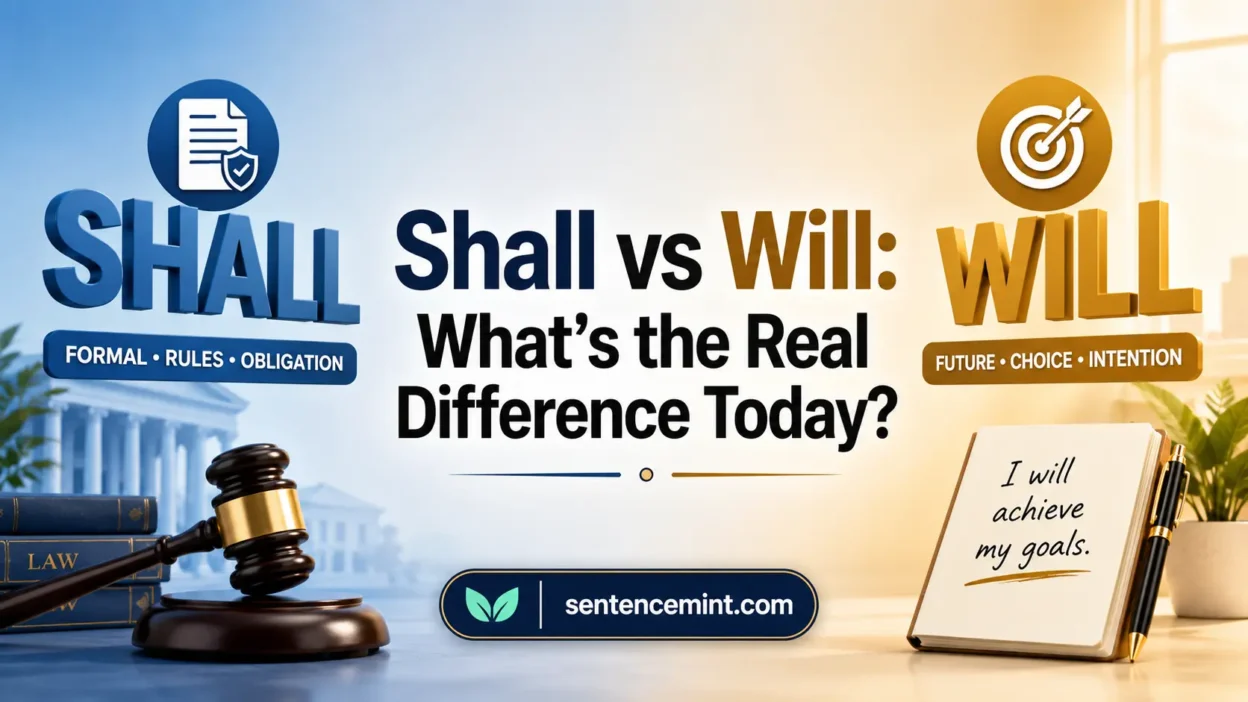
Many English learners struggle with shall vs will because both words can refer to the future. Older grammar books often taught strict rules about when to use each one, but modern English works differently.
Today, will is far more common in everyday American English. Meanwhile, shall survives mostly in formal writing, legal language, suggestions, and certain traditional expressions.
For example:
- “I will call you tomorrow.”
- “Shall we start?”
Both sentences are correct, but they create different tones and purposes. Understanding the difference helps you sound more natural and avoid overly formal wording.
Quick Answer
Use will for most future situations in modern English.
Use shall mainly for:
- suggestions
- formal promises
- obligations
- legal or official writing
Examples:
- “We will arrive at noon.”
- “Shall we leave now?”
The two words sometimes overlap, but tone and context usually determine which one sounds natural.
Why People Confuse Them
People confuse shall and will because older grammar rules treated them differently from modern English.
Traditional grammar often taught this pattern:
- “I/we shall”
- “You/he/she/they will”
For strong determination, the rule supposedly reversed:
- “I/we will”
- “You/he/she/they shall”
Most native speakers no longer follow these rules consistently, especially in the United States.
Modern English usually prefers will in conversation:
- “I will see you later.”
- “We will call you tomorrow.”
At the same time, shall still appears in formal contexts:
- “Shall we begin?”
- “The tenant shall pay all fees.”
This mix of old rules and modern habits keeps the topic confusing.
Key Differences At A Glance
| Context | Best Choice | Why |
|---|---|---|
| Everyday future statements | will | Sounds natural and modern |
| Suggestions with “I” or “we” | shall | Common polite structure |
| Casual conversation | will | Standard modern usage |
| Legal or official documents | shall | Expresses obligation clearly |
| Predictions | will | Most common future auxiliary |
| Ceremonial or dramatic tone | shall | Sounds formal or literary |
Compact Comparison Block
- Will = standard modern future word
- Shall = formal, legal, or suggestion-focused
- Will dominates casual American English
- Shall we…? remains common in polite suggestions
- Legal writing often prefers shall
- Tone changes more than grammar in many situations
Meaning and Usage Difference
Both shall and will are modal auxiliary verbs connected to future meaning.
Will
In modern English, will handles most future situations.
It commonly expresses:
- future actions
- predictions
- promises
- intentions
- willingness
Examples:
- “I will finish the report tonight.”
- “She will probably arrive early.”
- “We will help you move.”
This usage sounds neutral and natural in American English.
Shall
Modern English uses shall much less often.
It usually appears in:
- suggestions
- offers
- formal declarations
- legal obligations
Examples:
- “Shall I open the window?”
- “Shall we order pizza?”
- “You shall obey the rules.”
Legal writing especially favors shall because it can signal obligation or requirement.
Example:
- “The company shall provide written notice.”
Historical Rule
Older grammar traditions tried to separate shall and will by grammatical person. Modern speakers rarely follow those patterns consistently.
Today, most Americans simply use will for ordinary future meaning.
Tone, Context, and Formality
The biggest difference between shall and will is tone.
Will
Will sounds:
- neutral
- conversational
- modern
- natural in daily speech
Examples:
- “I will text you later.”
- “They will meet us downtown.”
Shall
Shall may sound:
- formal
- literary
- authoritative
- ceremonial
- old-fashioned in some contexts
Examples:
- “We shall overcome.”
- “The tenant shall pay all fees.”
In legal documents, shall often carries stronger authority than will.
Compare:
- “The employee will submit reports.”
- “The employee shall submit reports.”
The second sentence sounds more mandatory and official.
Still, not every use of shall sounds outdated. Questions like “Shall we begin?” remain common and natural.
Which One Should You Use?
For most modern English situations, use will.
Examples:
- “Will you join us?”
- “I will send the email tonight.”
- “They will arrive tomorrow.”
Use shall mainly when:
- making polite suggestions
- offering help
- writing formally
- reading legal or official language
Examples:
- “Shall we continue?”
- “Shall I carry that for you?”
- “The buyer shall pay all taxes.”
A practical rule:
- Everyday future → will
- Formal or suggestion-based tone → shall
Audience and context matter more than memorizing old grammar charts.
When One Choice Sounds Wrong
Sometimes the wrong choice creates an unnatural tone.
Example:
- “Shall you be there tonight?”
This sounds stiff or overly formal in modern American English.
More natural:
- “Will you be there tonight?”
Another example:
- “Will we begin?”
This sounds more like a prediction than a suggestion.
If the speaker wants to politely start an activity, this sounds better:
- “Shall we begin?”
The meaning changes because shall often signals suggestion or invitation in questions.
Common Mistakes (and Quick Fixes)
Mistake: Overusing “shall” in casual American English
Overly formal:
- “I shall call you tomorrow.”
More natural:
- “I will call you tomorrow.”
Mistake: Using “will” for polite suggestion questions
Less natural:
- “Will we start now?”
Better:
- “Shall we start now?”
Mistake: Treating old grammar rules as mandatory
Many learners believe they must always say:
- “I shall”
- “We shall”
Modern English does not require this.
Quick Memory Aid
- Everyday future = will
- Polite suggestion or formal obligation = shall
Everyday Examples
- “I will see you tomorrow.”
- “Will you help me move this table?”
- “Shall we order takeout tonight?”
- “The company shall provide benefits to employees.”
- “She will probably finish early.”
- “Shall I turn on the lights?”
- “We will meet after lunch.”
- “The contract shall remain valid for one year.”
Mini-dialogues:
At work
- “Will the report be ready today?”
- “Yes, I will send it this afternoon.”
At dinner
- “Shall we split the bill?”
- “Sure.”
In formal writing
- “The renter shall maintain the property.”
Dictionary-Style Word Details
Verb
- shall: modal auxiliary verb mainly used for suggestions, obligations, and formal future reference
Example: “Shall I help you with that?” - will: modal auxiliary verb used for future actions, intentions, predictions, and willingness
Example: “She will arrive soon.”
Both words fully function as modal auxiliary verbs.
Noun
- shall: noun use is not common in standard English.
- will: commonly functions as a noun meaning determination, desire, or personal choice
Example: “He has strong willpower.”
Example: “People believe in free will.”
Synonyms
- shall: depending on context, closest plain alternatives may include “must,” “should,” or “will”
- will: depending on context, closest plain alternatives may include “intend to” or “going to”
Exact replacements often depend on tone and context.
Example Sentences
- shall: “Shall we go now?”
- shall: “You shall receive a response soon.”
- shall: “The tenant shall pay monthly fees.”
- shall: “Shall I close the door?”
- will: “I will text you later.”
- will: “They will arrive by noon.”
- will: “She will probably win.”
- will: “We will support the project.”
Word History
- shall: historically played a stronger role in older English grammar and formal future constructions.
- will: gradually became the dominant future auxiliary in modern English, especially in American usage.
Modern English relies much more heavily on will than older grammar traditions did.
Phrases Containing
- shall: shall we, shall not, shall be
- will: free will, will do, will power, at will
Some phrases are fixed expressions rather than standard future-tense structures.
FAQ
What is the difference between shall and will?
Both words can refer to the future, but modern English uses them differently.
- Will is the normal choice for most future situations.
- Shall is mainly used for suggestions, formal language, or legal writing.
Examples:
- “I will call you tomorrow.”
- “Shall we begin?”
Is “shall” outdated in modern English?
Not completely. “Shall” is less common in everyday American English, but it still appears in:
- polite suggestions
- legal documents
- formal speeches
- ceremonial language
Example:
- “Shall we continue?”
Which is more formal: shall or will?
“Shall” usually sounds more formal than “will.”
Compare:
- “I will email you later.” → neutral and modern
- “I shall email you later.” → formal or old-fashioned
Can shall and will be interchangeable?
Sometimes, yes. Both can refer to future actions.
However, changing one to the other can affect tone or meaning.
Compare:
- “Will we begin now?” → asks about a future action
- “Shall we begin now?” → polite suggestion
Why do legal documents use “shall”?
Legal writing often uses “shall” to express obligation or requirement.
Example:
- “The tenant shall pay all fees.”
In this context, “shall” sounds stronger and more official than “will.”
Is “shall” mainly British English?
“Shall” is more common in British English than in American English, especially in polite questions.
However, Americans still use it in phrases like:
- “Shall we go?”
- “Shall I help you?”
Should learners use shall or will?
For most everyday English, learners should usually use will.
Use shall mainly for:
- polite suggestions
- formal writing
- legal or official contexts
Is “shall we” still correct?
Yes. “Shall we” remains common and natural in modern English.
Examples:
- “Shall we dance?”
- “Shall we order pizza?”
It often sounds polite and cooperative.
Why does “shall” sometimes sound old-fashioned?
In casual American English, people rarely use “shall” for ordinary future statements anymore.
Example:
- “I shall return tomorrow.”
This may sound dramatic, literary, or very formal today.
Can “will” express determination?
Yes. “Will” can show determination, promise, or willingness.
Examples:
- “I will finish this project tonight.”
- “We will not give up.”
The tone depends on context and emphasis.
Is there an old grammar rule for shall and will?
Yes. Traditional grammar books once taught strict rules based on grammatical person, such as:
- “I/we shall”
- “You/he/she/they will”
Modern English speakers usually do not follow these rules consistently anymore.
What is an easy way to remember shall vs will?
A simple guide is:
- Everyday future = will
- Suggestions or formal obligations = shall
This approach sounds natural in modern American English.
Conclusion
The difference between shall vs will today is mostly about tone, context, and modern usage.
- Will dominates everyday English and works naturally in most future situations.
- Shall survives mainly in suggestions, formal speech, legal language, and ceremonial expressions.
A simple comparison shows the difference clearly:
- “We will start the meeting now.”
- “Shall we start the meeting now?”
The first sounds like a statement. The second sounds like a polite suggestion.
In modern American English, choosing the natural tone matters more than memorizing old grammar rules.