Continuous vs Continual: Meaning, Usage, and Key Difference
Many writers struggle with continuous vs continual because the words look and sound very similar. Both describe something ongoing, which makes the distinction easy to blur in everyday English.
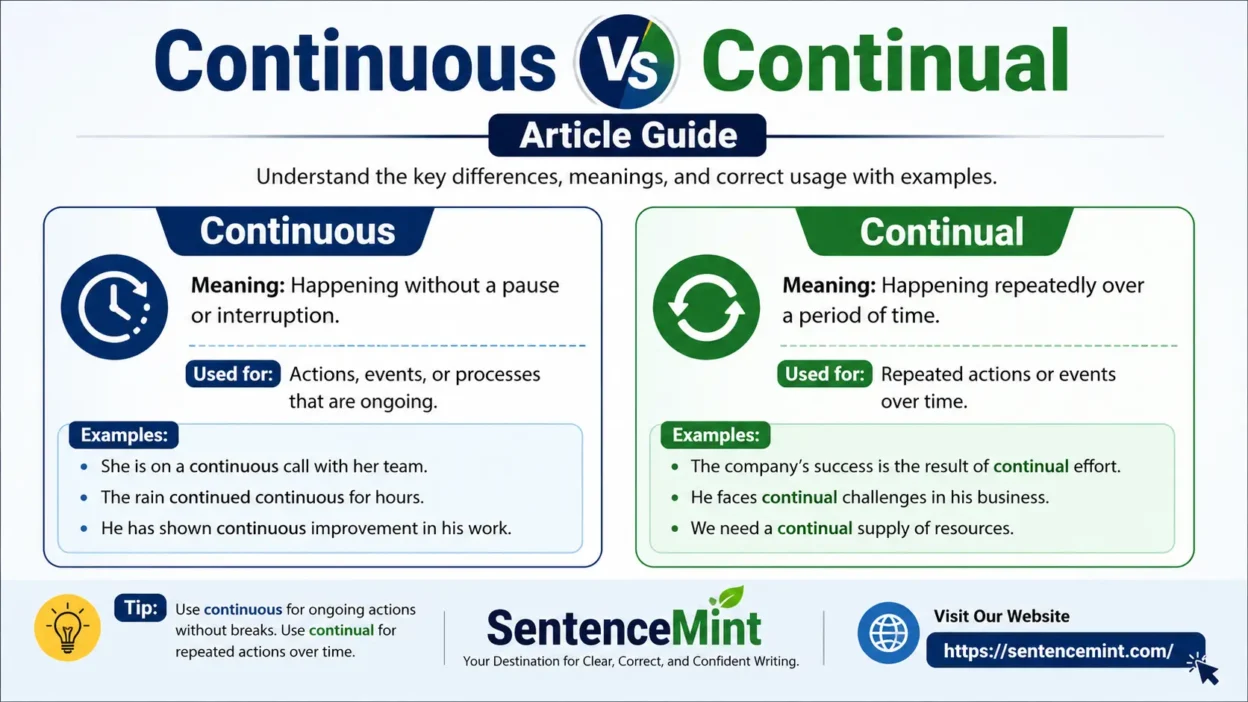
The traditional difference is still useful, though. In most situations, continuous means something happens without interruption, while continual describes something that happens repeatedly over time, often with pauses in between.
For example:
- “continuous rain”
- “continual interruptions”
Modern usage sometimes overlaps, especially in casual writing, but understanding the distinction helps your writing sound clearer and more precise.
Quick Answer
Use continuous when something happens nonstop or without interruption.
Use continual when something happens repeatedly over time.
Examples:
- “The machine operated continuously for 12 hours.”
- “We experienced continual delays during construction.”
The words can overlap in casual speech, but they are not always interchangeable. In formal and edited writing, the traditional distinction still matters.
Why People Confuse Them
The confusion comes from the words’ nearly identical spelling and closely related meanings.
Both suggest persistence or ongoing activity. Because of that, many people assume they mean exactly the same thing.
Real-world usage also adds to the confusion. Some writers use continuous loosely when they really mean repeated activity, while others use continual in situations where nonstop action is intended.
Compare these examples:
- “continuous background music”
- “continual phone calls”
The first suggests uninterrupted sound. The second suggests repeated calls throughout the day with breaks between them.
The distinction is subtle, but context usually makes the intended meaning clear.
Key Differences At A Glance
| Context | Best Choice | Why |
|---|---|---|
| nonstop machine operation | continuous | no interruption involved |
| repeated customer complaints | continual | recurring over time |
| scientific monitoring | continuous | technical meaning of uninterrupted activity |
| recurring schedule changes | continual | repeated events with pauses |
| flowing electricity | continuous | uninterrupted flow |
| repeated distractions | continual | events happen again and again |
| streaming audio | continuous | ongoing without stopping |
| recurring software issues | continual | repeated occurrences |
Quick Comparison Block
- continuous → nonstop, uninterrupted, ongoing without breaks
- continual → repeated frequently, recurring over time
- continuous is common in technical and scientific writing
- continual often appears in conversational or repetitive contexts
- overlap exists in casual English, but the meanings are not always identical
Meaning and Usage Difference
Both continuous and continual are adjectives.
The main difference is focus.
Continuous emphasizes uninterrupted duration.
Examples:
- “continuous power supply”
- “continuous internet connection”
- “continuous monitoring”
In these cases, the activity does not stop.
Continual emphasizes repeated recurrence.
Examples:
- “continual interruptions during the meeting”
- “continual policy changes”
- “continual reminders from the app”
The action keeps happening, but not necessarily every second.
Modern English does allow some overlap. Certain business phrases use both forms depending on style preference.
For example:
- “continuous improvement”
- “continual improvement”
Both appear in real writing, although continuous improvement is more common in technical and professional settings.
Tone, Context, and Formality
Context strongly affects which word sounds more natural.
Continuous often sounds more technical, neutral, or process-focused.
Examples:
- continuous monitoring
- continuous production
- continuous data collection
This word is especially common in science, engineering, healthcare, and education.
Continual often appears in conversational situations or when discussing repeated experiences.
Examples:
- continual distractions
- continual complaints
- continual interruptions
The word sometimes carries a slightly negative tone because people often use it for recurring problems. Still, it can also be neutral or positive.
Examples:
- continual learning
- continual growth
In formal American English, many editors still prefer continuous for uninterrupted systems and continual for repeated events.
Which One Should You Use?
A quick meaning test usually helps.
Does the action truly happen without stopping?
If yes, choose continuous.
Example:
- “The patient required continuous medical supervision.”
Does the action repeat again and again over time?
If yes, choose continual.
Example:
- “The office dealt with continual staffing issues.”
Some contexts accept either word, especially in casual writing. Still, careful writing usually sounds clearer when you preserve the traditional distinction.
Compare these examples:
- “continuous rainfall” → rain never stopped
- “continual rainfall” → rain kept returning repeatedly
Another example:
- “continuous traffic noise” → nonstop sound
- “continual traffic noise” → recurring noise throughout the day
When One Choice Sounds Wrong
Sometimes the wrong word creates a logical mismatch.
Example:
- “continual electrical current”
This sounds awkward because electrical current is usually understood as uninterrupted. Continuous electrical current sounds more natural.
Another example:
- “continuous interruptions during class”
Interruptions normally happen in separate moments. Because pauses exist between them, continual interruptions usually fits better.
That said, casual speech often bends the distinction for emphasis.
Someone frustrated might say:
- “I dealt with continuous interruptions all morning.”
Even if the interruptions technically included pauses, most listeners would still understand the meaning.
Common Mistakes (and Quick Fixes)
Mistake: Using continuous for every repeated action
Incorrect:
- “continuous phone calls all afternoon”
Better:
- “continual phone calls all afternoon”
Why: The calls likely happened repeatedly rather than nonstop.
Mistake: Using continual for uninterrupted systems
Incorrect:
- “continual power supply”
Better:
- “continuous power supply”
Why: The meaning involves uninterrupted operation.
Mistake: Treating the words as exact synonyms
The meanings overlap sometimes, but they are not fully identical.
Helpful memory aid:
- continuous = continues without stopping
- continual = continues by happening repeatedly
That shortcut works in most modern writing situations.
Everyday Examples
- The hospital uses continuous patient monitoring overnight.
- We faced continual software problems during the rollout.
- Continuous music played in the background of the store.
- Her continual texting distracted everyone at dinner.
- Scientists collected continuous data from the weather station.
- The project suffered continual delays for months.
- Continuous internet access is required for the course.
- The manager complained about continual interruptions during meetings.
- Continuous operation helped the factory meet demand.
- The city experienced continual traffic problems during construction.
- Students received continuous feedback throughout the semester.
- Their continual arguments created tension in the office.
Dictionary-Style Word Details
Verb
- continuous: not commonly used as a verb
- continual: not commonly used as a verb
Both words function mainly as adjectives.
Noun
- continuous: noun use is uncommon outside technical fields
- continual: noun use is extremely uncommon
Most modern English usage treats both words primarily as adjectives.
Synonyms
- continuous: nonstop, uninterrupted, constant
- continual: repeated, recurring, frequent
These are closest plain alternatives rather than perfect substitutes in every sentence.
Example Sentences
- continuous: “The machine requires continuous cooling.”
- continuous: “The stream provided continuous water flow.”
- continual: “We experienced continual schedule changes.”
- continual: “His continual complaints frustrated the team.”
Word History
- continuous: historically connected to uninterrupted continuation
- continual: historically connected to repeated continuation over time
The two words developed closely related meanings, which explains why modern confusion still exists.
Phrases Containing
- continuous: continuous improvement, continuous monitoring, continuous flow
- continual: continual interruptions, continual complaints, continual change
Some phrases appear much more often in edited American English than others.
Another commonly confused pair in English is affect vs effect confusion explained, which is often mixed up just like continuous and continual.
FAQ
What is the main difference between continuous and continual?
“Continuous” usually means something happens without stopping. “Continual” usually means something happens repeatedly over time, often with breaks in between.
Can continuous and continual be used interchangeably?
Sometimes. In casual writing, many people use them loosely. In formal or edited writing, the traditional distinction is still common.
Does continuous always mean nonstop?
Usually, yes. A “continuous signal” or “continuous flow” suggests no interruption.
Does continual mean repeated?
Yes. “Continual” typically describes something that keeps happening again and again.
Why do people confuse continuous and continual?
The words look and sound similar, and both describe ongoing activity. Modern usage also overlaps in some situations.
Is continual always negative?
No. It often appears in negative phrases like “continual complaints,” but it can also be neutral or positive, such as “continual learning.”
Which word is better in technical writing?
“Continuous” is usually preferred in scientific, mathematical, and technical contexts because it clearly suggests uninterrupted action.
What about phrases like “continuous improvement” and “continual improvement”?
Both appear in business writing. “Continuous improvement” is more common because it suggests an ongoing process, but “continual improvement” can also sound natural in some contexts.
Is “continuous interruptions” wrong?
It can sound awkward if the interruptions happen with pauses between them. In that case, “continual interruptions” is usually clearer.
How can I quickly choose the right word?
Ask yourself one question: Does the action stop?
• If no, use “continuous.” • If yes, but it keeps happening repeatedly, use “continual.”
Conclusion
The simplest way to understand continuous vs continual is this:
- continuous usually means uninterrupted
- continual usually means repeated over time
Modern English does allow some overlap, especially in casual conversation. Still, the traditional distinction remains useful because it makes your meaning clearer.
If something never stops, choose continuous. If it keeps happening again and again, continual will usually sound more natural.
Conclusion
The simplest way to understand continuous vs continual is this:
- continuous usually means uninterrupted
- continual usually means repeated over time
Modern English does allow some overlap, especially in casual conversation. Still, the traditional distinction remains useful because it makes your meaning clearer.
If something never stops, choose continuous. If it keeps happening again and again, continual will usually sound more natural.
<<<ARTICLE_READY>>>