The confusion between historic vs historical is common because the words look alike, sound similar, and both relate to history. But they do not always mean the same thing.
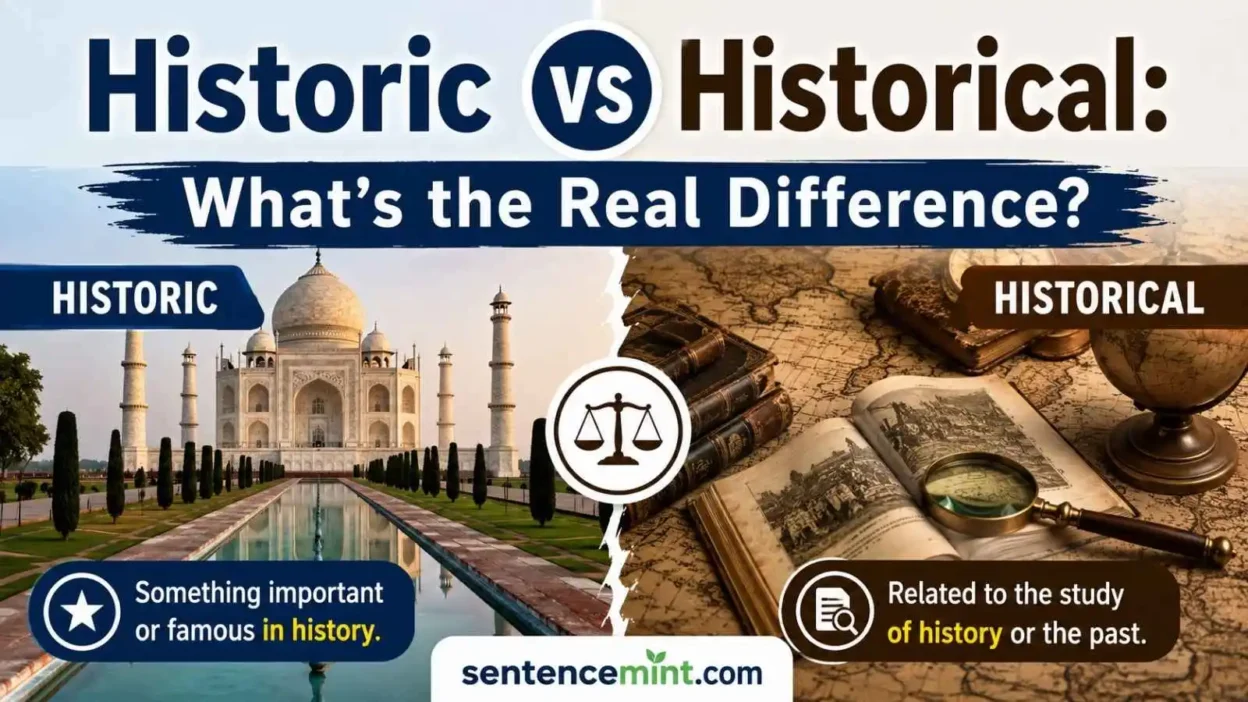
In most cases, historic describes something important or memorable in history, while historical simply describes something connected to the past or the study of history.
For example:
- A historic victory changed the course of an election.
- Historical records help researchers study the past.
The distinction may seem subtle, but it affects tone, meaning, and clarity in journalism, education, business writing, and everyday communication.
2. Quick Answer
Use historic when something is historically important or significant.
- “The agreement was a historic achievement.”
- “It was a historic election.”
Use historical when something relates generally to history or the past.
- “She studies historical documents.”
- “The museum contains historical artifacts.”
A quick way to think about it:
- Historic = important in history
- Historical = related to history
That distinction works most of the time, although some overlap exists in real-world usage.
3. Why People Confuse Them
People confuse these words because they share the same root and often describe the same kinds of nouns.
You might hear:
- “historic building”
- “historical building”
Both phrases involve the past, but they emphasize different things.
The confusion also comes from context. A building can be merely old and connected to history, or it can be especially important in history. That changes which adjective feels more natural.
Pronunciation adds to the confusion because the words sound very similar in fast speech.
4. Key Differences At A Glance
| Context | Best Choice | Why |
|---|---|---|
| A major political victory | historic | Emphasizes importance |
| Research documents from the 1800s | historical | Simply related to history |
| A landmark peace agreement | historic | Suggests lasting significance |
| Academic analysis of ancient Rome | historical | Neutral connection to history |
| A famous battlefield | historic | Implies cultural or historical importance |
| A textbook about the Civil War | historical | Describes subject matter |
Quick Comparison
| Feature | historic | historical |
|---|---|---|
| Main meaning | Important in history | Related to history |
| Tone | Dramatic or notable | Neutral or descriptive |
| Common contexts | Events, victories, landmarks | Research, records, studies |
| Implies significance? | Usually yes | Not necessarily |
| Part of speech | Adjective | Adjective |
5. Meaning and Usage Difference
The clearest distinction is this:
- Historic suggests importance, impact, or lasting significance.
- Historical describes a connection to history without judging importance.
For example:
- “The court ruling was historic.”
- The ruling mattered in a major way.
- “The professor studies historical court rulings.”
- The rulings are simply part of history.
Both words are adjectives, and neither commonly functions as a verb.
You will often see historic in headlines, speeches, and media coverage:
- “Historic breakthrough”
- “Historic season”
- “Historic moment”
Meanwhile, historical appears more often in academic, educational, and research contexts:
- “Historical analysis”
- “Historical archives”
- “Historical fiction”
Overlap can happen. A very old building may be called either a historic building or a historical building, depending on whether the writer wants to emphasize importance or simple age and historical connection.
6. Tone, Context, and Formality
Tone strongly affects which word sounds natural.
Historic often feels emotional, dramatic, or celebratory. News reports commonly use it after elections, championships, discoveries, or legal decisions.
Examples:
- “The team earned a historic win.”
- “Congress passed historic legislation.”
Historical usually sounds more neutral and academic.
Examples:
- “The article examined historical trends.”
- “The documentary aimed for historical accuracy.”
In tourism writing, both words may appear:
- “Visit this historic landmark.”
- “Explore the area’s historical sites.”
The first emphasizes significance. The second focuses more generally on the area’s connection to the past.
Neither word is inherently more formal, but historical appears more often in scholarly and research writing.
7. Which One Should You Use?
Ask yourself one question:
Is the sentence emphasizing importance, or simply connection to history?
Choose historic if the thing feels notable, groundbreaking, famous, or culturally important.
Choose historical if you only mean “related to history.”
Compare these examples:
- “The senator delivered a historic speech.”
- The speech mattered in a major way.
- “The senator quoted historical sources.”
- The sources come from history.
More examples:
- “The company announced a historic merger.”
- “The museum displayed historical photographs.”
In some situations, either word works with a slight meaning shift:
- “historic church” → famous or important church
- “historical church” → church connected to history
8. When One Choice Sounds Wrong
Sometimes the wrong choice changes the meaning noticeably.
Awkward:
- “The historian examined historic records.”
Better:
- “The historian examined historical records.”
Why? The sentence is about records connected to history, not necessarily records of great importance.
Another example:
Awkward:
- “The city celebrated a historical victory.”
Better:
- “The city celebrated a historic victory.”
The second version sounds more natural because the sentence highlights significance and achievement.
Context matters more than rigid grammar rules, but some choices clearly fit better than others.
9. Common Mistakes (and Quick Fixes)
Mistake 1: Using “historic” for anything old
Incorrect:
- “The library stores historic newspapers.”
Better:
- “The library stores historical newspapers.”
Old or history-related does not automatically mean historically important.
Mistake 2: Using “historical” for major milestones
Incorrect:
- “The country signed a historical agreement.”
Better:
- “The country signed a historic agreement.”
The agreement is being presented as important and memorable.
Mistake 3: Treating the rule as absolute
Some contexts allow both words.
- “historic district”
- “historical district”
Both exist in real usage, although the emphasis changes slightly.
Mistake 4: Confusion with articles
Both “a historic” and “an historic” appear in English.
In modern American English, a historic is far more common because the “h” is pronounced clearly.
10. Everyday Examples
- “She gave a presentation about historical immigration trends.”
- “The team celebrated a historic championship win.”
- “We toured several historical sites during the trip.”
- “The court issued a historic ruling.”
- “He enjoys reading historical fiction.”
- “The mayor called it a historic day for the city.”
- “The documentary used historical photographs and interviews.”
- “That bridge became a historic landmark decades ago.”
- “The professor specializes in historical research.”
- “The peace agreement was considered historic around the world.”
Short dialogue examples:
- “Was that building historic?”
- “Yes, it played a major role in the civil rights movement.”
- “What are you reading?”
- “A historical biography about early American politics.”
11. Dictionary-Style Word Details
Verb
- historic: Not used as a verb.
- historical: Not used as a verb.
Noun
- historic: Occasionally appears informally as a noun in limited expressions, but this is uncommon.
- historical: Not commonly used as a noun outside specialized contexts.
Synonyms
- historic: significant, landmark, momentous
- historical: archival, documented, history-related
These are closest context-based alternatives, not exact replacements in every sentence.
Example Sentences
- historic: “The mission became a historic achievement in space exploration.”
- historic: “Voters called the decision historic.”
- historical: “The author reviewed historical records from the 19th century.”
- historical: “The film was praised for historical accuracy.”
Word History
- historic: Developed from words connected to noteworthy events worthy of historical record.
- historical: Developed as a broader descriptive term related to history in general.
Both words share the same historical roots but evolved into slightly different meanings over time.
Phrases Containing
- historic: historic victory, historic landmark, historic agreement
- historical: historical records, historical fiction, historical research
If you often get confused between similar English word pairs, you may also want to understand the difference between affect vs effect, another commonly misunderstood grammar concept.
12. FAQs
Can historic and historical be interchangeable?
Sometimes. Certain phrases allow either word, but the emphasis changes.
- “historic building” = important building
- “historical building” = building connected to history
Is it “historic event” or “historical event”?
Usually historic event if the event was important or memorable.
Use historical event when discussing events from history more generally.
What about “historic building” vs “historical building”?
Both can work.
- historic building emphasizes significance
- historical building emphasizes age or historical connection
Is “an historic” correct?
Yes, but it sounds formal or old-fashioned in modern American English.
Most US writers now prefer a historic.
Which word sounds more formal?
Neither word is automatically more formal, but historical appears more often in academic and research writing.
13. Conclusion
The simplest way to understand historic vs historical is this:
- Historic usually means important in history.
- Historical usually means related to history.
A historic victory changed something important. Historical documents simply help us understand the past.
The words sometimes overlap, but context and tone usually make the right choice clear.