
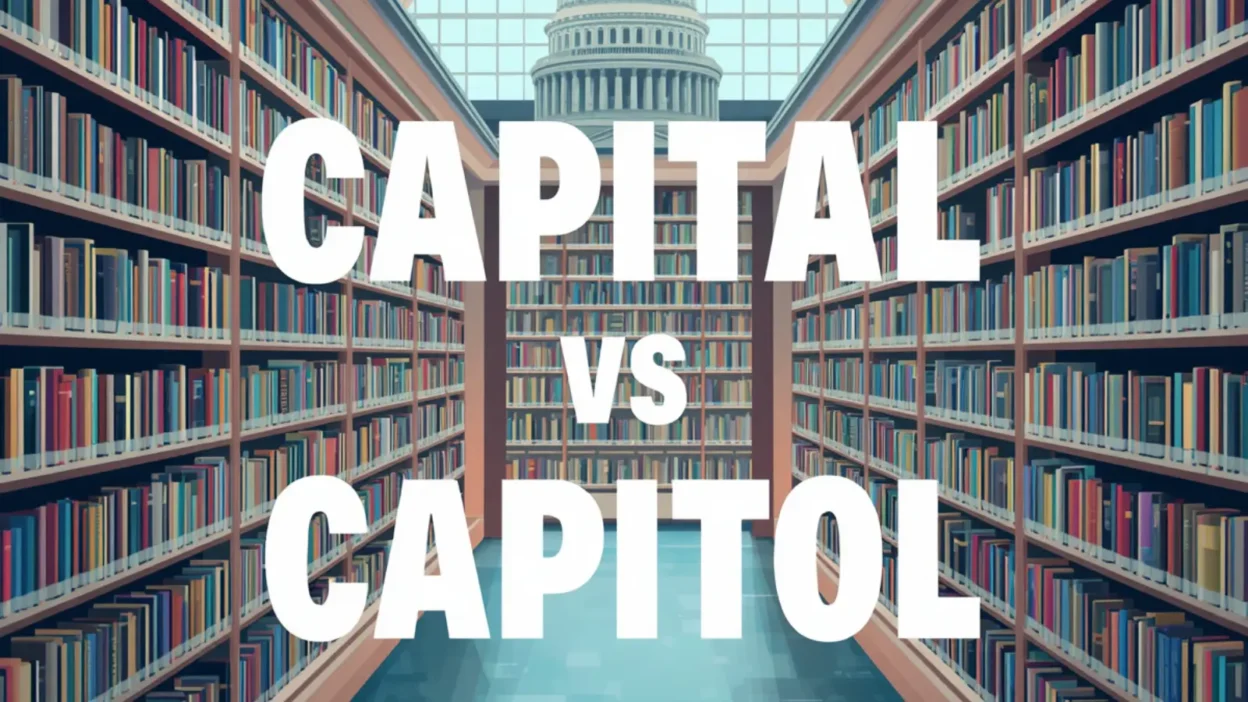
The confusion between capital vs capitol is very common in English writing. Both words sound exactly the same, but they have different meanings and uses.
People often mix them up when talking about government, cities, or buildings. For example, writing “capitol city” instead of “capital city” is a frequent mistake.
This guide makes the difference simple and easy to remember.
2. Quick Answer
- capital = a city, money, or uppercase letters
- capitol = a government building where lawmakers meet
They are homophones, so they sound the same, but they are never interchangeable.
Example:
- Paris is the capital of France.
- The U.S. Capitol is in Washington, D.C.
3. Why People Confuse Them
People confuse capital and capitol because they sound identical when spoken. The spelling difference is small, and both words are used in government-related topics.
Another reason is that “Capitol” is part of famous names like Capitol Hill, which makes it look like it could mean “capital city.”
The confusion is based on sound and context—not meaning.
4. Key Differences At A Glance
| Context | Best Choice | Why |
|---|---|---|
| City or seat of government | capital | Refers to administrative city |
| Money or financial resources | capital | Refers to wealth or investment |
| Uppercase letters | capital | Used in writing system |
| Government building | capitol | Specific legislative building |
Feature Comparison
| Feature | capital | capitol |
|---|---|---|
| Meaning scope | multiple meanings | single meaning |
| Usage | city, money, letters | government building |
| Common context | general English | political/architectural |
5. Meaning and Usage Difference
capital has several meanings:
- A city where a government is based
- Money or financial resources
- Uppercase letters in writing
Examples:
- Islamabad is the capital of Pakistan.
- She invested her capital wisely.
- Always start a sentence with a capital letter.
capitol has only one meaning:
- A building where lawmakers meet, especially in the United States
Examples:
- The Texas State Capitol is in Austin.
- Protesters gathered outside the Capitol building.
6. Tone, Context, and Formality
capital is used in everyday language, education, writing, and finance. It appears in many different topics.
capitol is used in formal government or civic contexts, mainly when talking about buildings.
Examples:
- The capital city has a large population.
- The lawmakers met inside the capitol.
7. Which One Should You Use?
Use this simple rule:
- If you mean city, money, or letters → capital
- If you mean government building → capitol
Think:
- Cities and money are always capital
- Buildings where laws are made are capitol
8. When One Choice Sounds Wrong
Wrong:
- Washington D.C. is the capitol of the USA.
Correct:
- Washington D.C. is the capital of the USA.
Wrong:
- The law was passed in the capital building.
Correct:
- The law was passed in the capitol building.
9. Common Mistakes (and Quick Fixes)
- Mistake: Using “capitol” for cities
Fix: Cities are always capital - Mistake: Assuming both mean government place
Fix: Only capitol is the building - Mistake: Spelling based on sound
Fix: Ask “city or building?”
10. Everyday Examples
- Tokyo is the capital of Japan.
- The company needs more capital to grow.
- Start each sentence with a capital letter.
- The protesters marched toward the capitol.
- The state capitol is open to visitors.
- Berlin is a famous European capital city.
11. Dictionary-Style Word Details
Verb
- capital: not used as a verb
- capitol: not used as a verb
Noun
- capital: city, money, or uppercase letter
- capitol: government legislative building
Synonyms
- capital: city, seat of government, funds (context-based)
- capitol: government building, legislative house
Example Sentences
- capital: London is the capital of England.
- capitol: The senators met at the state capitol.
Word History
- capital: comes from Latin meaning “head” or “chief,” later used for cities and importance
- capitol: derived from Roman history, linked to Capitoline Hill and government buildings
Phrases Containing
- capital: capital city, capital gain, capital letter
- capitol: U.S. Capitol, state capitol building
If you often get confused between similar English word pairs, you may also find it helpful to understand the difference between Discreet vs Discrete, another commonly confused spelling pair in English.
FAQ: Capital vs Capitol
1. What is the main difference between capital and capitol?
capital refers to a city, money, or uppercase letters, while capitol refers only to a government building where lawmakers meet.
2. Are capital and capitol homophones?
Yes. capital and capitol are homophones, meaning they sound the same but have different meanings and spellings.
3. When should I use “capital”?
Use capital when talking about:
- a city that is the seat of government
- financial money or resources
- uppercase letters in writing
Example: Islamabad is the capital of Pakistan.
4. When should I use “capitol”?
Use capitol only when referring to:
- a government building where laws are made (especially in the U.S.)
Example: The lawmakers met at the state capitol.
5. Is “capital” only about cities?
No. capital has multiple meanings:
- city (capital of a country/state)
- money (financial capital)
- letters (capital A, B, C)
6. Is “capitol” used outside the United States?
It is mostly used in the U.S. context for government buildings, especially state capitol buildings and the U.S. Capitol in Washington, D.C.
7. Why do people confuse capital and capitol?
They sound identical when spoken, and both relate to government topics, so people often mix them up in writing.
8. What is an easy trick to remember capital vs capitol?
- capital = city, cash, letters
- capitol = building with a dome (government building)
Think: “Capitol has an O like a dome.”
9. Can capital and capitol be used interchangeably?
No. They are never interchangeable because they have completely different meanings.
10. What is a simple example using both words?
- Paris is the capital of France.
- The Texas State Capitol is in Austin.
12. Conclusion
The difference between capital vs capitol is simple once you focus on meaning. One word covers cities, money, and letters, while the other is only for government buildings.
Remember: capital for general use, capitol for buildings. That rule will keep your writing accurate every time.