You may see the word ambiguous in school, work, news, contracts, stories, movies, or daily conversation. People use it when something can be understood in more than one way.
- The word matters because unclear meaning can cause real confusion. An ambiguous reply can hide someone’s true answer. An ambiguous rule can lead people to follow it differently. An ambiguous ending in a movie may leave viewers debating what really happened.
This guide explains ambiguous meaning in simple English. You will learn the definition, pronunciation, part of speech, word forms, examples, common contexts, related terms, and mistakes to avoid. You will also see how ambiguous differs from words like unclear, vague, and ambivalent.
Quick Answer
Ambiguous means having more than one possible meaning or interpretation. The word usually describes a statement, word, answer, rule, situation, role, message, or ending that is not fully clear.
TL;DR
- Ambiguous means open to more than one meaning.
- It is usually an adjective.
- The noun form is ambiguity.
- Context often removes ambiguity.
- It is not a slang word.
- Clear writing avoids unwanted ambiguity.
- Do not confuse ambiguous with ambivalent.
What Ambiguous Means In Plain English
Ambiguous means something is not fully clear because it can be read, heard, or understood in different ways. The problem is not always missing information. The problem is that more than one meaning seems possible.
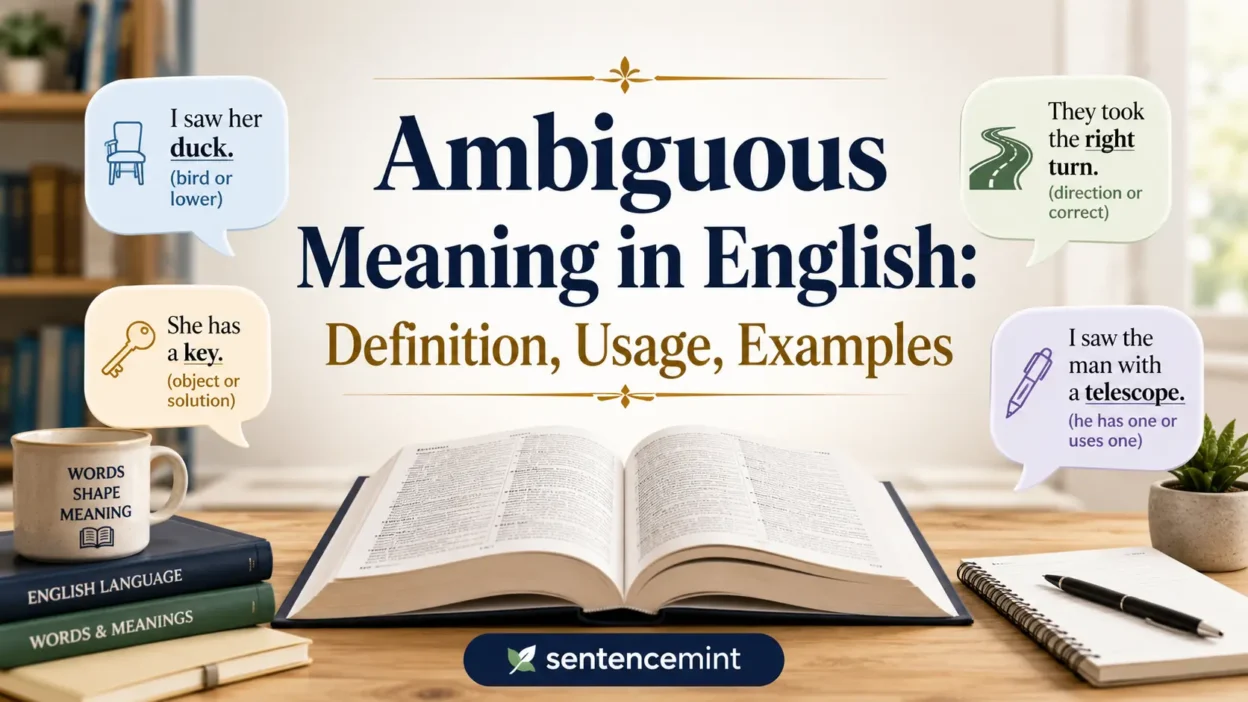
For example, “I saw her duck” is ambiguous. It could mean you saw her bird. It could also mean you saw her lower her head quickly.
Ambiguous often describes language, but it can also describe a situation. A person’s role, answer, attitude, facial expression, or decision can be ambiguous when others cannot tell exactly what it means.
Simple meaning:
Ambiguous means “not clear because there is more than one possible meaning.”
Ambiguous Meaning In English
In English, ambiguous is a formal but common word. You may hear it in classrooms, offices, legal writing, movie reviews, news reports, and serious conversations.
It often appears before nouns like answer, statement, wording, rule, role, ending, message, meaning, or language.
Examples:
- “Her answer was ambiguous.”
- “The email had ambiguous wording.”
- “The movie has an ambiguous ending.”
- “The rule is too ambiguous to follow.”
- “His role in the project is ambiguous.”
- “The contract contains ambiguous language.”
The word does not always mean something is bad. In instructions, contracts, and rules, ambiguity can cause problems. In stories, jokes, poetry, or art, ambiguity can make the meaning more interesting.
Pronunciation Of Ambiguous
Ambiguous is pronounced:
am-BIG-yoo-us
The stress is on the second syllable: BIG.
Break it like this:
- am
- BIG
- yoo
- us
Say it smoothly:
am-BIG-yoo-us
A common mistake is saying it too quickly and losing the middle sound. Keep the “yoo” sound clear.
Correct:
“The directions were am-BIG-yoo-us.”
Not natural:
“The directions were am-big-us.”
Part Of Speech And Word Forms
Ambiguous is an adjective. It describes a noun.
Examples:
- an ambiguous answer
- an ambiguous sentence
- an ambiguous rule
- an ambiguous ending
- an ambiguous message
The noun form is ambiguity. Use it when talking about the state or example of unclear meaning.
Example:
“The ambiguity in the contract caused a dispute.”
The adverb form is ambiguously. Use it to describe how something is said, written, or presented.
Example:
“The policy was ambiguously worded.”
Word family:
| Word | Part Of Speech | Meaning |
|---|---|---|
| ambiguous | adjective | having more than one possible meaning |
| ambiguity | noun | the state of being ambiguous |
| ambiguously | adverb | in an unclear or double-meaning way |
| unambiguous | adjective | clear; having one obvious meaning |
How To Use Ambiguous In A Sentence
Use ambiguous when something can reasonably mean two or more things. It works best when the confusion comes from wording, context, structure, behavior, or interpretation.
Good examples:
- “The teacher said my answer was ambiguous.”
- “Her text was ambiguous, so I asked what she meant.”
- “The sign was ambiguous and confused drivers.”
- “The ending is ambiguous on purpose.”
- “The instructions are too ambiguous for beginners.”
- “The phrase is ambiguous without more context.”
You can also use it with people’s actions, attitudes, or roles.
Example:
“His position on the issue remains ambiguous.”
Be careful with tone. Calling someone’s answer ambiguous can sound polite in formal writing. In casual speech, unclear may sound simpler.
Common Contexts For Ambiguous
Ambiguous appears in many everyday and formal contexts. The meaning stays the same, but the effect changes by situation.
| Context | Best Choice | Why |
| School writing | ambiguous sentence | Shows more than one possible meaning |
| Work email | ambiguous wording | Explains why the message caused confusion |
| Movie review | ambiguous ending | Means the ending allows different readings |
| Legal document | ambiguous language | Warns that a rule may be read differently |
| Daily talk | unclear message | Often sounds more natural than ambiguous |
| News report | ambiguous statement | Suggests the meaning is not definite |
| Instructions | ambiguous directions | Shows people may follow them differently |
In contracts, rules, policies, and instructions, ambiguous language can create mistakes. People may follow different meanings.
In stories, poetry, movies, jokes, and art, ambiguity can be useful. It can create mystery, humor, emotional depth, or discussion.
Ambiguous Words And Sentences
A word is ambiguous when it has more than one possible meaning. A sentence is ambiguous when its structure or wording allows more than one reading.
Example 1: I went to the bank.
Possible meaning 1: A financial bank.
Possible meaning 2: The side of a river.
Example 2: The chicken is ready to eat.
Possible meaning 1: The cooked chicken is ready for people to eat.
Possible meaning 2: The living chicken is ready to eat food.
Example 3: She saw the man with binoculars.
Possible meaning 1: She used binoculars to see the man.
Possible meaning 2: The man had binoculars.
Example 4: Emma told Ava she was late.
Possible meaning 1: Emma was late.
Possible meaning 2: Ava was late.
Context usually solves the problem. Without enough context, the sentence can stay ambiguous.
Ambiguous Vs Unclear, Vague, And Ambivalent
- Ambiguous, unclear, vague, and ambivalent are related, but they are not the same.
| Word | Meaning | Example |
| Ambiguous | More than one meaning is possible | “The sentence has two possible meanings.” |
| Unclear | Hard to understand | “The handwriting is unclear.” |
| Vague | Not specific enough | “Soon” is vague because it gives no exact time. |
| Ambivalent | Having mixed feelings | “She is ambivalent about moving.” |
- Ambiguous means more than one meaning is possible.
Example:
“The sentence has two possible meanings.”
Unclear means hard to understand. It may have one meaning, but that meaning is not expressed well.
Example:
“The handwriting is unclear.”
Vague means not specific enough.
Example:
“Soon” is vague because it does not give an exact time.
Ambivalent describes mixed feelings, not mixed meanings.
Example:
“She feels ambivalent about moving. She wants the new job but fears leaving her friends.”
Common mistake:
Incorrect:
“I am ambiguous about the offer.”
Correct:
“I am ambivalent about the offer.”
Synonyms And Antonyms Of Ambiguous
Ambiguous has several close synonyms, but each one has a slightly different meaning.
Useful Synonyms
- unclear — hard to understand
- vague — not specific enough
- equivocal — unclear, often on purpose
- obscure — hidden or hard to understand
- confusing — difficult to follow
- uncertain — not settled or definite
- open-ended — allowing more than one result or interpretation
- double-edged — carrying two possible effects or meanings
The best synonym depends on the sentence.
Example:
“The rule is ambiguous.”
Close meaning: “The rule is unclear.”
Example:
“His answer was equivocal.”
Meaning: His answer may have been unclear on purpose.
Useful Antonyms
- clear
- explicit
- definite
- direct
- certain
- precise
- specific
- unambiguous
Unambiguous is the closest opposite. It means the meaning is clear and has only one likely reading.
Example:
“The instructions were unambiguous.”
Common Mistakes With Ambiguous
Mistake 1: Using Ambiguous For Every Unclear Thing
Ambiguous should mean more than one meaning is possible.
Weak:
“The room was ambiguous.”
Better:
“The room was dark and confusing.”
Better if two meanings exist:
“The room’s purpose was ambiguous because it looked like both an office and a bedroom.”
Mistake 2: Confusing Ambiguous With Ambivalent
Ambiguous describes unclear meaning. Ambivalent describes mixed feelings.
Incorrect:
“He is ambiguous about buying the car.”
Correct:
“He is ambivalent about buying the car.”
Mistake 3: Leaving Pronouns Unclear
Pronouns can easily create ambiguity.
Ambiguous:
“Emma told Ava she was late.”
Clear:
“Emma told Ava, ‘I am late.’”
Clear:
“Emma told Ava that Ava was late.”
Mistake 4: Using Ambiguous When You Mean Vague
Vague means not specific enough. Ambiguous means more than one meaning is possible.
Vague:
“I’ll call you later.”
Ambiguous:
“I saw her duck.”
To fix ambiguity, add context, name the person, change the word order, or choose a more exact word.
How To Fix Ambiguous Writing
Clear writing removes unwanted ambiguity. Use these simple fixes:
- Add missing context.
- Replace unclear pronouns with names.
- Choose more specific words.
- Change the sentence order.
- Add punctuation where needed.
- Explain the exact meaning if confusion is likely.
Ambiguous:
“Liam told Noah he won.”
Clear:
“Liam told Noah, ‘I won.’”
Clear:
“Liam told Noah that Noah won.”
Ambiguous:
“Meet me by the bank.”
Clear:
“Meet me by the bank on River Road.”
Clear:
“Meet me outside the bank near the ATM.”
Examples Of Ambiguous In Real Sentences
- “The rule was ambiguous, so students interpreted it differently.”
- “Her answer was ambiguous, and I could not tell whether she agreed.”
- “The movie’s ambiguous ending made viewers debate the final scene.”
- “The contract had ambiguous language.”
- “The sign was ambiguous and confused drivers.”
- “His role in the meeting was ambiguous.”
- “The message sounded ambiguous without more context.”
- “The writer used ambiguity to create mystery.”
- “The teacher asked us to rewrite the ambiguous sentence.”
- “The company clarified the ambiguous policy.”
Mini Quiz
Choose the best answer.
1. What does ambiguous mean?
A. Very loud
B. Open to more than one meaning
C. Always wrong
2. Which sentence is ambiguous?
A. “I bought milk at the store.”
B. “I saw her duck.”
C. “The sky is blue.”
3. What is the noun form of ambiguous?
A. Ambiguity
B. Ambiguate
C. Ambivalent
4. Which word means mixed feelings?
A. Ambiguous
B. Ambivalent
C. Explicit
5. What is the closest opposite of ambiguous?
A. Unambiguous
B. Confusing
C. Vague
Answer Key:
- B
- B
- A
- B
- A
FAQs About Ambiguous
What does ambiguous mean in simple words?
Ambiguous means something can have more than one meaning. It is not fully clear because people may understand it in different ways.
Example: “Meet me by the bank” can be ambiguous without more context.
Does ambiguous mean unclear?
Yes, but it means a specific kind of unclear. Ambiguous usually means unclear because two or more meanings are possible.
Unclear can also mean messy, hard to read, or poorly explained.
Is ambiguous a negative word?
Not always. In rules, directions, contracts, and instructions, ambiguous usually suggests a problem.
In stories, jokes, poetry, and movie endings, ambiguity can be useful because it makes people think and discuss different meanings.
What is an example of ambiguous?
“The chicken is ready to eat” is ambiguous. It could mean the chicken is cooked and ready for people to eat.
It could also mean the chicken is ready to eat food.
What is the noun form of ambiguous?
The noun form is ambiguity. It means the state of having more than one possible meaning.
Example:
“The ambiguity of the message confused everyone.”
What is the difference between ambiguous and ambivalent?
Ambiguous describes unclear meaning. Ambivalent describes mixed feelings.
Correct:
“The rule is ambiguous.”
Correct:
“I feel ambivalent about the decision.”
Is ambiguous slang?
No, ambiguous is not slang. It is a standard English adjective.
You can use it in school, work, formal writing, legal writing, and everyday speech.
How do you fix an ambiguous sentence?
You can fix an ambiguous sentence by adding context, replacing unclear pronouns, changing the word order, or choosing more exact words.
Ambiguous:
“Emma told Ava she was late.”
Clear:
“Emma told Ava that Ava was late.”
Conclusion
Ambiguous meaning is simple: something has more than one possible meaning or interpretation.
Use ambiguous when a sentence, answer, rule, role, message, or situation is not clear in one definite way. When clarity matters, add context and choose exact wording so readers know exactly what you mean.