
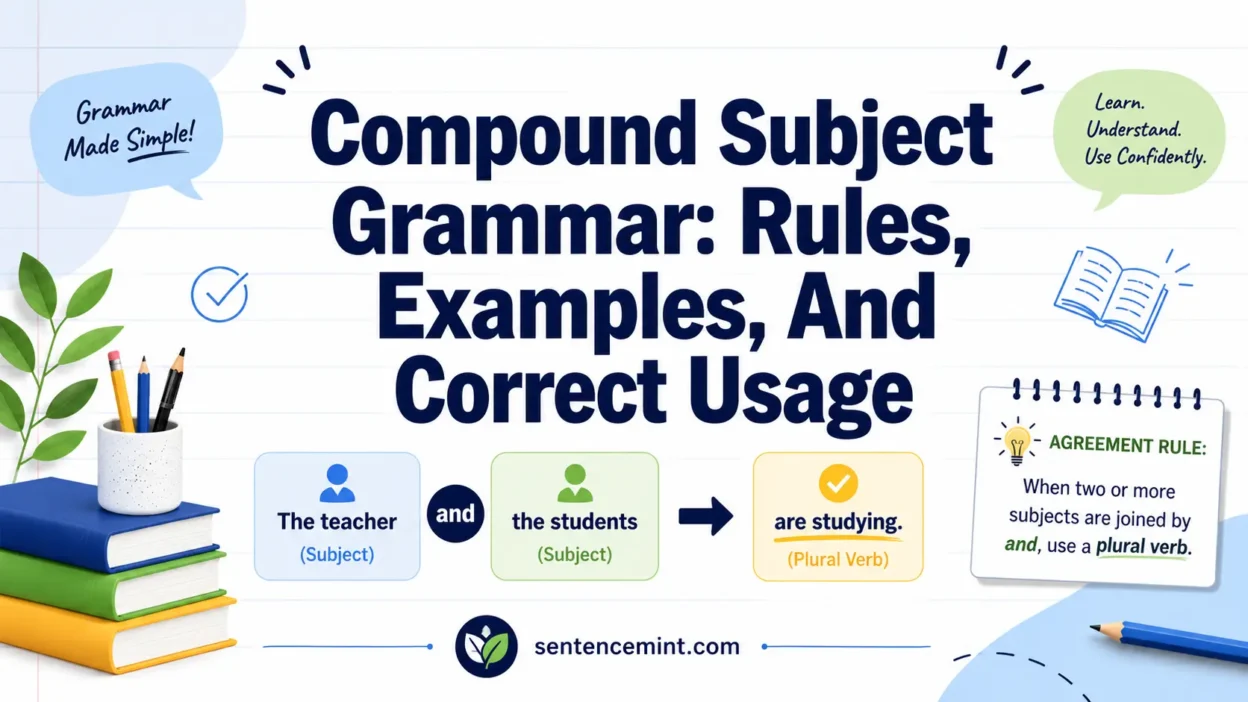
Feature Image Prompt: Create a clean 1600×900 educational grammar graphic for “Compound Subject Grammar.” Center the title in bold modern typography. Add two subject cards joined by “and,” an arrow pointing to a plural verb, and a small side note for “or/nor = nearest subject.” Use a bright, professional classroom style with strong contrast and clear readable text.
Alt Text: Compound subject grammar chart showing two subjects joined by and and matched with a plural verb.
Quick Answer
A compound subject is a subject with two or more nouns, pronouns, or noun phrases that share the same verb.
Maya and Jordan are ready.
Compound subject: Maya and Jordan
Verb: are
The main rule in compound subject grammar is subject-verb agreement.
Most compound subjects joined by and take a plural verb:
Correct: The laptop and the charger are on the desk.
Incorrect: The laptop and the charger is on the desk.
But compound subjects joined by or or nor follow the nearest-subject rule:
Either the manager or the assistants are handling it.
Either the assistants or the manager is handling it.
The fastest rule is this:
And usually makes the subject plural. Or and nor make the verb agree with the nearest subject. Each, every, and one-unit ideas usually take a singular verb.
What Is A Compound Subject?
A compound subject is made of two or more simple subjects joined together as one subject.
A simple subject is the main noun or pronoun the sentence is about.
Maya is ready.
Simple subject: Maya
Jordan is ready.
Simple subject: Jordan
When the two subjects share one verb, they form a compound subject:
Maya and Jordan are ready.
Compound subject: Maya and Jordan
A compound subject can include nouns:
The printer and scanner need repair.
It can include pronouns:
She and I are presenting today.
It can include noun phrases:
The new marketing plan and the final budget are due Friday.
It can also include more than two parts:
The teacher, the students, and the parents were invited.
The Core Compound Subject Grammar Rule
A verb must agree with its subject in number.
A singular subject takes a singular verb:
The file is ready.
A plural subject takes a plural verb:
The files are ready.
A compound subject can be singular or plural depending on how its parts are joined.
| Compound Subject Pattern | Correct Verb Pattern | Example |
|---|---|---|
| A and B | Usually plural | The file and folder are ready. |
| A or B | Depends on the nearest subject | The file or folder is ready. |
| A or plural B | Nearest subject is plural | The file or folders are ready. |
| Plural A or B | Nearest subject is singular | The folders or file is ready. |
| Neither A nor B | Depends on the nearest subject | Neither the file nor the folders are ready. |
| Each A and B | Singular | Each file and folder has a label. |
| Every A and B | Singular | Every file and folder has a label. |
| One combined idea | Singular | Mac and cheese is on the menu. |
Compound Subjects Joined By And
A compound subject joined by and usually takes a plural verb because it names more than one person, place, thing, or idea.
Maya and Jordan are ready.
The laptop and the charger are on the desk.
My sister and I are driving to Austin.
The report and the chart were submitted yesterday.
The word and normally means both parts are included. That makes the subject plural.
Correct: The email and the attachment are ready.
Incorrect: The email and the attachment is ready.
Correct: My coworker and I were late.
Incorrect: My coworker and I was late.
Compound Subjects Joined By Or
A compound subject joined by or does not automatically become plural. The verb agrees with the subject closest to it.
When both parts are singular, use a singular verb:
The laptop or the tablet is in my bag.
A call or an email works for me.
Either Monday or Tuesday is fine.
When the nearest subject is plural, use a plural verb:
The manager or the assistants are handling it.
Either the folder or the files are missing.
When the nearest subject is singular, use a singular verb:
The assistants or the manager is handling it.
Either the files or the folder is missing.
This is called the nearest-subject rule or proximity rule.
Compound Subjects Joined By Nor
A compound subject joined by nor follows the same nearest-subject rule.
When both subjects are singular, use a singular verb:
Neither the manager nor the assistant is available.
Neither the invoice nor the receipt is attached.
When the nearest subject is plural, use a plural verb:
Neither the assistant nor the managers are available.
Neither the receipt nor the invoices are attached.
When the nearest subject is singular, use a singular verb:
Neither the managers nor the assistant is available.
Neither the invoices nor the receipt is attached.
If the sentence sounds awkward, rewrite it.
Awkward but grammatical:
Neither the employees nor the supervisor is ready.
Smoother:
Neither the supervisor nor the employees are ready.
Even clearer:
The supervisor is not ready, and neither are the employees.
Compound Subjects With Each And Every
When each or every comes before a compound subject, the verb is usually singular because the sentence treats each item individually.
Each teacher and student has a badge.
Every desk and chair was cleaned before the event.
Each file and folder has a name.
Every guest and volunteer was checked in.
Do not use a plural verb just because the subject has two nouns.
Incorrect: Every desk and chair were cleaned.
Correct: Every desk and chair was cleaned.
Incorrect: Each parent and teacher have access.
Correct: Each parent and teacher has access.
When A Compound Subject Takes A Singular Verb
A compound subject joined by and can take a singular verb when the two parts name one combined idea, one unit, one title, one activity, or one thing.
Mac and cheese is on the menu.
Peanut butter and jelly is my favorite sandwich.
Research and development is a major department.
Breaking and entering is a crime.
In these sentences, the two words work together as one idea.
Compare:
The peanut butter and the jelly are in the pantry.
This means two separate items.
Peanut butter and jelly is my favorite sandwich.
This means one combined food.
One Person Or Two People: Articles Matter
Sometimes a compound subject can refer to one person or two people. Articles such as the, a, and an can change the meaning.
The founder and CEO is speaking today.
This usually means one person is both the founder and the CEO.
The founder and the CEO are speaking today.
This usually means two people are speaking: one founder and one CEO.
More examples:
My friend and neighbor is helping me move.
One person is both my friend and my neighbor.
My friend and my neighbor are helping me move.
Two people are helping.
When you mean one person with two roles, use a singular verb. When you mean two separate people, use a plural verb.
False Compound Subjects: Along With, As Well As, And Including
Not every sentence with two nouns has a compound subject.
Phrases such as along with, as well as, together with, in addition to, and including add information, but they do not work like and for subject-verb agreement.
The teacher, along with the students, is excited.
The subject is teacher, so the verb is is.
The laptop, as well as the cables, is packed.
The subject is laptop, so the verb is is.
The manager, together with the interns, has arrived.
The subject is manager, so the verb is has.
Do not let the noun inside the extra phrase control the verb.
Incorrect: The teacher, along with the students, are excited.
Correct: The teacher, along with the students, is excited.
If the sentence sounds awkward, rewrite it with a true compound subject:
The teacher and the students are excited.
Compound Subject Vs. Compound Predicate
A compound subject is not the same as a compound predicate.
A compound subject has two or more subjects sharing one verb.
Mia and Ava cooked dinner.
Compound subject: Mia and Ava
Verb: cooked
A compound predicate has one subject doing two or more actions.
Mia cooked dinner and washed the dishes.
Subject: Mia
Compound predicate: cooked dinner and washed the dishes
A sentence can also have both:
Mia and Ava cooked dinner and washed the dishes.
Compound subject: Mia and Ava
Compound predicate: cooked dinner and washed the dishes
The easiest test is this:
Who or what is the sentence about? That is the subject.
What does the subject do or what is said about it? That is the predicate.
Compound Subjects With Pronouns
When a pronoun is part of a compound subject, use the subject form of the pronoun.
Use I, not me, when the pronoun is doing the action.
Correct: Jason and I are going.
Incorrect: Jason and me are going.
Correct: She and I are presenting today.
Incorrect: Her and me are presenting today.
Use me, him, her, us, or them when the compound phrase is the object.
Correct: The teacher called Jason and me.
Incorrect: The teacher called Jason and I.
Here is the quick test:
Remove the other person.
Jason and I are going.
Test: I am going.
That works.
The teacher called Jason and me.
Test: The teacher called me.
That works.
Common Mistakes With Compound Subjects
| Mistake | Incorrect | Correct |
| Using a singular verb after normal and | The report and chart is ready. | The report and chart are ready. |
| Treating or like and | A call or an email are fine. | A call or an email is fine. |
| Ignoring the nearest-subject rule | Either the manager or the assistants is coming. | Either the manager or the assistants are coming. |
| Treating as well as like and | The coach, as well as the players, are nervous. | The coach, as well as the players, is nervous. |
| Missing each/every | Every file and folder have a label. | Every file and folder has a label. |
| Using the wrong pronoun case | Me and Jason are leaving. | Jason and I are leaving. |
Real-World Examples Of Compound Subjects
The client and the designer are reviewing the homepage.
The subject has two separate people, so the verb is plural.
My phone and wallet are on the kitchen counter.
Two separate things share the same verb.
Neither the invoice nor the receipt is attached.
Both subjects are singular, and the nearest subject is singular.
Neither the receipt nor the invoices are attached.
The nearest subject is plural, so the verb is plural.
Each teacher and student has a badge.
The word each makes the subject singular.
Every desk and chair was cleaned before the event.
The word every makes the subject singular.
Mac and cheese is on the menu.
The phrase names one dish.
The sales team, along with the interns, is attending the meeting.
The true subject is team. The phrase along with the interns does not make it a compound subject.
How To Choose The Correct Verb
Use this quick test:
- Find the full subject.
- Look at the joining word.
- Decide whether the subject is singular, plural, or a single combined idea.
- Match the verb to the correct subject.
Use these rules:
| If The Subject Is Joined By | Use This Verb Rule |
| And | Use a plural verb unless the subject names one unit. |
| Or | Match the verb to the nearest subject. |
| Nor | Match the verb to the nearest subject. |
| Each or every before the subject | Use a singular verb. |
| Along with, as well as, including | Match the verb to the main subject only. |
Practice: Choose The Correct Verb
Choose the correct verb in each sentence.
- The laptop and the charger is/are on the desk.
- Either the manager or the assistants is/are available.
- Neither the assistants nor the manager is/are available.
- Every folder and file has/have a label.
- The coach, along with the players, is/are excited.
- Peanut butter and jelly is/are my favorite sandwich.
- My sister and I was/were late.
- The founder and CEO is/are speaking today.
- The founder and the CEO is/are speaking today.
- Either the reports or the spreadsheet is/are missing.
Answers:
- are
- are
- is
- has
- is
- is
- were
- is
- are
- is
FAQ
What is a compound subject in grammar?
A compound subject is a subject with two or more nouns, pronouns, or noun phrases that share the same verb.
Nina and Chris are ready.
The compound subject is Nina and Chris.
Does a compound subject always take a plural verb?
No. A compound subject joined by and usually takes a plural verb, but a compound subject joined by or or nor follows the nearest-subject rule. A compound subject can also be singular when it names one combined idea.
What verb should I use with either/or?
Use the verb that agrees with the subject closest to the verb.
Either the dog or the cats are outside.
Either the cats or the dog is outside.
If the sentence sounds awkward, rewrite it.
What verb should I use with neither/nor?
Use the nearest-subject rule.
Neither the teacher nor the students are ready.
Neither the students nor the teacher is ready.
The second sentence is grammatical but may sound less smooth. You can rewrite it for clarity.
Is “my friend and I” correct?
Yes. In a compound subject, use I.
Correct: My friend and I are leaving.
Incorrect: My friend and me are leaving.
Use me when the phrase is the object.
Correct: The teacher called my friend and me.
Is “as well as” a compound subject?
No. As well as adds information, but it does not work like and for subject-verb agreement.
Correct: The coach, as well as the players, is nervous.
The subject is coach, so the verb is singular.
Can a compound subject be one person?
Yes. If two labels refer to the same person, the subject can be singular.
The founder and CEO is speaking today.
This means one person is both founder and CEO.
The founder and the CEO are speaking today.
This suggests two people.
What is the difference between a compound subject and a compound predicate?
A compound subject has two or more subjects sharing one verb.
Maya and Leo finished the project.
A compound predicate has one subject with two or more verbs.
Maya finished the project and emailed the client.
Do each and every make a compound subject singular?
Yes. When each or every comes before a compound subject, use a singular verb.
Each parent and teacher has access.
Every chair and table was cleaned.
Conclusion
Compound subject grammar is mainly about subject-verb agreement.
Use a plural verb for most compound subjects joined by and.
Use the nearest-subject rule for compound subjects joined by or or nor.
Use a singular verb when each or every comes before the compound subject, or when the subject names one combined unit.
And remember: phrases like along with, as well as, and including do not create compound subjects.
The best quick rule is this:
Find the real subject, check the joining word, and then choose the verb that agrees.