The confusion around less vs fewer is common even among native English speakers. Both words describe smaller amounts, but they do not work the same way in every sentence.
You have probably seen phrases like “10 items or less” at a grocery store while also hearing teachers say “fewer” is correct for countable things. That mix of real-world usage and grammar rules is exactly why people hesitate.
The good news is that the difference is usually straightforward once you understand how English treats countable items versus general amounts.
Quick Answer
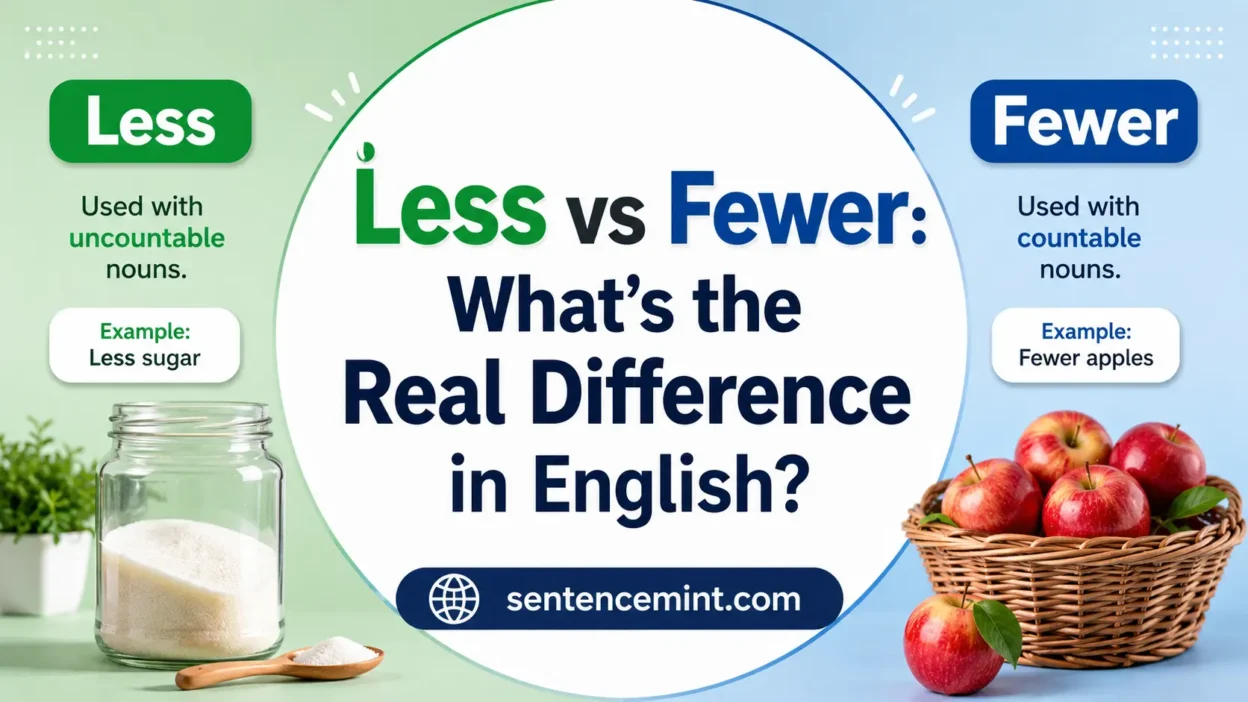
Use “fewer” with things you can count individually.
- fewer books
- fewer people
- fewer mistakes
Use “less” with things treated as amounts or quantities.
- less water
- less time
- less traffic
There are also important exceptions. English commonly uses “less” with measurements, money, distance, and time.
- less than 5 miles
- less than 20 dollars
- less than 30 minutes
So the words are not fully interchangeable, but the real rule is more flexible than many people think.
Why People Confuse Them
Both words suggest reduction, so they naturally overlap in conversation.
The confusion also comes from how people actually speak. In casual English, many speakers use “less” with plural nouns even when formal writing would prefer “fewer.”
Public signs helped reinforce that habit. Phrases like “10 items or less” became familiar to millions of people, even though editors often prefer “10 items or fewer.”
Another reason is that English treats measurements differently from individually counted objects. A phrase like “less than 10 miles” sounds natural because the distance is viewed as one total amount.
Key Differences At A Glance
| Context | Best Choice | Why |
|---|---|---|
| Countable items | fewer | Individual items can be counted |
| General amounts | less | Used for mass or uncountable nouns |
| Time expressions | less | Time is often treated as one amount |
| Distance | less | Measurements commonly use “less” |
| Money | less | Total amounts usually take “less” |
| Formal editing | fewer with plurals | Preferred in edited writing |
| Casual speech | either sometimes appears | Spoken English is more flexible |
Quick Comparison
| Feature | less | fewer |
|---|---|---|
| Main use | Uncountable amounts | Countable items |
| Common with measurements | Yes | Rare |
| Common in casual speech | Very common | Common |
| Preferred in formal plural counts | Usually no | Usually yes |
| Example | less sugar | fewer cookies |
Meaning and Usage Difference
The core difference is countability.
Use “fewer” when you can count separate items one by one.
- fewer students
- fewer emails
- fewer chairs
Use “less” when talking about something as a mass, quantity, or overall amount.
- less information
- less stress
- less furniture
This distinction becomes more nuanced with measurements. English often treats time, money, and distance as combined quantities instead of separate units.
That is why these sound natural:
- less than 20 dollars
- less than 5 years
- less than 100 miles
Even though dollars, years, and miles are technically countable, the sentence focuses on the total measurement.
Tone, Context, and Formality
In formal writing, editors usually expect “fewer” with plural count nouns.
- fewer customers
- fewer mistakes
- fewer employees
In everyday speech, many people use “less” more loosely.
- less people
- less cars on the road today
Those phrases may sound normal in conversation, but they often feel incorrect in academic or professional writing.
Measurements are different. Even careful editors commonly accept phrases like:
- less than 30 minutes
- less than 50 dollars
These forms sound natural because they describe totals rather than individual units.
Which One Should You Use?
A quick mental test helps most of the time.
Ask yourself: “Can I count the items individually?”
If yes, “fewer” is usually the better choice.
- fewer assignments
- fewer meetings
- fewer problems
If not, use “less.”
- less noise
- less work
- less energy
Then check whether the sentence describes a measurement or total quantity. If it does, “less” may still sound more natural.
- less than 10 miles
- less than 3 hours
The goal is not to memorize rigid rules. It is to choose the form that sounds natural for the context.
When One Choice Sounds Wrong
Some combinations immediately sound awkward because they clash with standard usage.
Incorrect or unnatural examples:
- fewer water ✗
- fewer furniture ✗
- less mistakes ✗ in formal writing
More natural versions:
- less water ✓
- less furniture ✓
- fewer mistakes ✓
At the same time, some phrases that technically break the simple classroom rule still sound completely normal.
- less than 20 minutes ✓
- less than 5 dollars ✓
That is because English treats these as measurements rather than individual counted objects.
Common Mistakes (and Quick Fixes)
Using “less” with countable plural nouns in formal writing:
- less errors ✗
- fewer errors ✓
Using “fewer” with mass nouns:
- fewer traffic ✗
- less traffic ✓
Overcorrecting measurement phrases:
- fewer than 5 years ✗ in many natural contexts
- less than 5 years ✓
Forgetting that context matters:
- less customers may appear in speech
- fewer customers is safer in professional writing
A simple shortcut is helpful, but remember that real English includes exceptions.
Everyday Examples
Here are some natural modern examples:
- We need less time to finish the project.
- Fewer students attended the meeting this week.
- There is less traffic today than yesterday.
- She made fewer mistakes on the second draft.
- The drive takes less than 20 minutes.
- We received fewer customer complaints this month.
- I want less stress at work.
- Fewer people are shopping in person lately.
- The new system uses less energy.
- They hired fewer seasonal workers this year.
Casual conversation:
- “There were less people at the game tonight.”
- “Yeah, but fewer people sounds better in writing.”
For a deeper comparison of similar grammar confusion, see our guide on Fewer vs Less usage explained simply.
Dictionary-Style Word Details
Verb
• TERM_A (“less”): partly applies in older or fixed expressions, but it is not commonly used as a modern verb.
• TERM_B (“fewer”): not commonly used as a verb in modern English.
Noun
• TERM_A (“less”): partly applies in limited or older constructions.
• TERM_B (“fewer”): not commonly used as a noun.
Synonyms
• TERM_A (“less”): closest plain alternatives include “smaller amount,” “not as much,” and “reduced quantity.”
• TERM_B (“fewer”): closest plain alternatives include “smaller number,” “not as many,” and “reduced count.”
These are approximate replacements, not perfect grammatical substitutes.
Example Sentences
• TERM_A (“less”):
- We need less time.
- There is less noise outside.
- The trip took less than an hour.
• TERM_B (“fewer”):
- Fewer people attended the event.
- She made fewer spelling mistakes.
- We had fewer delays this week.
Word History
• TERM_A (“less”): comes from older Germanic roots and historically appeared in a wide range of quantity expressions, including some plural contexts.
• TERM_B (“fewer”): developed more specifically for countable comparisons, and later grammar traditions strengthened the distinction between the two words.
Phrases Containing
• TERM_A (“less”):
- less than
- less is more
- no less than
• TERM_B (“fewer”):
- fewer and fewer
- fewer than expected
These phrases remain common in modern American English.
FAQ
What is the difference between less and fewer?
“Fewer” is generally used with countable nouns, while “less” is used with uncountable nouns or overall amounts.
- fewer books ✓
- less water ✓
You can count books individually, but water is treated as a quantity.
Is “10 items or less” grammatically wrong?
Not completely. In formal edited English, many style guides prefer “10 items or fewer” because “items” are countable.
However, “10 items or less” is extremely common in everyday American English and sounds natural to many speakers.
Should I say “less people” or “fewer people”?
In formal writing, “fewer people” is the standard choice because people are countable.
- fewer people ✓
- less people ✗ in formal writing
You may still hear “less people” in casual speech.
Why is “less than 5 miles” correct?
English often uses “less” with measurements of time, money, distance, and quantity.
- less than 5 miles ✓
- less than 20 dollars ✓
- less than 30 minutes ✓
These expressions treat the measurement as one total amount.
Can less and fewer ever be interchangeable?
Sometimes in conversation, yes. But they are not fully interchangeable in careful formal writing.
Compare:
- fewer mistakes ✓
- less mistakes ✗ in edited writing
Context matters.
Is “one less problem” correct?
Yes. Even though “problem” is countable, this phrase sounds natural in modern English.
Example:
- “That’s one less problem to worry about.” ✓
English sometimes uses “less” naturally with numbers and expressions treated as a whole amount.
Why do grocery stores use “10 items or less”?
The phrase became common because it sounds short, familiar, and natural in everyday speech.
Many editors would prefer “10 items or fewer,” but the original version became widely accepted in public signage.
When should I always use fewer?
Use “fewer” when talking about individual things you can count separately.
Examples:
- fewer emails
- fewer cars
- fewer customers
- fewer mistakes
If you can count them one by one, “fewer” is usually the safer choice.
When should I use less?
Use “less” for uncountable nouns, general quantities, and many measurement expressions.
Examples:
- less stress
- less traffic
- less information
- less than 50 miles
These are treated as amounts rather than individual countable units.
Which sounds more natural in modern American English?
In casual speech, people often use “less” more broadly.
In formal writing, editors usually prefer:
- fewer with countable nouns
- less with uncountable nouns and measurements
Using the more formal distinction is usually the safest option in professional or academic contexts.
Conclusion
The practical difference in less vs fewer comes down to how English views quantity.
Use “fewer” for countable items like books, people, or mistakes. Use “less” for general amounts, mass nouns, and many measurement expressions.
Most importantly, remember that real-world English is more flexible than a strict classroom slogan. Once you understand the pattern, choosing the natural option becomes much easier.