
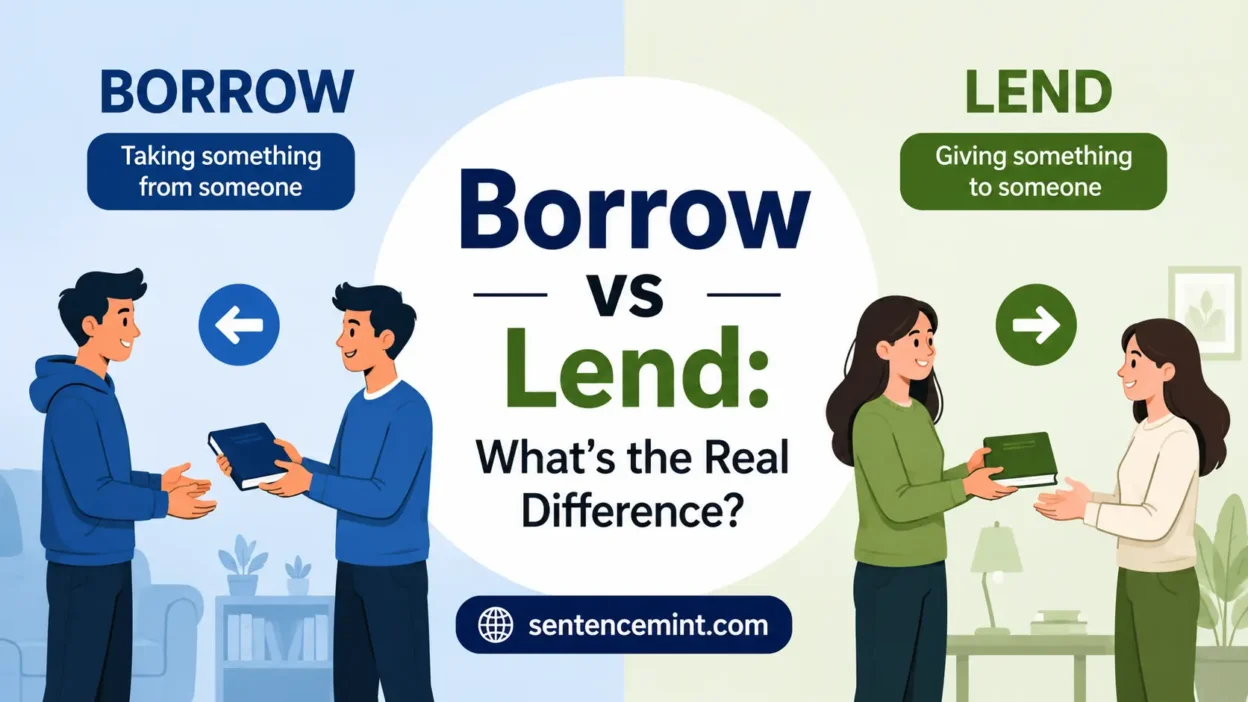
Many English learners confuse borrow vs lend because both words describe the same kind of exchange. One person gives something temporarily, and another person receives it temporarily.
The difference comes down to perspective.
- Borrow focuses on the receiver.
- Lend focuses on the giver.
For example:
- “Can I borrow your book?”
- “Sure, I can lend it to you.”
Understanding the distinction matters in everyday English, especially when talking about money, books, favors, work items, or even ideas. Using the wrong word can completely reverse the meaning of a sentence.
Quick Answer
Use borrow when someone receives something temporarily and plans to return it.
Use lend when someone gives something temporarily and expects it back later.
Examples:
- “Can I borrow your pen?”
- “I can lend you my pen.”
The two words describe the same transaction from opposite viewpoints, but they are not interchangeable.
Why People Confuse Them
People confuse borrow and lend because both involve temporary use of something.
The confusion becomes stronger because the same event can use either word depending on who is speaking.
For example:
- “I borrowed Sarah’s laptop.”
- “Sarah lent me her laptop.”
Both sentences describe the same action from different perspectives.
Many learners also translate directly from their first language, where one verb may cover both meanings. That often leads to mistakes such as:
- “Can you borrow me a pen?”
In standard English, this sounds incorrect because borrow usually focuses on receiving, not giving.
Another reason for confusion is that both words often appear in the same situations:
- money
- books
- classroom items
- favors
- office equipment
Without paying attention to direction, the meanings can easily get reversed.
Key Differences At A Glance
| Context | Best Choice | Why |
|---|---|---|
| Receiving something temporarily | borrow | Focus is on the receiver |
| Giving something temporarily | lend | Focus is on the giver |
| Asking for temporary use | borrow | “Can I borrow your charger?” |
| Offering temporary use | lend | “I can lend you mine.” |
| Figurative support or help | lend | Common idiomatic usage |
| Taking ideas or styles | borrow | Common abstract usage |
Compact Comparison Block
- Borrow = receive temporarily
- Lend = give temporarily
- Same exchange, opposite perspectives
- Borrow often appears in requests
- Lend often appears in offers or assistance
- Switching the verbs usually changes the meaning
Meaning and Usage Difference
Both borrow and lend are verbs connected to temporary possession.
Borrow
Use borrow when someone receives or uses something temporarily with the intention of returning it.
Examples:
- “I borrowed a book from the library.”
- “Can I borrow your headphones?”
- “She borrowed money from her parents.”
The focus stays on the person receiving the item.
Lend
Use lend when someone gives something temporarily and expects it back later.
Examples:
- “Can you lend me twenty dollars?”
- “He lent his coworker a charger.”
- “The bank lent them money for the house.”
The focus stays on the giver.
Figurative Uses
Both words can also describe abstract things.
Examples with borrow:
- “The movie borrows ideas from classic science fiction.”
- “Writers sometimes borrow terminology from other fields.”
Examples with lend:
- “The data lends credibility to the report.”
- “Her experience lends support to the argument.”
Sentence Structure Difference
A common grammar difference is object structure.
Natural:
- “Can you lend me your pen?”
- “Can I borrow your pen?”
Unnatural:
- “Can you borrow me your pen?”
That sounds incorrect because borrow does not normally work like lend in that sentence pattern.
Tone, Context, and Formality
Both words work in casual and formal English.
You can hear them in:
- schools
- offices
- banks
- libraries
- emails
- everyday conversations
However, lend appears more often in formal or figurative expressions.
Examples:
- “lend support”
- “lend credibility”
- “lend assistance”
Meanwhile, borrow commonly appears in practical everyday situations.
Examples:
- “borrow a laptop”
- “borrow money”
- “borrow notes from class”
Academic and professional writing also uses both words naturally.
Examples:
- “The researcher borrowed terminology from economics.”
- “The findings lend weight to the conclusion.”
Neither word is more “correct” overall. The context simply determines which perspective fits the sentence.
Which One Should You Use?
A quick way to choose the right word is to identify who receives the item and who gives it.
Use borrow if you are focusing on the receiver.
Examples:
- “Can I borrow your calculator?”
- “She borrowed my jacket.”
Use lend if you are focusing on the giver.
Examples:
- “I can lend you my calculator.”
- “He lent his friend a jacket.”
A simple check:
- Receiving = borrow
- Giving = lend
Side-by-side examples:
- “I borrowed a book from Jake.”
- “Jake lent me a book.”
Email example:
- “Could I borrow the presentation slides for tomorrow’s meeting?”
Classroom example:
- “The teacher lent extra pencils to the students.”
When One Choice Sounds Wrong
Some mistakes reverse the meaning completely.
Incorrect:
- “Can you borrow me your car?”
This sounds unnatural because the speaker is asking to receive the car, not give it.
Correct:
- “Can you lend me your car?”
Another example:
Incorrect:
- “I lent a book from the library.”
This changes the meaning because the library is the giver, not the receiver.
Correct:
- “I borrowed a book from the library.”
Using the wrong verb can confuse who gives and who receives the item.
Common Mistakes (and Quick Fixes)
Mistake: Mixing up giver and receiver
Incorrect:
- “I borrowed him my charger.”
Better:
- “I lent him my charger.”
Mistake: Using “borrow me”
Incorrect:
- “Can you borrow me ten dollars?”
Better:
- “Can you lend me ten dollars?”
Mistake: Forgetting figurative uses
Incorrect:
- “The evidence borrowed support to the theory.”
Better:
- “The evidence lent support to the theory.”
Quick Memory Aid
- Borrow = receive
- Lend = give
Think about which person the sentence focuses on.
Everyday Examples
- “Can I borrow your phone charger?”
- “My neighbor lent me a ladder.”
- “She borrowed money for college.”
- “The bank lent them a small business loan.”
- “I borrowed his notes after class.”
- “Could you lend me a hand with these boxes?”
- “The article borrows ideas from older research.”
- “Her experience lends credibility to the project.”
Mini-dialogues:
- At school
- “Can I borrow a pencil?”
- “Sure, I can lend you one.”
- At work
- “Who borrowed my stapler?”
- “I think Marcus did.”
- At home
- “Can you lend me your toolkit?”
- “Of course. Just bring it back tomorrow.”
Dictionary-Style Word Details
Verb
- borrow: to receive or use something temporarily with the intention of returning it
Example: “She borrowed a camera for the trip.” - lend: to give something temporarily expecting it to be returned
Example: “He lent his cousin some money.”
Both words fully function as verbs.
Noun
- borrow: noun use exists but is uncommon and limited in modern English.
- lend: noun use is not common in standard modern English.
Most modern usage treats both words primarily as verbs.
Synonyms
- borrow: closest plain alternatives include “take temporarily” and “use temporarily”
- lend: closest plain alternatives include “loan,” “provide temporarily,” and “extend”
These alternatives depend on context and are not always exact replacements.
Example Sentences
- borrow: “I borrowed a hoodie because it got cold.”
- borrow: “Can we borrow your speaker for the party?”
- lend: “She lent me her tablet for the meeting.”
- lend: “The teacher lent support to the new program.”
Word History
- borrow: comes from historical roots connected to taking or using something temporarily under agreement.
- lend: developed from older English roots connected to granting temporary use or assistance.
Both words have been part of English for centuries.
Phrases Containing
- borrow: borrow money, borrow time, borrow an idea, borrow trouble
- lend: lend a hand, lend support, lend credibility, lend assistance
Many of these phrases extend beyond physical objects into abstract meaning.
If you often confuse modal verbs, you may also want to understand the difference between can vs may, which is another common English grammar confusion related to permission and possibility.
FAQ
What is the difference between borrow and lend?
The difference is perspective.
- Borrow means receiving something temporarily.
- Lend means giving something temporarily.
Example:
- “I borrowed her book.”
- “She lent me her book.”
Both sentences describe the same exchange from different viewpoints.
Is “borrow” the opposite of “lend”?
Yes. They are opposite verbs used for the same type of transaction.
- The borrower receives something.
- The lender gives something.
Is it “borrow me” or “lend me”?
In standard English, “lend me” is correct.
Correct:
- “Can you lend me a pen?”
Incorrect:
- “Can you borrow me a pen?”
The reason is that borrow focuses on the receiver, not the giver.
Can you borrow something to someone?
Normally, no. In standard English, you usually lend something to someone or borrow something from someone.
Correct:
- “She lent me her notebook.”
- “I borrowed her notebook.”
When should I use “lend”?
Use lend when talking about the person giving something temporarily.
Examples:
- “Can you lend me twenty dollars?”
- “The library lends books for two weeks.”
When should I use “borrow”?
Use borrow when talking about the person receiving something temporarily.
Examples:
- “Can I borrow your charger?”
- “He borrowed money from the bank.”
Are borrow and lend interchangeable?
No. Replacing one with the other usually reverses the meaning.
Compare:
- “I borrowed her laptop.”
- “I lent her my laptop.”
These sentences describe completely different actions.
Can “lend” be used figuratively?
Yes. “Lend” is often used in figurative expressions.
Examples:
- “lend support”
- “lend credibility”
- “lend assistance”
These phrases do not involve physical objects.
Can “borrow” be used for ideas or styles?
Yes. “Borrow” often applies to abstract things.
Examples:
- “The movie borrows ideas from older films.”
- “The designer borrowed elements from vintage fashion.”
Why do ESL learners confuse borrow and lend?
Many languages use one verb for both actions, so learners may not naturally separate the giver’s perspective from the receiver’s perspective.
The sentence structure in English can also cause confusion.
What is an easy way to remember borrow vs lend?
A simple memory trick is:
- Borrow = receive
- Lend = give
Think about who has the item at the beginning and who has it temporarily afterward.
Is “lend a hand” literal?
No. “Lend a hand” is an idiomatic expression meaning “help someone.”
Conclusion
The difference between borrow vs lend is mainly about perspective.
- Borrow means receiving something temporarily.
- Lend means giving something temporarily.
They describe the same transaction from opposite viewpoints, so switching the words usually changes the meaning.
A simple comparison makes the distinction clear:
- “Can I borrow your laptop?”
- “Yes, I can lend it to you.”
Once you focus on who gives and who receives, choosing the correct word becomes much easier.