
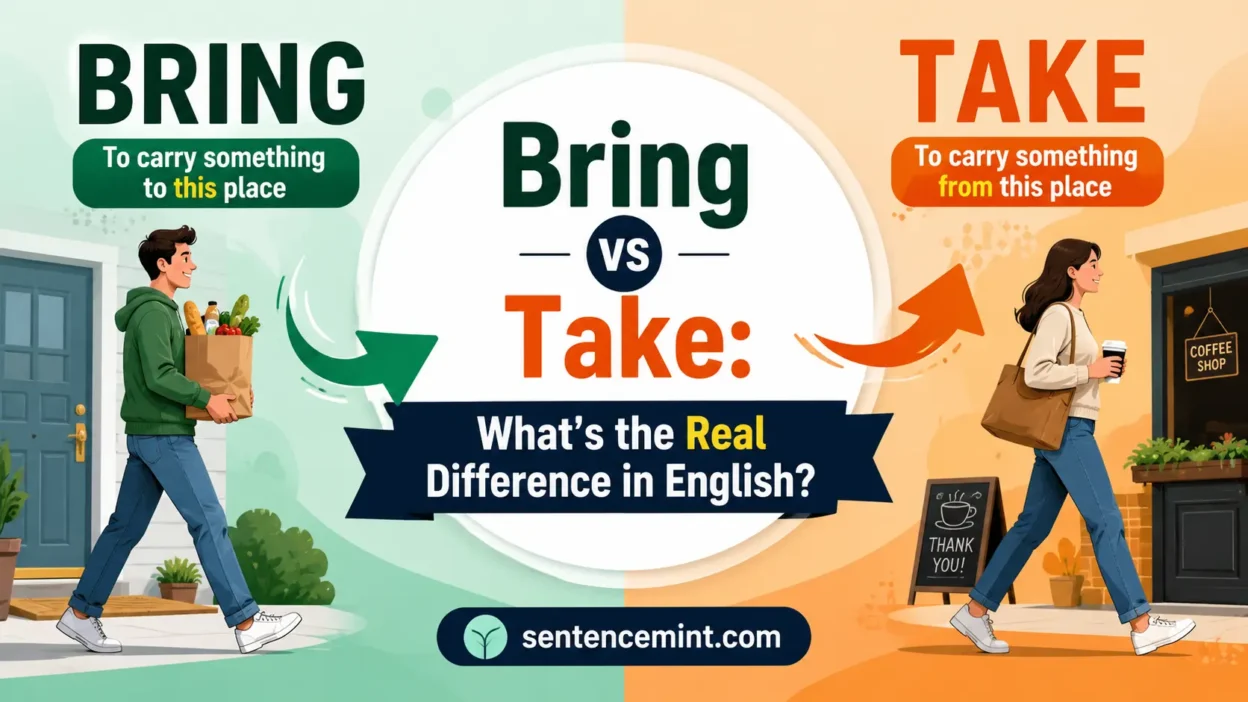
Many English learners and native speakers mix up bring vs take because both words involve moving something from one place to another. The real difference comes down to perspective.
In most situations, bring means movement toward someone or somewhere, while take means movement away from someone or somewhere.
For example:
- “Bring the book here.”
- “Take the book there.”
The confusion starts when the speaker’s viewpoint changes. Phone calls, invitations, travel plans, and workplace conversations can make the choice less obvious. Once you understand the direction behind each word, the difference becomes much easier to spot.
Quick Answer
Use bring when something moves toward the speaker, listener, or destination being discussed.
Use take when something moves away from the speaker or current location.
Examples:
- “Please bring snacks to the meeting.”
- “Take these files to HR.”
The two words are not usually interchangeable. Changing one to the other often changes the meaning or direction of the sentence.
Still, real conversations can be flexible. In casual speech, especially during phone calls or invitations, people sometimes choose the word based on shared perspective rather than strict grammar rules.
Why People Confuse Them
People confuse bring and take because both describe carrying or moving something.
The main challenge is viewpoint. The correct word depends on where the speaker mentally places the action.
For example, someone hosting a party might say:
- “Can you bring drinks tonight?”
The drinks are moving toward the host’s location.
But a parent leaving home with a child might say:
- “Take your backpack to school.”
The backpack is moving away from the current location.
Phone conversations often blur the difference. A friend calling from another city may say:
- “I’ll bring my laptop when I visit.”
Another person might naturally say:
- “I’ll take my laptop with me.”
Both can sound reasonable depending on the speaker’s focus.
Key Differences At A Glance
| Context | Best Choice | Why |
|---|---|---|
| Moving something toward the speaker | bring | Direction comes toward the reference point |
| Moving something away from the speaker | take | Direction moves outward |
| “___ this over to my house” | bring | The item moves toward the destination speaker |
| “___ these papers to the office” | take | The papers leave the current location |
| Invitations and gatherings | bring | Focus is usually on arrival |
| Leaving with an item | take | Focus is usually on departure |
Compact Comparison Block
- Bring = movement toward
- Take = movement away
- Bring often matches invitations and arrivals
- Take often matches departures and deliveries
- Perspective decides the correct choice
- Casual speech sometimes allows overlap
Meaning and Usage Difference
Both bring and take are mainly verbs. They describe movement, but they point in opposite directions.
Bring usually points toward the destination or person involved in the conversation.
Examples:
- “Bring your notebook to class tomorrow.”
- “Can you bring coffee to my office?”
- “She brought dessert to dinner.”
Take usually points away from the current place or speaker.
Examples:
- “Take these boxes downstairs.”
- “He took the kids to school.”
- “Please take your shoes outside.”
The tricky part is that context can shift the viewpoint.
Imagine a manager speaking from the office:
- “Bring the signed contract to me.”
Now imagine the employee leaving home for work:
- “I’ll take the contract to the office.”
The same object is involved, but the viewpoint changes the correct word.
Family conversations also show this clearly:
- “Bring the groceries into the kitchen.”
- “Take the trash outside.”
One action moves inward. The other moves outward.
Tone, Context, and Formality
There is no major formal versus informal split between bring and take. Both are standard everyday English words.
What changes is the conversational perspective.
In invitations, English speakers often prefer bring because the focus is on arriving at the destination.
Examples:
- “Bring dessert if you want.”
- “Bring the kids over this weekend.”
When someone leaves with something, take sounds more natural.
Examples:
- “Take your laptop with you.”
- “Take an umbrella before you leave.”
Phone conversations create flexible usage because speakers mentally shift locations.
For example:
- “I’ll bring the documents tomorrow.”
- “I’ll take the documents tomorrow.”
Both may sound natural depending on whether the speaker focuses on arrival or departure.
Idiomatic expressions also affect usage:
- “bring up a topic”
- “take over a company”
- “bring home the message”
- “take away the plates”
These phrases do not always follow the literal movement rule.
Which One Should You Use?
Start by asking one simple question:
Is the movement going toward the destination being discussed, or away from the current location?
Use bring when the movement goes toward the person, place, or event being focused on.
Examples:
- “Bring your ID to the interview.”
- “Can you bring drinks to the barbecue?”
- “Bring your homework to class.”
Use take when the movement goes away from the speaker or starting point.
Examples:
- “Take these packages to the post office.”
- “Take your bag upstairs.”
- “Take the car to the mechanic.”
A practical way to think about it:
- Arrival focus → bring
- Departure focus → take
Still, remember that conversations are not always rigid. Context matters more than memorizing a single rule.
When One Choice Sounds Wrong
Sometimes the wrong word creates a confusing direction.
Imagine a host already at home saying:
- “Take the cake to my house tonight.”
This sounds awkward because the movement is toward the host’s location. “Bring” sounds more natural.
Correct version:
- “Bring the cake to my house tonight.”
Another example:
- “Please bring these boxes to storage.”
If the speaker is standing in the office sending someone elsewhere, “take” usually fits better.
More natural version:
- “Please take these boxes to storage.”
Incorrect directional wording can make listeners pause because the movement logic feels off.
Common Mistakes (and Quick Fixes)
Mistake: Using “bring” for outward movement
Incorrect:
- “Bring these returns to the shipping center.”
Better:
- “Take these returns to the shipping center.”
Mistake: Using “take” for incoming movement
Incorrect:
- “Can you take drinks to my party tonight?”
Better:
- “Can you bring drinks to my party tonight?”
Mistake: Forgetting the speaker’s perspective
Incorrect:
- “I’ll bring my son to school,” said while leaving home.
This may still sound natural in conversation, but many speakers would prefer:
- “I’ll take my son to school.”
Quick Memory Aid
- Toward = bring
- Away = take
Just remember that real conversations sometimes bend the rule slightly.
Everyday Examples
Here are some realistic examples from everyday American English.
- “Bring your charger when you come over.”
- “Take your lunch to work.”
- “Can you bring extra chairs for the cookout?”
- “Please take these forms to the front desk.”
- “She brought cookies to the school fundraiser.”
- “He took the dog to the vet.”
- “Bring your jacket inside.”
- “Take the recycling out before dinner.”
Short dialogue examples:
At work
- “Can you bring the client file into the meeting?”
- “Sure. I’ll take it upstairs now.”
At home
- “Are you taking the kids to practice?”
- “Yes, but they’re bringing their own equipment.”
Travel planning
- “Should I bring cash?”
- “No, just take your card.”
Dictionary-Style Word Details
Verb
- bring: to carry or move something toward a person, place, or destination
Example: “Please bring the receipts to my office.” - take: to carry or move something away from a place or toward another destination
Example: “Take these books back to the library.”
Both words are extremely common everyday verbs.
Noun
- bring: noun use is uncommon in modern English.
- take: commonly used as a noun in media and conversation to mean an opinion or interpretation
Example: “That’s an interesting take on the movie.”
Synonyms
- bring: closest plain alternatives include “carry here,” “deliver,” and “transport toward”
- take: closest plain alternatives include “carry away,” “remove,” and “transport away”
These alternatives depend heavily on context.
Example Sentences
- bring: “Can you bring ice to the game tonight?”
- bring: “She brought her laptop into the meeting.”
- take: “Take these papers downstairs.”
- take: “He took his daughter to dance class.”
Word History
- bring: comes from Old English roots connected to carrying or conveying something toward a place or person.
- take: has historical roots related to grasping, seizing, or carrying something away.
Both words have existed in English for centuries and developed many idiomatic meanings over time.
Phrases Containing
- bring: bring up, bring along, bring home, bring back
- take: take away, take over, take home, take off
Some phrases follow the movement idea closely, while others became idiomatic over time.
Many English learners also struggle with other commonly confused word pairs such as bring vs take, where the confusion is based on perspective and direction rather than spelling or structure.
FAQ
What is the main difference between bring and take?
The main difference is direction.
- Bring usually means movement toward someone or somewhere.
- Take usually means movement away from someone or somewhere.
Example:
- “Bring the documents to my office.”
- “Take the documents to HR.”
When should you use “bring” instead of “take”?
Use bring when the action moves toward the speaker, listener, or destination being discussed.
Example:
- “Can you bring drinks to the party?”
The drinks are moving toward the party location.
Is it “bring me home” or “take me home”?
Usually, “take me home” sounds more natural because the movement is away from the current location toward home.
However, “bring me home” can sound natural if the speaker views home as the destination point from another perspective.
Why do people confuse bring and take?
People confuse them because both words involve carrying or moving something. The correct choice depends on viewpoint and direction, which can shift during conversations.
Phone calls and invitations often make the distinction less obvious.
Can bring and take sometimes be interchangeable?
Sometimes, yes. In casual speech, native speakers occasionally use both naturally depending on perspective.
Example:
- “I’ll bring my laptop tomorrow.”
- “I’ll take my laptop tomorrow.”
Both may sound acceptable depending on whether the speaker focuses on arrival or departure.
Is “bring” always toward and “take” always away?
That is the general rule, but real conversations are more flexible. Context and speaker perspective can change what sounds natural.
Idiomatic expressions also do not always follow the literal movement rule.
Is it “bring to school” or “take to school”?
Both can be correct depending on perspective.
- “Take the kids to school” focuses on leaving home.
- “Bring your homework to school” focuses on arrival at school.
Which word sounds more natural in invitations?
“Bring” usually sounds more natural in invitations because the focus is on coming toward the event or host.
Example:
- “Bring a dessert if you’d like.”
Are bring and take both verbs?
Yes. Both words mainly function as verbs related to movement and carrying.
However, take can also be used as a noun in expressions like:
- “That’s my take on the issue.”
What is an easy way to remember bring vs take?
A simple memory aid is:
- Toward = bring
- Away = take
Just remember that natural conversation sometimes bends the rule depending on context.
Conclusion
The difference between bring vs take mainly depends on direction and perspective.
In most cases:
- Bring = movement toward
- Take = movement away
The speaker’s viewpoint controls which word sounds natural. That is why context matters so much in invitations, travel plans, work conversations, and phone calls.
A simple comparison makes the distinction easier:
- “Bring the snacks to my house.”
- “Take the snacks to the office.”
Once you focus on movement and perspective, choosing the right word becomes much more natural.