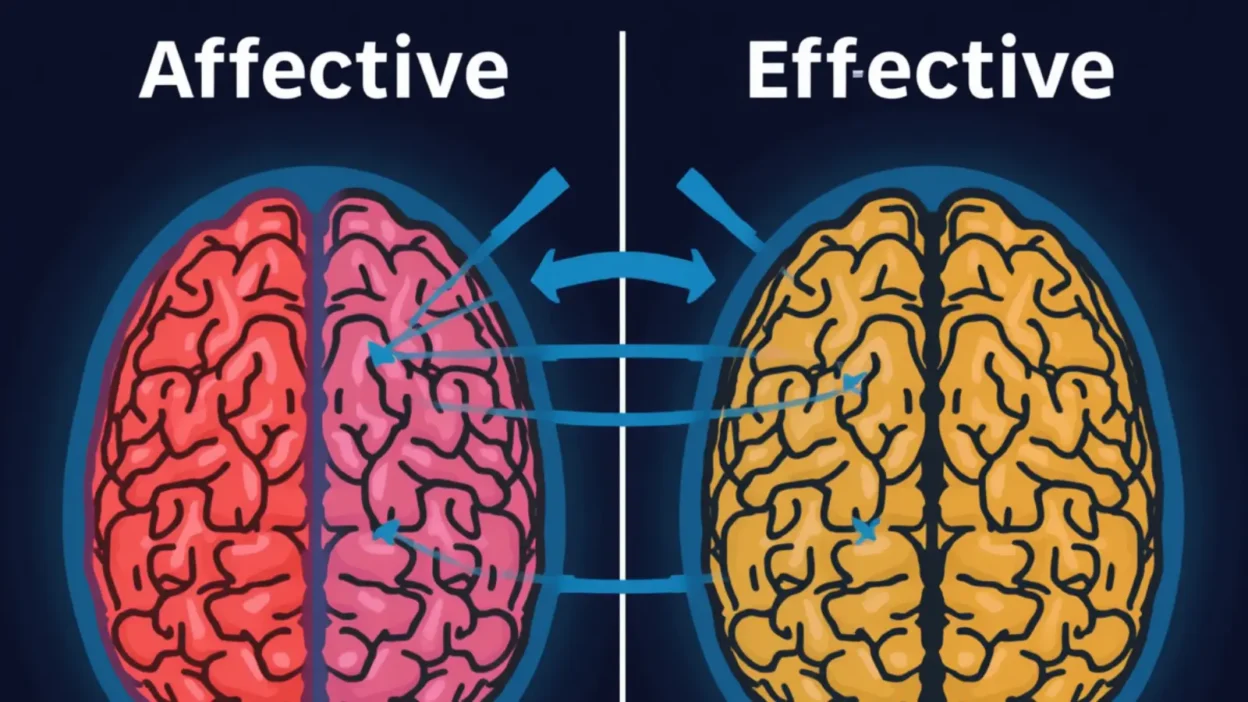
The confusion between affective vs effective is very common because the words look and sound similar, but their meanings are completely different. This often leads to mistakes in writing, especially in academic and professional contexts.
At a glance, they may seem related, but they describe two totally different ideas—one is about emotions, and the other is about results. Understanding this difference makes your writing clearer and more accurate.
Example confusion:
- Incorrect: The plan had an affective impact on sales.
- Correct: The plan had an effective impact on sales.
2. Quick Answer
Affective relates to emotions, feelings, and psychological responses.
Effective means producing a result or achieving a goal.
In simple terms:
- Affective = emotional response
- Effective = successful result
They are not interchangeable because they belong to different meaning categories.
3. Why People Confuse Them
People confuse these words mainly because they look similar and are both adjectives ending in “-ive.” When reading quickly, the spelling difference is easy to miss.
Another reason is that both can describe “impact,” but in different ways—emotional impact vs practical impact. This overlap in general idea creates confusion.
Example of confusion in reading:
- “affective response” (emotional reaction)
- “effective response” (successful action)
4. Key Differences At A Glance
| Context | Best Choice | Why |
|---|---|---|
| Emotions or feelings | Affective | Refers to emotional or psychological state |
| Results or success | Effective | Refers to achieving a goal or outcome |
| Psychology | Affective | Common in emotional/mental studies |
| Business or work | Effective | Focus on performance and results |
Extra Comparison
| Feature | Affective | Effective |
|---|---|---|
| Meaning | Emotional/feeling-based | Result-producing/successful |
| Usage Area | Psychology, emotions | Business, communication, general use |
5. Meaning and Usage Difference
Affective is used when talking about emotions, mood, or psychological reactions. It often appears in psychology or mental health contexts.
Effective is used when something works well or produces the desired result in real-life situations.
Examples:
- The study measured affective responses to stress.
- The new system is very effective in reducing errors.
6. Tone, Context, and Formality
Affective is mostly found in academic or psychological discussions. It has a more technical tone and is not commonly used in everyday speech.
Effective is widely used in both formal and informal writing, especially when discussing performance, solutions, or results.
Examples:
- Affective disorder (clinical context)
- Effective strategy (business or everyday context)
7. Which One Should You Use?
Use affective when referring to emotions, feelings, or mental responses.
Use effective when referring to success, results, or performance.
Quick guide:
- If it’s about feelings → affective
- If it’s about results → effective
8. When One Choice Sounds Wrong
Using the wrong word can completely change the meaning.
Incorrect:
- The therapy was affective in treating the disease.
Correct:
- The therapy was effective in treating the disease.
Incorrect:
- He showed an effective response to sadness.
Correct:
- He showed an affective response to sadness.
9. Common Mistakes (and Quick Fixes)
Mistake 1: Mixing spelling due to similarity
- Wrong: affective solution
- Correct: effective solution
Mistake 2: Using “effective” for emotions
- Wrong: effective disorder
- Correct: affective disorder
Fix tip: Ask yourself—“Is this about feelings or results?”
10. Everyday Examples
- The medicine was effective within hours.
- Her affective response showed she was upset.
- The manager chose an effective plan to increase sales.
- The therapist studied affective behavior in patients.
- This is the most effective way to solve the problem.
- Emotional and affective reactions can differ between people.
11. Dictionary-Style Word Details
Verb
- Affective: Not commonly used as a verb.
- Effective: Not used as a verb; mainly an adjective.
Noun
- Affective: No standard noun form.
- Effective: No noun form; related noun is effectiveness.
Synonyms
- Affective: emotional, feeling-based, mood-related
- Effective: successful, efficient, productive, working
Example Sentences
- Affective: The test measured affective responses to stress.
- Effective: The new method is highly effective in practice.
Word History
- Affective: Comes from Latin roots related to emotion and feeling.
- Effective: Comes from Latin effectivus, meaning producing an effect.
Phrases Containing
- Affective: affective response, affective disorder
- Effective: effective immediately, effective strategy, effective solution
Another commonly confused pair is affect vs effect, which explains the difference between influence and outcome in everyday English usage.
FAQ: Affective vs Effective
1. What is the difference between affective and effective?
Affective relates to emotions, feelings, or psychological responses, while effective means something that produces a successful result or achieves a goal.
2. Is affective the same as emotional?
Yes. Affective is commonly used in psychology to describe emotional or feeling-based responses.
3. What does effective mean in simple words?
Effective means something that works well and produces the desired result.
4. Can affective and effective be used interchangeably?
No. They have completely different meanings and cannot replace each other in sentences.
5. What is an example of affective in a sentence?
- The study measured affective responses to stress.
- She showed a strong affective reaction to the news.
6. What is an example of effective in a sentence?
- The new method is very effective in solving the problem.
- This medicine is highly effective.
7. Is affective used in everyday English?
Not much. It is mostly used in psychology, medical, or academic contexts.
8. What is an easy way to remember affective vs effective?
- Affective = feelings (emotional)
- Effective = results (successful outcome)
12. Conclusion
The difference between affective vs effective is simple but important. One is about emotions and psychological responses, while the other is about achieving results and success.
They are not interchangeable, and using them correctly improves clarity in writing and communication. A quick rule to remember:
- Affective = feelings
- Effective = results
Once you keep this distinction in mind, you’ll avoid one of the most common word-choice mistakes in English.