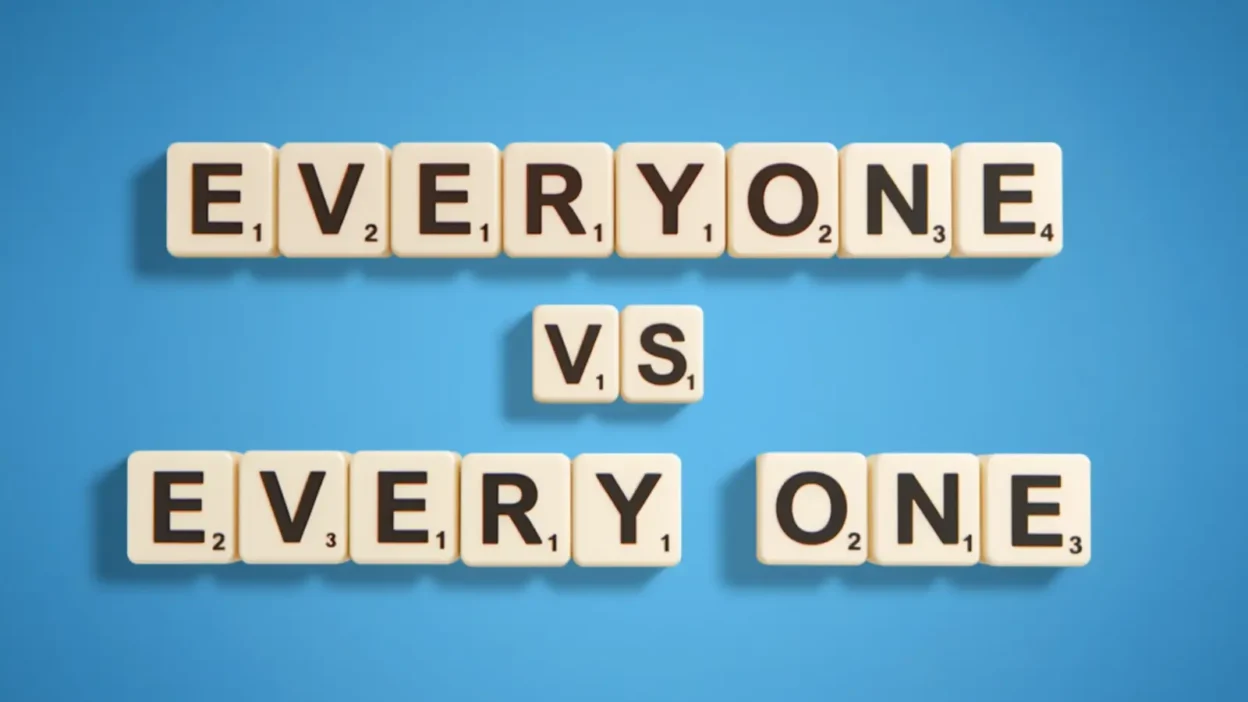
The confusion between everyone vs every one is common because they sound exactly the same and often appear in similar sentences. But in writing, the space changes everything.
One form refers to a whole group of people. The other focuses on each individual item or person separately. If you mix them up, the meaning of your sentence can shift in a way you didn’t intend.
This guide breaks down the difference in a simple, practical way so you can choose the right form every time.
2. Quick Answer
Everyone is a single word that means all people in a group. It works like a pronoun.
Every one (two words) means each individual person or thing. It is often used with “of.”
They are not interchangeable.
Examples:
- Everyone is invited.
- Every one of the students passed.
3. Why People Confuse Them
The confusion comes from three main reasons:
- They sound identical when spoken
- Both refer to groups of people or things
- The meaning feels very similar at first glance
In fast writing or texting, the space between the words is easy to miss. That small difference is what changes the meaning completely.
4. Key Differences At A Glance
| Context | Best Choice | Why |
|---|---|---|
| Referring to all people in a group | everyone | It acts as one collective idea |
| Referring to each individual member | every one | It separates each item or person |
| Formal sentence with general statement | everyone | More natural and concise |
| Emphasizing individuals separately | every one | Highlights each unit clearly |
Extra Comparison
| Feature | everyone | every one |
|---|---|---|
| Word form | Single word | Two-word phrase |
| Meaning | Whole group of people | Each individual separately |
| Common structure | Standalone subject | Often followed by “of” |
5. Meaning and Usage Difference
Everyone is used when you talk about all people as a single group. It treats the group as one unit.
- Everyone is ready for the meeting.
- Everyone enjoyed the trip.
Every one focuses on individuals inside a group. It highlights each person or item separately.
- Every one of the answers was correct.
- Every one of the cookies was eaten.
A simple way to think about it:
- “Everyone” = the whole group together
- “Every one” = each member one by one
6. Tone, Context, and Formality
Both forms are used in everyday English, but they behave slightly differently in writing.
- Everyone feels smoother and is more common in speech and writing.
- Every one is used when you want to stress individual attention or precision.
Examples:
- Everyone agreed with the decision. (general statement)
- Every one of the employees signed the form. (focused detail)
Neither is more formal, but “every one” often appears in more detailed or careful writing.
7. Which One Should You Use?
Use this simple rule:
- If you mean all people together → use everyone
- If you mean each individual separately → use every one
Quick checks:
- Can I replace it with “all people”? → use everyone
- Can I replace it with “each one”? → use every one
Examples:
- Everyone was happy at the event.
- Every one of the players received a medal.
8. When One Choice Sounds Wrong
Using the wrong form can make a sentence sound off or change the meaning.
Incorrect:
- Every one is coming to the party. (sounds incomplete or unclear)
Correct:
- Everyone is coming to the party.
Incorrect:
- Everyone of the books is missing.
Correct:
- Every one of the books is missing.
If you are talking about a full group, “everyone” almost always fits better. If you need precision, “every one of” is the correct structure.
9. Common Mistakes (and Quick Fixes)
Mistake 1: Dropping the space
- Wrong: everyone of the students passed
- Correct: every one of the students passed
Mistake 2: Using “every one” for a general group
- Wrong: Every one is invited
- Correct: Everyone is invited
Mistake 3: Forgetting “of” with every one
- Wrong: Every one students passed
- Correct: Every one of the students passed
Quick fix tip:
If you see “of,” you almost always need every one, not everyone.
10. Everyday Examples
Here are real-world uses you might see:
- Everyone in the office joined the call on time.
- Every one of the emails was answered.
- Everyone loved the new restaurant.
- Every one of the tickets was checked at the gate.
- Everyone should bring their ID tomorrow.
- Every one of the team members signed the agreement.
These examples show how “everyone” is general, while “every one” is more detailed and specific.
11. Dictionary-Style Word Details
Verb
- everyone: Not used as a verb
- every one: Not used as a verb
Noun
- everyone: Functions as an indefinite pronoun referring to all people
- every one: Noun phrase meaning each individual item or person
Synonyms
- everyone: everybody, all people
- every one: each one, each individual
Example Sentences
- everyone: Everyone is waiting outside.
- every one: Every one of the students passed the test.
Word History
- everyone: Developed as a single-word form to simplify “every one” when referring to groups collectively
- every one: Older structure used to emphasize individual units; still used for clarity today
Phrases Containing
- everyone: everyone else, everyone involved
- every one: every one of them, every one of the items
Many English learners also get confused between similar-sounding words like everyone and every one, just like they struggle with tricky choices in there, their, and they’re. Understanding these small differences helps you avoid common grammar mistakes and write more confidently in English.
FAQ — Everyone vs Every One
1. What is the main difference between everyone and every one?
Everyone means all people in a group. Every one means each individual person or thing separately.
2. Is everyone singular or plural?
Everyone is singular in grammar, even though it refers to many people. That’s why it takes a singular verb:
- Everyone is here (not “are here”).
3. When should I use every one instead of everyone?
Use every one when you want to emphasize individuals:
- Every one of the students passed the test.
Use everyone when talking about a whole group:
- Everyone passed the test.
4. Do everyone and every one mean the same thing?
No. They may sound similar, but they are not interchangeable. The space changes the meaning completely.
5. Does every one always need “of” after it?
Not always, but very often yes in modern English:
- Every one of the books was sold.
Without “of,” it can sound incomplete depending on the sentence.
6. Can everyone be used for things or only people?
Everyone is used only for people, not objects or things.
7. What is a simple way to remember the difference?
- Everyone = everyone together (group)
- Every one = each one separately
Quick trick: if you can say “each one,” use every one.
8. Is every one more formal than everyone?
Not exactly. Everyone is more common and natural, while every one is used when you want to be more precise or detailed.
9. Are everyone and everybody the same?
Yes. Everyone and everybody mean the same thing and are fully interchangeable.
10. What is the most common mistake people make?
The most common mistake is dropping the space:
- ❌ every one is coming (wrong if you mean a group)
- ✅ everyone is coming
Or using “everyone” when “every one of” is needed for individual emphasis.
12. Conclusion
The difference between everyone vs every one comes down to grouping versus individuality. One treats people as a whole, while the other focuses on each separate member.
If you remember one simple rule—group vs individual—you will always choose the right form.
The keyword everyone vs every one may look small, but using it correctly makes your writing clearer and more precise every time.